

Local women drive ERA car tour across America
Mainers, including from Castine and Brooksville, playing major role in tour calling for women’s rights to be included in Constitution
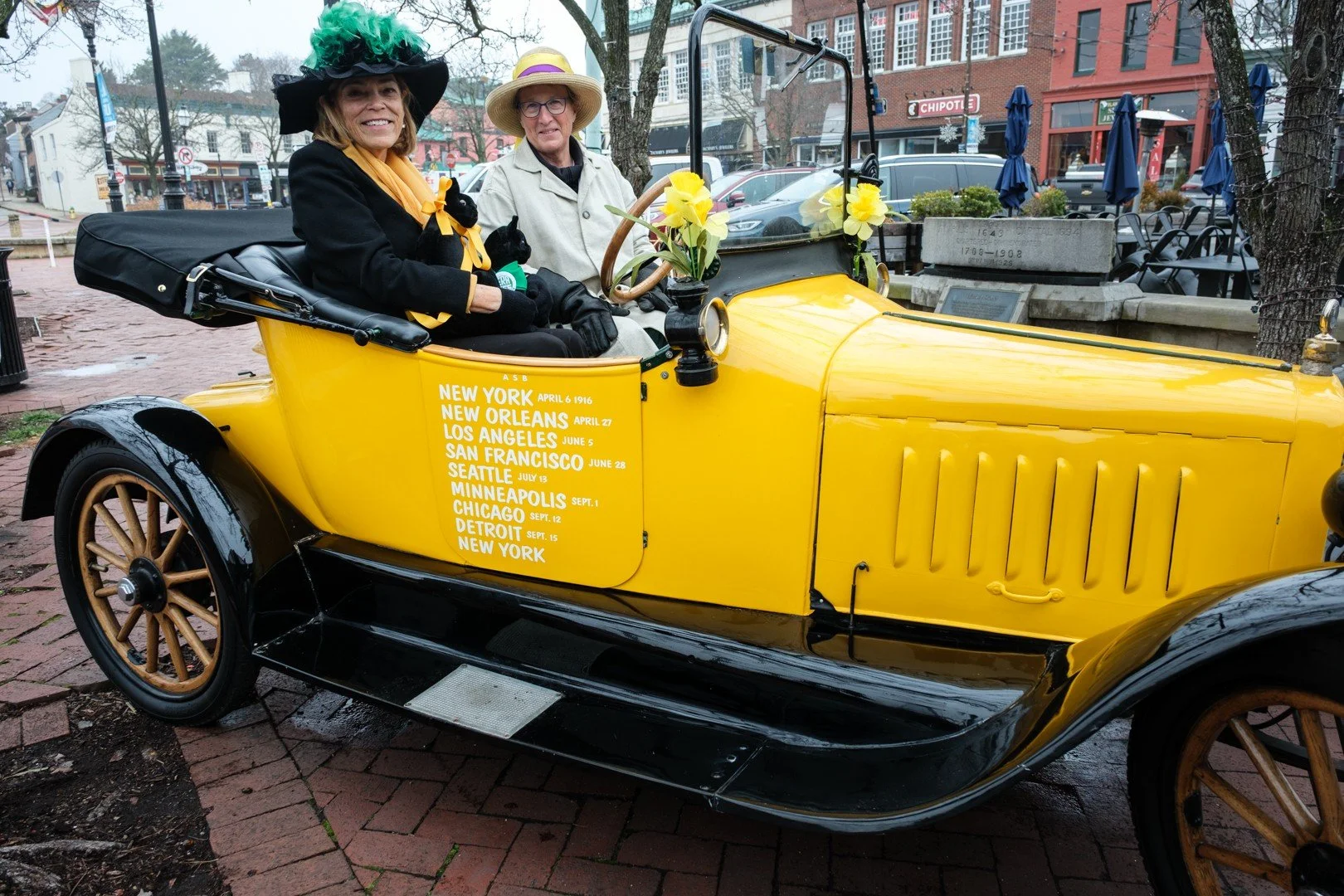
Jeryl Schriever of Castine, in the green hat, and Susan Nourse of Freeport in the 1914 Saxon roadster making its way across America. Photo courtesy of Nina Zacuto.
March 9, 2026
By Steele Hays
WASHINGTON, DC—In 1916, two women drove an open-air, two-seater Saxon roadster 10,700 miles across the country and back to drum up support for a constitutional amendment granting women the right to vote. Four years later the 19th Amendment was adopted.
Now, 110 years later, supporters of the long-stalled Equal Rights Amendment (ERA) are using the same campaign idea to promote the ERA’s ratification–and two Blue Hill Peninsula women are playing key leadership roles in the national effort.
The “Driving the Vote for Equality Tour” launched March 1 in New York City, but a series of serendipitous events that resulted in the tour becoming a reality actually started six years ago when Jeryl Schriever of Castine began working on an exhibition at Maine’s Seal Cove Auto Museum about how early-generation motor vehicles changed society. Schriever, now the museum’s president, ended up writing an article about the 1916 car tour for an antique car magazine. A few years later, she went on to write a book about the tour: “Driving the Vote for Women: An American Journey for Suffrage.”

Kathy Bonk of Brooksville, one of the organizers of the road trip supporting the ERA. Photo by Steele Hays.
The book and exhibition at Seal Cove caught the imagination of another local resident, Kathy Bonk of Brooksville, who has long been involved in women’s issues and is a contributor to Ms. Magazine. Bonk saw the potential for recreating the 1916 tour as a way to promote ratification of the ERA.
The ERA’s text consists of just three short sentences: “Equality of rights under the law shall not be denied or abridged by the United States or by any State on account of sex. The Congress shall have the power to enforce, by appropriate legislation, the provisions of this article. This amendment shall take effect two years after the date of ratification."
History of the ERA
Congress passed the ERA in 1972 and set a seven-year deadline for it to be ratified by the necessary three quarters of the states (38). Later, Congress extended the deadline to 1982, but as that deadline came and went, the ERA was still three states short of the needed total.
There was no action for several decades. Then, in 2017, Nevada became the 36th state to approve it, followed by Illinois in 2018, and finally by Virginia in 2020.
That seemingly would have met the goal of 38 states. But the Justice Department’s Office of Legal Counsel then issued an opinion saying that the necessary number of states did not approve the measure by the deadline, and therefore the amendment cannot be considered as ratified.
Other constitutional experts and the American Bar Association have taken the opposite view, saying the ERA has met all constitutional requirements for ratification. The Constitution does not set any timing requirements for ratification. As a case in point, the last amendment to be ratified and added to the Constitution–the 27th, which deals with Congressional compensation increases–took 202 years between being proposed in 1789 and finally ratified in 1992. In several lawsuits seeking to resolve the ERA timeline question, the courts have said the decision is up to Congress.
A bright yellow beacon
The car being driven on the tour is the same make and model driven by the suffragists in 1916: a 1914 Saxon owned by Schriever and her husband, Alex Huppé, who are longtime antique car enthusiasts. The top speed of the Golden Flyer II is 35 miles per hour, so the tour’s organizers are trailering the car from city to city and limiting the distance driven locally at each stop.
One of the highlights so far was driving the bright yellow Golden Flyer II through New York’s Central Park on the first day of the tour, Schriever said in an interview with The Rising Tide in Washington, DC during one of the tour’s whistle stops.
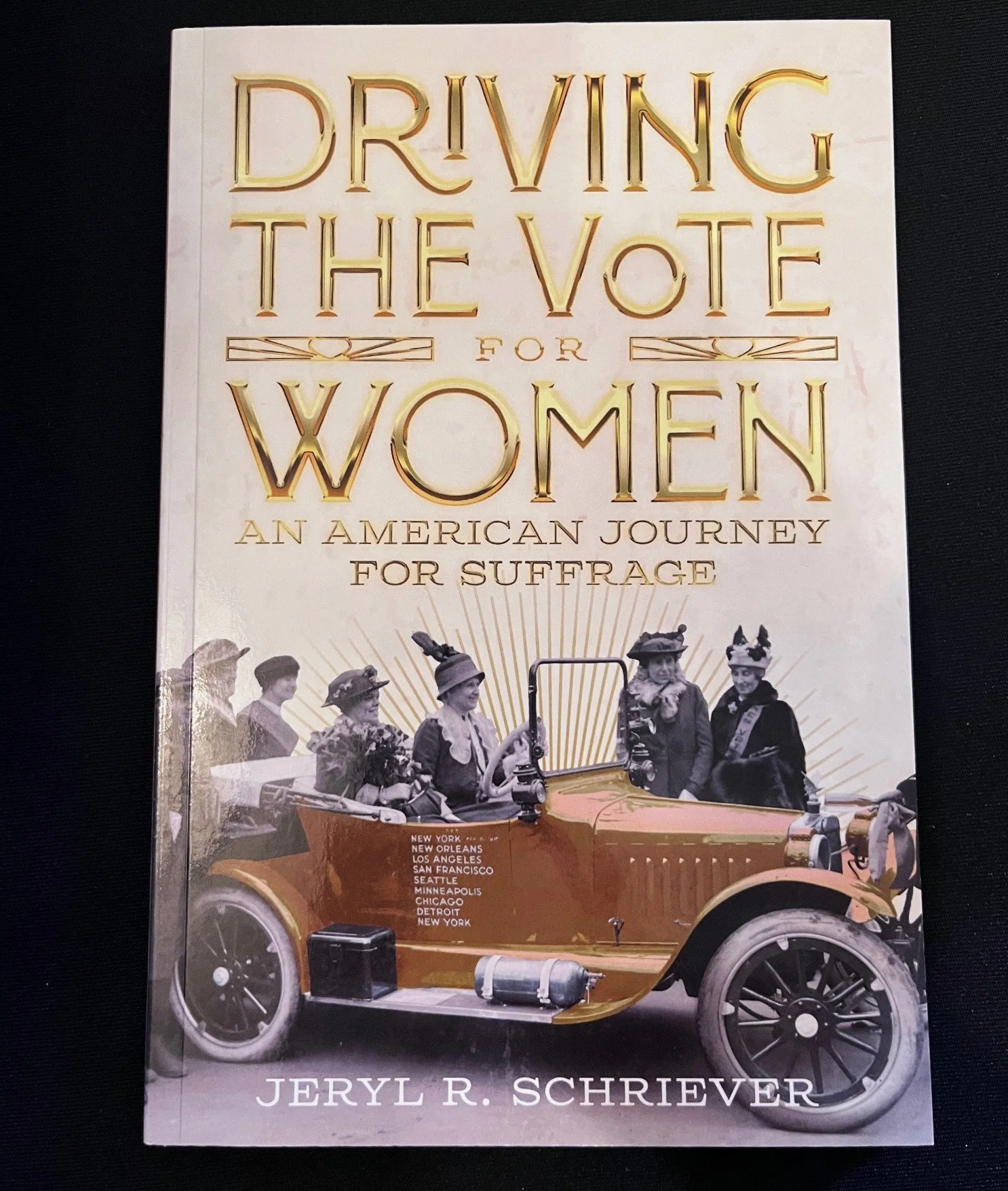
The book by Castine resident Jeryl Schriever that inspired the recreation of the 1916 drive across the country. Photo by Steele Hays.
“It was cold, but it was such fun,” Schriever said. “The looks on the faces of the people as they saw the car and we were driving through were incredible.”
Schriever and Bonk are both volunteering their time to this tour, with Bonk serving as tour coordinator and Schriever often speaking at local events, telling the story of the 1916 tour when Nell Richardson and Alice Burke actually drove every mile themselves on the primitive roads of the era. Former U.S. Rep. Carolyn Maloney of New York, a longtime champion of women’s rights and the founder of the group ERA NOW, has also been heavily involved in organizing the national car tour.
In addition to Bonk and Schriever, the project has additional Maine ties. The two primary drivers on the current tour, Peter Brown and Susan Nourse, are Mainers. Brown is the former head mechanic at the Seal Cove Auto Museum and Nourse is a retired Freeport police chief.
Brown’s skills have already been called upon. On the fourth day of the tour, the Golden Flyer II’s clutch began failing. Brown had to drop the engine to repair the clutch.
On March 6, Bonk and Schriever spoke at the Woman’s National Democratic Club in Washington, D.C., to a crowd that included many national leaders in the women’s movement, including Eleanor Smeal, 86, the former president of the National Organization for Women (NOW), and Kim Villaneuva, the current NOW president.
“We have the energy to do this just as Alice and Nell did 110 years ago,” Schriever said.
At each stop on the 25-state tour, the campaign organizers are meeting with a range of groups, holding events, and encouraging supporters to sign a petition calling on Congress to pass a resolution recognizing the ERA as ratified. Supporters have so far gathered more than 160,000 signatures. Their goal is to have a million by Election Day on Nov. 3.
Maine is not one of the stops on the tour, which will follow a southerly route from New York to California, then up the West Coast and eastward again from Washington State, returning to New York City by June. More information on the tour, including daily updates as it moves across the country, is available at Driving the Vote for Equality
