

GSA fields layoff questions at first fully open meeting
Two more students ask school to rethink cutting French teacher
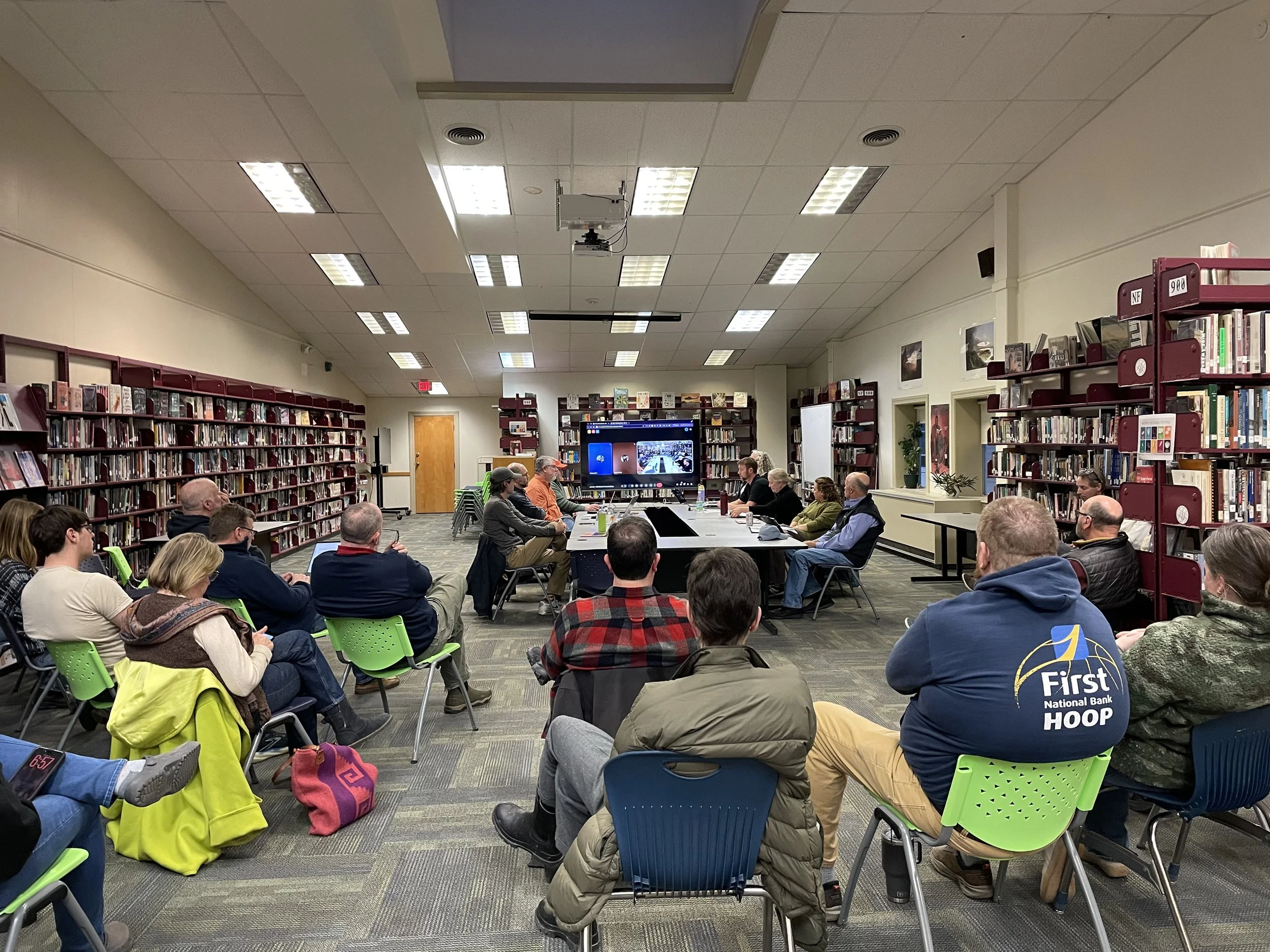
Nearly 20 people attended the first open meeting of GSA's board of trustees last week, including those who support a full reinstatement of the private school's French program, which is slated for belt-tightening cuts this spring. Photo by Tricia Thomas.
March 24, 2026
By Tricia Thomas
BLUE HILL—Nearly 20 local residents attended GSA’s first open board of trustees meeting on March 19, including two students who again questioned the board’s recent decision to dismantle its four-year French program and lay off French teacher Maria Razi.
The board also addressed Penobscot voters’ recent rejection by ballot vote for $1,530 in supplemental tuition for each student attending the private town academy. Faced with declining enrollment and budget shortfalls, GSA has made the request each year for the past seven years. In Penobscot, the request was denied by two votes. Two other towns—Blue Hill and Surry—are set to vote on the request next month.
“It was very close. Heartbreakingly close, and if I had made two phone calls, it would have been different,” board chair Deb Ludlow said at the start of the meeting. “I just want everyone to know that we’re working hard to meet the financial needs of the Penobscot students. We want them to be here. They want to be here.”
Ludlow said that covering Penobscot students’ supplemental tuition, which totals $24,480, will be a major focus of the board’s fundraising.
“It will be all hands on deck to make this happen,” she said. “But, to be clear, GSA needs the supplemental tuition that our peninsula towns have voted to support every year.”
“We have worked really hard to reduce costs and to balance our budget. We have just completed a $325,000 budget reduction for next year. We’ve also been able to reduce the supplemental tuition dollars that we’re asking for by 10 percent every year for the next three years, and we pledge to continue those efforts,” Ludlow added, reading from a prepared statement. “But, right now, today, next year, supplemental tuition is crucial for GSA to provide the kind of education our communities [and] our high school students want and need. We urge sending towns to vote in favor of the supplemental tuition.”
“[S]upplemental tuition is crucial for GSA to provide the kind of education our communities [and] our high school students want and need. We urge sending towns to vote in favor of the supplemental tuition.”
Penobscot is the first of the seven so-called “sending towns” to vote “no” on the supplemental tuition this year. Voters in Brooksville and Sedgwick approved it, adding $24,480 and $47,430, respectively, to their education costs. Blue Hill voters will weigh spending $116,280 in supplemental tuition on April 3. In Surry, voters will consider spending $32,130 in supplemental tuition on April 10.
Students advocate for French
French students Hazel Kimball and Flynn Johnson stood during the first of two public comment portions of the meeting to ask the board to reinstate the school’s French program, which reportedly is being cut from a four-year, in-classroom program to two years of online classes.
French teacher Maria Razi said in an interview with The Rising Tide that she was informed after returning from winter break that her part-time job would be eliminated at the end of this school year. Razi is one of an undetermined number of GSA staff members whose jobs will be cut in June as part of the $325,000 budget reduction. The school has not yet made those cuts public.
Razi, who also teaches French at two local elementary schools, told her students at GSA about the pending layoff soon after she was notified.
Johnson, a junior, told the board on March 19 that while Razi’s students are a small group, they are among the school’s “most passionate” learners.
“I’m fully aware that there are budget changes that need to happen because of decreased enrollment but, if we take away this program, I think that there will be a lot of students who [might go elsewhere]”
“We’ve been taking [French] with Ms. Razi for the last two years, and we’ve really enjoyed it. We’ve come here to say why we think it shouldn’t be cut,” Johnson told the board. “[Ms. Razi’s] class has probably got the most passionate students, towards learning, than any class in the school. The way she cares for each and every one of her students is something I haven’t seen anywhere.”
Kimball, a sophomore, said she feared that cutting French will cause prospective GSA students to go elsewhere, deepening the school’s enrollment challenges. Now, students in GSA’s sending towns can choose where they attend high school. For the past several years, increasing numbers of students have opted for Bucksport High School, Ellsworth High School, John Bapst Memorial High School, the Harbor School or the Hancock County Technical Center over GSA.
“I’m fully aware that there are budget changes that need to happen because of decreased enrollment but, if we take away this program, I think that there will be a lot of students who [might go elsewhere],” Kimball said.
Kimball said after the meeting that, as a French II honors student, she’s already taken the two years of French that GSA plans to offer online. Next year, she said, she’ll be forced to begin the first of two years of Spanish—the only in-person language program the school plans to continue offering.
Tracy Lameyer, a Castine resident who teaches at the Adams School alongside Razi, joined the students in asking the board to reconsider its decision. She also praised Johnson and Kimball for speaking up.
“I’ve worked with Maria for the past two years, and she has added so much to our foreign language program,” Lameyer said. “I’m so happy to see so many former students getting up to speak for her. She’s a gift.”
Layoffs still unannounced
Blue Hill resident Sean Dooley asked when GSA would formally announce the layoffs and program cuts.
GSA head Dan Welch said that details on cuts have not yet been released to protect staff members’ privacy and to give the school time to adapt to the change.
“There are a few employees that are still deciding what they’re going to do next year and, so, with all of that information, we’ll be able to put a plan together for who’s going to do what,” Welch said. “It just feels premature to do that without all of that information and, as an employer, we have to follow different guidelines than employees that are affected by such things. For example, if the board were to fire me tonight, I could go and talk about that to anybody I wanted to. That’s my right. But the board, as an employer, can’t talk about specific personnel issues with anybody outside of that individual.”
“We have avoided cuts to our academic programs, with the exception of the French program, which will be impacted to some extent but, hopefully, not eliminated. This is reflecting historically low student demand for these courses.”
Dooley also asked if incoming freshmen, who soon will be choosing their courses for next year, will be made aware of the cuts.
“We’re confident that the courses we’re putting in front of kids we’ll be able to offer next year,” Welch said. “Very few of the reductions actually impacted the courses offered. It might alter the number of sections we can offer for a certain course [or] how often we can offer a course. Some courses may have to become bi-year courses instead of yearly courses, but we’re pretty confident that the courses in the catalogue can be offered.”
Welch added that GSA’s catalogue of courses is “pretty robust for a school of our size.”
“The number of courses, I don’t think, is the issue. It’s the number of kids per section that has led to this reduction,” he said.
Later in the hour-long meeting, Welch read a prepared board statement about the staff cuts as part of his regular monthly head-of-school report.
“Our decisions were guided by two priorities: aligning expenses with current enrollment trends and protecting the programs and teaching faculty that most directly support our students. And, that’s not talking about the quality of the people that have been affected. When we look at reductions in force, we don’t look at individuals necessarily, like ‘oh, they’re such a great person,’” Welch said. “We have to look at positions, and have to look at how the positions are affecting the student body, mainly by student sign-ups and numbers. So, it really doesn’t have to do with picking a person. It’s looking at which positions we think we can still [keep to] provide a really great education, and maybe find alternative ways to provide those courses and services.”
Welch continued: “We have avoided cuts to our academic programs, with the exception of the French program, which will be impacted to some extent but, hopefully, not eliminated. This is reflecting historically low student demand for these courses.”
Welch’s statement did not include a timeline for releasing more information on the cuts.
“We know that many are eager for more details. However, until contract negotiations are complete, and a few anticipated retirements have been announced, we’re not able to share more specifics,” Welch said.
Teacher speaks about cuts
Razi, a Brooksville resident, said in a recent telephone interview that she isn’t sure what she’ll do when her job at GSA ends in June.
“Of course, I was devastated and in shock,” she said of the board’s decision. “For me, it’s a big hardship, because it’s half of my income.”
Razi, a recognized educator who has taught and tutored students at the pre-K, elementary, high school and college levels in both the U.S. and abroad, moved from California to take the job at GSA in 2022. Raised in France and French-speaking Africa, she has traveled the world, but also has strong family ties to Brooksville and the Blue Hill Peninsula. The area also was one of her parents’ favorite places to visit during holidays from their diplomatic work abroad. When the opportunity arose for her to live and work here full-time, Razi took it.
“I grew up in France and in French-speaking Africa, so I had this privilege, this incredible richness growing up in those countries, because my father was an American diplomat, and I want to share all of that—my love of the French-speaking world—with my students,” she said.
Razi said that she signed a two-year contract for full-time employment at GSA, but was told a year later that her job was being reduced from full- to part-time. That decision, made during a wave of layoffs at the school, reduced her classes from six to three per week. Razi’s students from introductory and honors French also were combined into one class, she said.
“The let-down, letting down these students who so much want to learn French…to take that away from them is terrible.”
While Razi said that she was “grateful to still have work,” she needed to supplement her income. At the suggestion of one of her students, Razi reached out to the Brooksville Elementary School, which was exploring an expansion of its foreign language program. She started teaching French there, part-time, in 2023. Later, Razi also was hired as a part-time French teacher at the Adams School in Castine. Now, she spends most mornings teaching at GSA, and travels between Brooksville and Castine in the afternoons.
Razi admits that traveling from school to school isn’t ideal, but said she revels in introducing her students to the language, culture, art, literature, foods, history and current events of France and French civilizations throughout the world.
“The let-down, letting down these students who so much want to learn French…to take that away from them is terrible,” she said.
Razi also feels that teaching French is important in a place like Maine, a state rich in French history and heritage.
“There’s this pride,” she said. “There are students whose grandparents have French Acadian heritage, and they’re so proud to tell me that. L’Acadie heritage is such an important part of this area, and the language connects you with that heritage.”
Razi said she was touched that her students felt so strongly about her teaching and her class that they mounted a petition and have twice championed her reinstatement at recent trustees’ meetings. She also has received support from co-workers.
“I’ve had colleagues, staff, students—an array of people—who have either texted me or have come to speak to me in my classroom who find it a terrible decision to terminate the [four-year] French program,” Razi said.
A spokesperson for GSA, contacted by email last month, had “no comment at this time” on how the school would be supporting those whose jobs are ending in June. Welch said in his statement on March 19 that the school first announced the proposed cuts last December, and notified affected staff last month, to give them ample time to look for other work.
Razi said that her busy schedule has left her little time to do that.
“My days are so packed, I haven’t had a second to think about anything else—about what I need to do—except for what I’m doing for the kids,” she said.
The next open meeting of the board of trustees will be held on April 23, beginning at 6:30 p.m. in the school’s library.
