

Meet the candidates vying to be Hancock County’s next Sheriff
One candidate switched parties. Another quit his job over sheriff’s office intrigue. Corey Bagley and Dakota Dupuis fight for the county’s top cop position.
Aug. 26, 2026
By John Epstein
It’s a big election year in Maine, with races for Governor, U.S. Senate and the 2nd Congressional District in full swing.
But on the Blue Hill Peninsula, it’s hard not to notice large wooden campaign signs along Route 15 and other well-traveled roads drawing attention to the race for Hancock County Sheriff.
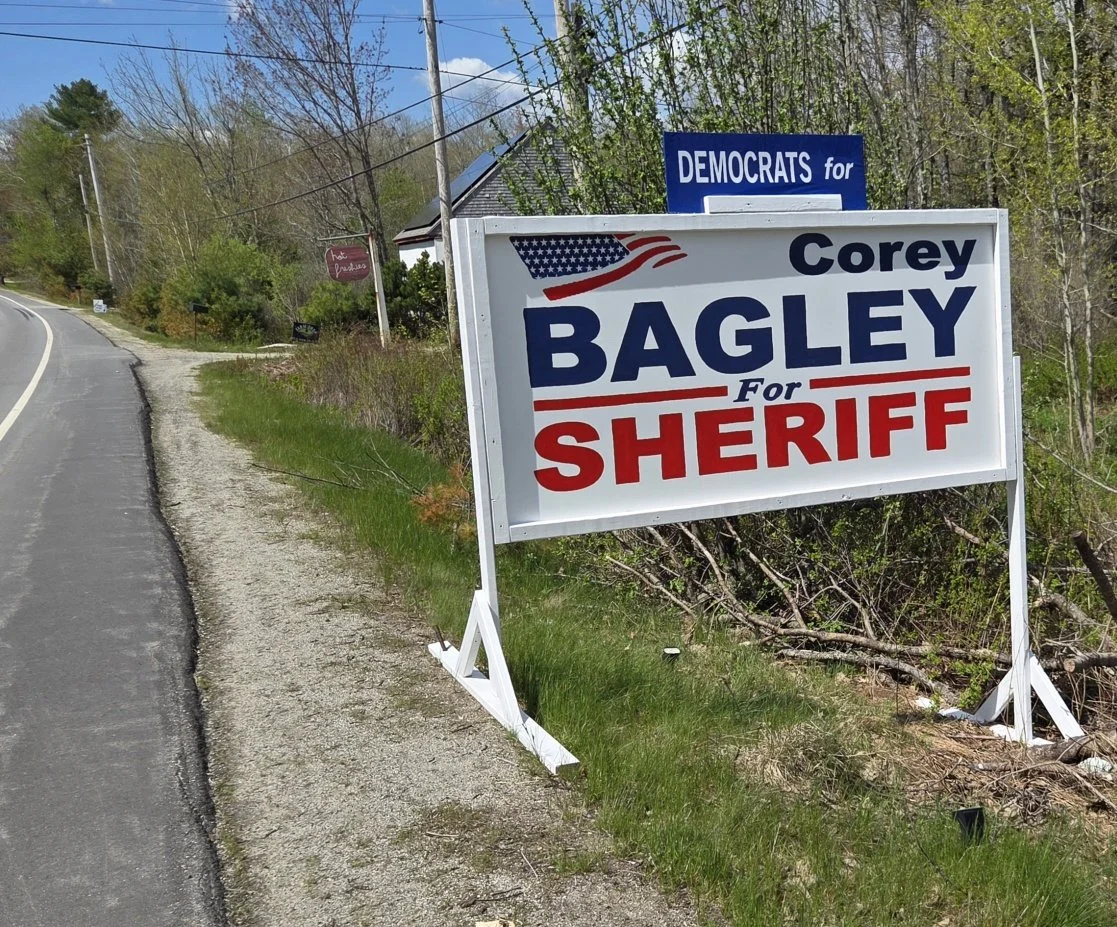
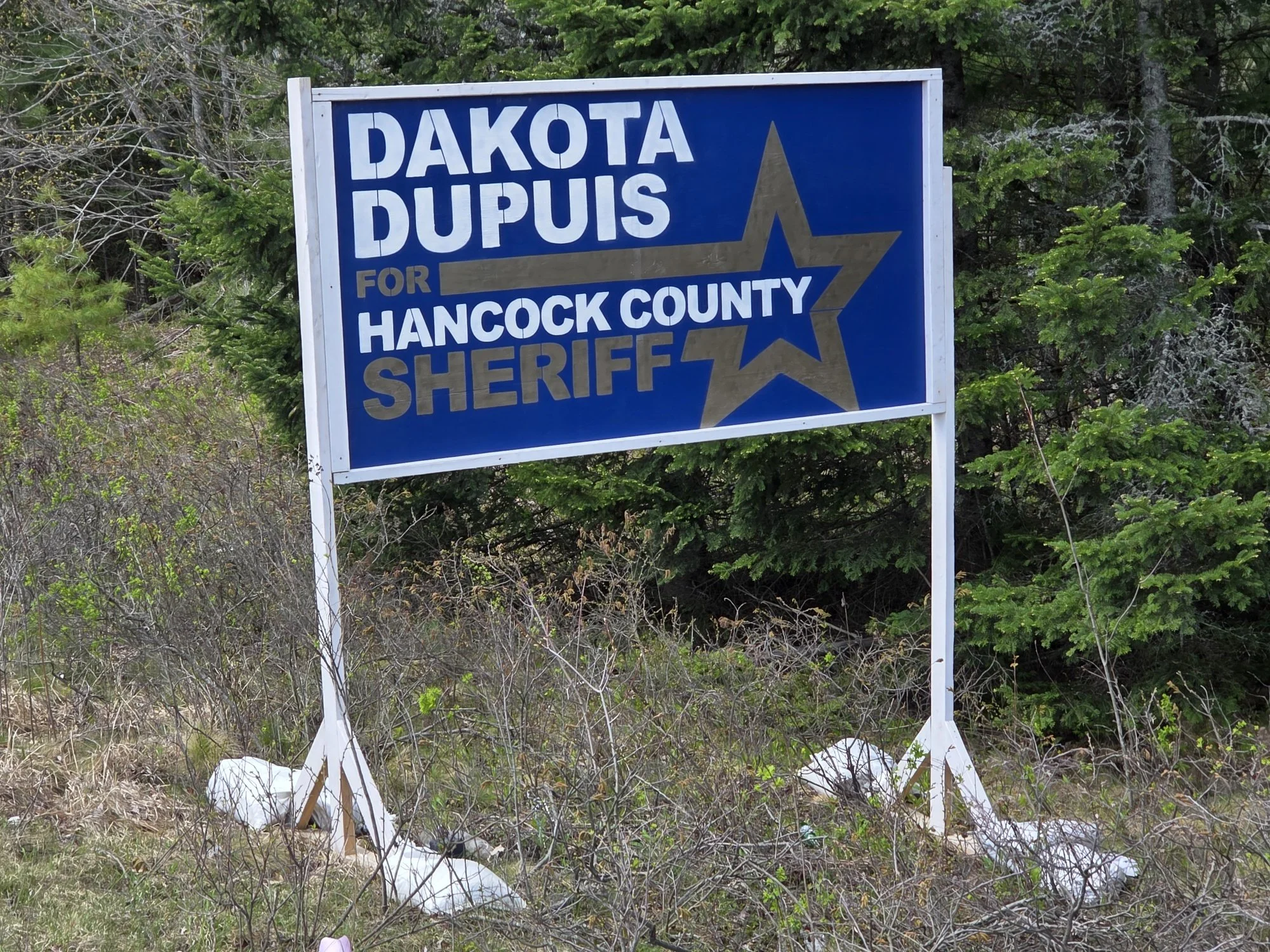
Corey Bagley, 57, a life-long Republican, has put up classic flag-themed red, white, and blue signs, some of which bear the notation “Democrats for Bagley” at the top. His opponent, Dakota Dupuis, 31, who recently switched over from the GOP and is running as a Democrat, has put up large signs that feature white lettering and a gold star surrounded by what he calls “Democratic blue.”
With the exception of Bucksport, the Sheriff’s Office provides most of the daily law enforcement protection for the small towns of the Blue Hill Peninsula, so who gets elected as the county’s top law enforcement officer is an important matter for our area.
The Rising Tide interviewed both candidates for insights into their backgrounds and experiences that they say make them best-suited for the critical job.
Corey Bagley
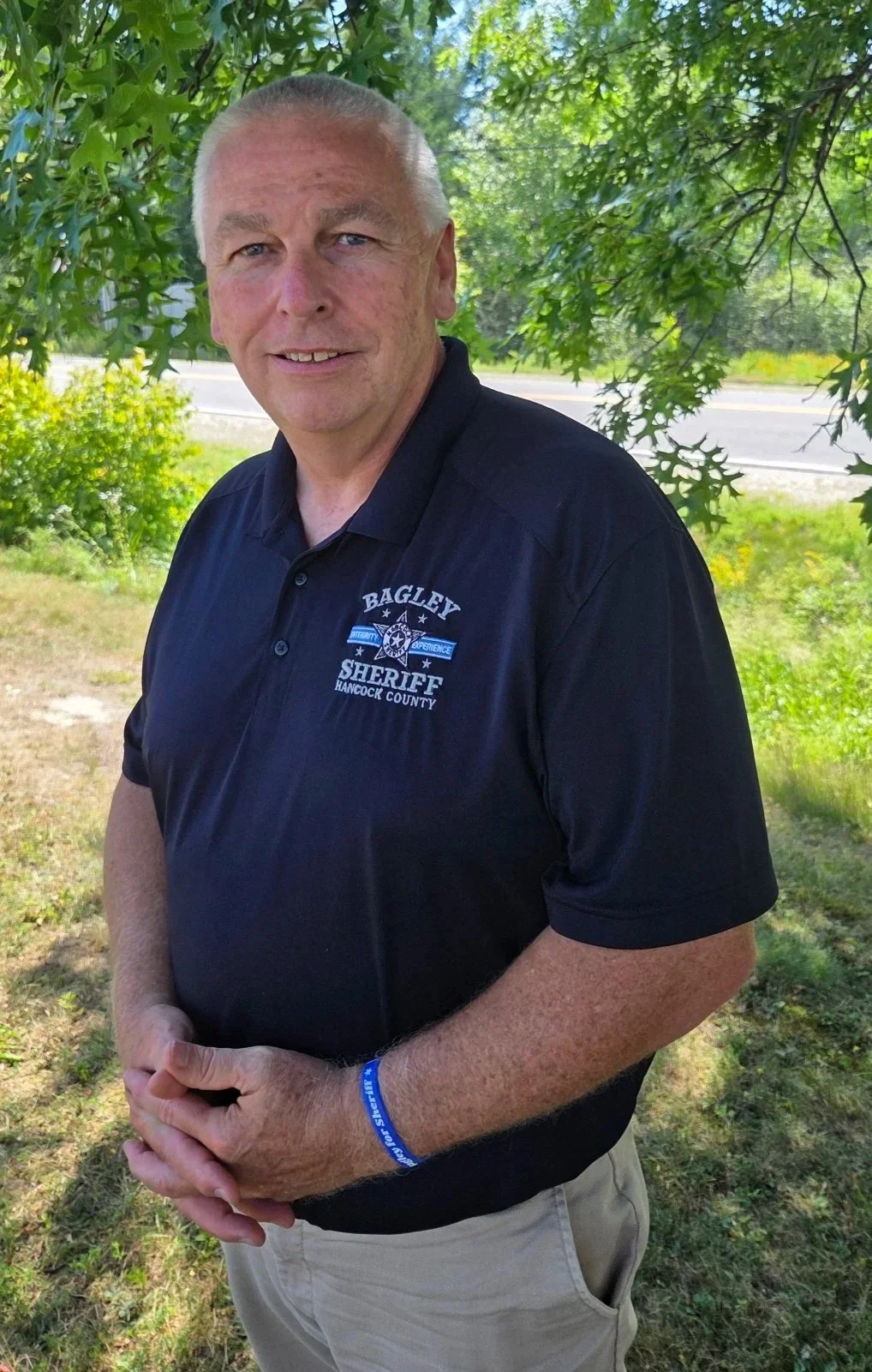
Bagley, 57, currently a detective with the Ellsworth Police Department, has over three decades of law enforcement experience in Hancock County, most of it in the Sheriff’s Office. He was born in Hancock and makes his home there with his wife, Stacey, where they raised two children, Nicholas and Katelynn.
Bagley got a degree in Liberal Studies with a minor in Physical Education at the University of Maine in Presque Isle.
Corey Bagley discusses what he sees as a need for more mental health professionals assisting law enforcement. Video by John Epstein.
“But I knew I wanted to be in law enforcement,” he told The Rising Tide. “You always have the cliché that ‘you want to help people,’” Bagley added, “But for me, it was true – I really enjoy being able to help and work with people.” He also noted that his best friend in high school, Alan Brown, who later became a police chief, also wanted to go into law enforcement.
In 1992, after working part-time at the Hancock County Jail for a couple of years during college, Bagley took a job as a patrol deputy for the Hancock County Sheriff’s Office, while also graduating from the Maine Criminal Justice Academy.
He was a patrol deputy for 12 years. During that time the area’s drug abuse problem grew to epidemic proportions.
“We were in a major crisis with heroin and oxycontin pills,” Bagley said. In 2004, then Sheriff William Brown appointed him to the Hancock County Drug Enforcement Task Force.
“I became part of the Maine Drug Enforcement Agency (MDEA) and I worked six years as a special agent and then seven more years as a supervisor,” said Bagley, who has worked for years in local schools as an instructor teaching Drug Awareness, Resistance and Education (D.A.R.E.) programs. “I’ve always been passionate about drug education, as well as drug enforcement.”
In 2016, under current Sheriff Scott Kane, Bagley returned to duty as a patrol deputy. A year later, Kane promoted him to patrol lieutenant. In 2022, he became Chief Deputy, the second highest position in the Sheriff's Office.
Bagley says he doesn’t think the position of sheriff should be affiliated with any political party. A Republican, Bagley claims support from Democrat voters. Photo by John Epstein.
“Then in May of 2023, I got blindsided,” Bagley said. He was informed that Sheriff Kane wanted to hire his brother Patrick Kane to the position of Chief Deputy. Bagley retired. In a June 6, 2023 meeting of the Hancock County Commissioners that is available online, Commissioner William Clark, the former Sheriff, vigorously objected to Patrick Kane’s proposed hiring as a gross act of nepotism, noting that the Sheriff’s brother would only be working part-time while getting full benefits, including health insurance. Patrick Kane took himself out of the running for the position, but Bagley had already quit.
After directing a controversial arrest of Democratic State Representative Nina Milliken on allegations of election interference – charges that were later dismissed in court – Sheriff Kane did not seek reelection.
Bagley, who has been working for the Ellsworth Police Department as a detective since 2023 focusing on property crimes, sexual assaults and fraud, said “I’m running for Sheriff because I’m not done there,” he said.
The first thing he wants to do, if elected, is to make sure the information technology at the Sheriff’s Office is up to speed.
“Then I want to bring in a mental health liaison, someone who is embedded with the officers because, right now, I would say 80 to 90% of our cases involve mental health,” Bagley said. His website also stresses “proactive law enforcement” and “building community partnerships.”
He acknowledged a newly enacted Maine law that forbids state law enforcement agencies from assisting Immigration and Customs Enforcement with investigations.
“But typically, local law enforcement does not enforce immigration laws,” he said, adding that the only thing that will change is how the jail handles ICE, by requiring the federal agency to present judicial warrants in order for a prisoner to be turned over to its officers.
Bagley said his campaign receives no funding from the national or state Republican Party. He funds his campaign with donations and by selling merchandise like T-shirts.
“I have a campaign committee that is very motivated, and we painted our signs using a stencil,” Bagley said, noting that he repurposed old campaign signs once used by Alan Brown, his childhood friend. Brown lost a 2014 Republican primary race for Hancock County Sheriff to Scott Kane by 60 votes, became Southwest Harbor’s police chief in 2015, and then died of heart attack while off duty in 2020.
While Bagley is running as a Republican, he doesn’t think the sheriff’s position should be politically affiliated. Bagley said that’s why there are Democrats who put signs up for him after listening to his reasons for seeking the office.
“When I respond to a complaint, I don’t ask people what political party they’re affiliated with, nor do I care,” he said. “Unfortunately, in the political climate that we have right now you have people who won’t even consider voting for me because I’m a Republican, but people who know me know it doesn’t matter whether I’m Republican or Democrat: it’s my experience that matters, and hands down, I’m more experienced than my opponent.
Dakota Dupuis
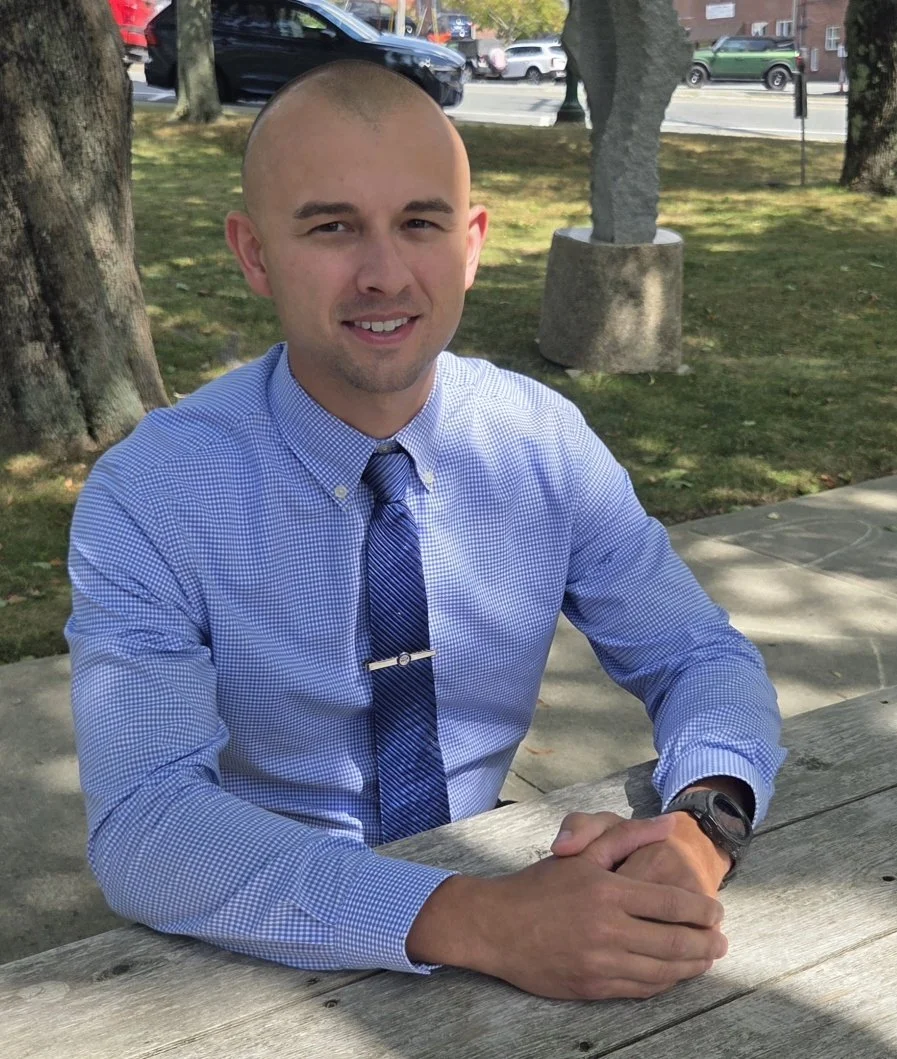
At 31 years old, Dakota Dupuis has risen rapidly through the ranks of local Maine law enforcement. Born in Bangor and raised in Otis, Bradley, and Dedham, he graduated from John Bapst High School and then completed two years of college, studying criminal justice at St. Joseph’s College in Southern Maine.
Dakota Dupuis says he wants to see more positive interaction between law enforcement and the community through regular contact such as stopping in at town offices or Little League games. Video by John Epstein.
At the urging of a professor, Dupuis started putting in applications to start the lengthy process of entering the law enforcement professions.
“But at 20, I was looking at how much debt I had,” Dupuis said in a recent interview with The Rising Tide, “so I ultimately decided to leave college after my sophomore year to take a full-time position with the Orono police department in 2015.”
During his first year as an Orono police officer, he also attended and graduated from the Maine Criminal Justice Academy. “I was the youngest in the class,” he said.
Dupuis worked for more than three years for the Orono Police Department as a patrol officer where he was trained to be a “drug recognition expert” when making traffic stops of drivers he suspected of being impaired.
“It was an interesting program,” he said. “Using a combination of physical and clinical indicators, you could determine if a driver was impaired even if they did not show alcohol-related impairment on a breath alcohol test.”
He would look at pupil sizes, walking patterns, and ability to follow instructions. If he suspected that a driver was impaired by a substance, Dupuis explained that the person would be taken to a medical facility for a blood test to determine if an impairing substance was present.
In 2018, Dupuis took a job as a patrol deputy with the Hancock County Sheriff’s Office. For a couple of years, he patrolled the entirety of Hancock County from Dedham to Stonington. “I’ve seen drug trafficking cases, sexual assaults, fatalities, people being shot and stabbed, and quite literally cut up – a lot of the same things that you might see in a big city like Boston or New York.”
From 2022 through 2023, Dupuis worked as a special agent under the Maine Drug Enforce,ment Agency.
“I was in plain clothes in jeans and a T-shirt, with my hair grown out, and I had quite a beard,” he said. “We did surveillance – drug buys, things like that. It was really cool – the type of experience you don’t get from being a patrol deputy.”
According to Dupuis, he participated in a six-month MDEA investigation in conjunction with the federal DEA and the FBI, which led to the arrest and conviction of 10 people for trafficking illegal drugs into Maine from Lawrence, Massachusetts.
In February 2024, Sheriff Kane promoted Dupuis to the position of lieutenant. Twenty months later, in early November 2025, Dupuis announced that he was running to be sheriff as a Democratic candidate in the 2026 election. He has the support of Kane, a Republican.
Dupuis said he became a Democrat about two years ago, and before that he was a Republican.
“But when I was considering running for sheriff, I was determining where my views were most closely aligned over the last three years and I thought my views and work as an administrator in the Sheriff’s Office are more with the Democrat party,” he said.
Dupuis said he believes in holding people accountable, “but every person doesn’t need a summons, citation or jail time, and you can promote change by positive interactions,” he said. As an example, he points to a program he has instituted regarding the number of contacts with the public that patrol deputies were expected to make each month.
Dupuis, a former Republican, switched to the Democrat ticket three years ago. Photo by John Epstein.
“Sure, a traffic stop counts as contact, but so does stopping in at the town office or at a Little League game,” Dupuis said. “Don’t get me wrong: Traffic enforcement is important, but so is positive interaction between law enforcement staff and the public.”
Dupuis said he is hoping to get budget approval for hiring a behavioral health coordinator, who could be called in by officers on service calls for follow-up visits with people with mental health and other behavior problems.
Asked about immigration enforcement policies, Dupuis said that the Sheriff’s Office does not cooperate with ICE.
“Our job is not immigration enforcement,” he said. “We are not out enforcing detainers [federal orders to detain people], asking people their immigration status, or anything like that.”
When he first started working in the Sheriff’s Office, Dupuis was living in Otis with his wife, Morgan. But in 2020 the couple moved into a newly built house in Orrington, in Penobscot County, where they began raising a family that now includes their two sons, Archer and Harrison.
Dupuis explained that under a hiring variance developed to retain deputies, he was permitted to work for the Hancock County Sheriff’s Office while living outside Hancock County.
“But when I decided to run for Hancock County Sheriff in 2025, the rules required me to be a resident of the County,” he said, “so we kind of went all in and sold our house and moved to Ellsworth where we currently are renting.”
Dupuis said his campaign is funded by donations and that he has not requested any funding support from the Democratic Party.
“My father and I painted our road signs based on a design I got on the internet where I saw a sign used in a sheriff’s election in the South,” he said.
The election is Tuesday, Nov. 3, 2026. For information on absentee ballots, see our previous coverage.
