

‘Universal access’ to some local trails is possible by next month
Island Heritage Trust’s strategic plan follows a state and nationwide trend of increased accessibility
Sept. 21, 2026
By Steele Hays

The graded gravel surface allows use by people in wheelchairs and those with other mobility issues. Photo by Steele Hays.
DEER ISLE — Island Heritage Trust expects to soon complete its longest “universal access” trail, allowing those in wheelchairs and with other mobility issues to access a half-mile-long, graded gravel trail at Lily Pond Park on Deer Isle.
The new trail and two upgraded parking areas will be open to the public by Oct. 1, according to Alex Drenga, conservation director of the Island Heritage Trust.
Later in October, the trust and its trail contractor, Erin Amadon, will begin work on the Barred Island Trail, the land trust’s most heavily used trail. More than 4,000 hiked the trail in July alone, Drenga said. The project will upgrade the first 0.25 miles of the trail to access standards set by the Architectural Barriers Act, with a smooth gravel surface and wooden boardwalks in several sections. The trust will close the trail to public use when the construction work starts and will announce the specific closure dates in advance.
“These are baby steps in trying to allow more people more access to places people love on the island,” Drenga said. “‘Universal access’ and trails for ‘all people’ are terms we are using now because nobody likes to be called handicapped.”
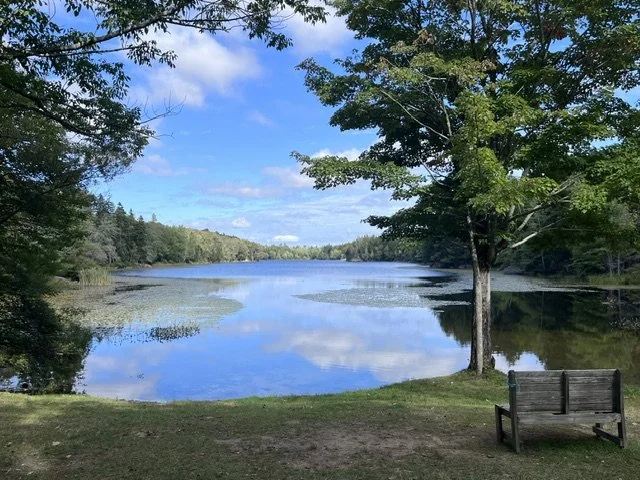
The universal access trail leads users to this view of Lily Pond. Photo by Steele Hays.
The focus on expanding universal access to hiking trails is a growing trend nationwide and in Maine, according to Drenga. Building accessible trails has been a topic of interest at the Maine Land Conservation Conference, he said, and Island Heritage Trust recently added the goal to build more universal access trails to its five-year strategic plan.
“It’s not just about people who are born with mobility issues,” Drenga said. “At some point in our lives, if we live long enough, we all are likely to have challenges in our mobility. Maine has an old demographic, and this is about helping more people stay active and have access to the outdoors.”
In addition to creating the accessible trail, the trust will construct two wheelchair-accessible granite picnic tables at Lily Pond Park by mid-November, and plans to upgrade the existing restroom and bathhouse next year.

Many beech trees along the trail have succumbed to Beech Leaf Disease and will be removed. Photo by Steele Hays.
The loop trail at Lily Pond passes through several areas where beech trees were once the dominant tree species. But virtually all the trees have been killed by Beech Leaf Disease, which has been decimating beech stands across Maine in recent years. Drenga said the trust plans to selectively cut any dead standing trees close to the trail that are a safety hazard. The land trust has hired a licensed forester to help them manage their forests, as well as develop a site plan for Lily Pond Park. The trust will leave some dead standing trees away from the trail as habitat for owls, woodpeckers and other wildlife, Drenga said.
The trail work is being funded by a $250,000 grant Island Heritage Trust received last year from the Maine Trails Program, a state-administered program passed by the legislature in 2024. The law allows the funding of up to $30 million for trail work over the next four years. The first round of grants was awarded in 2025.
