

Memories from the Brooksville and Blue Hill mines
Anecdotes from the peninsula’s bygone mining days
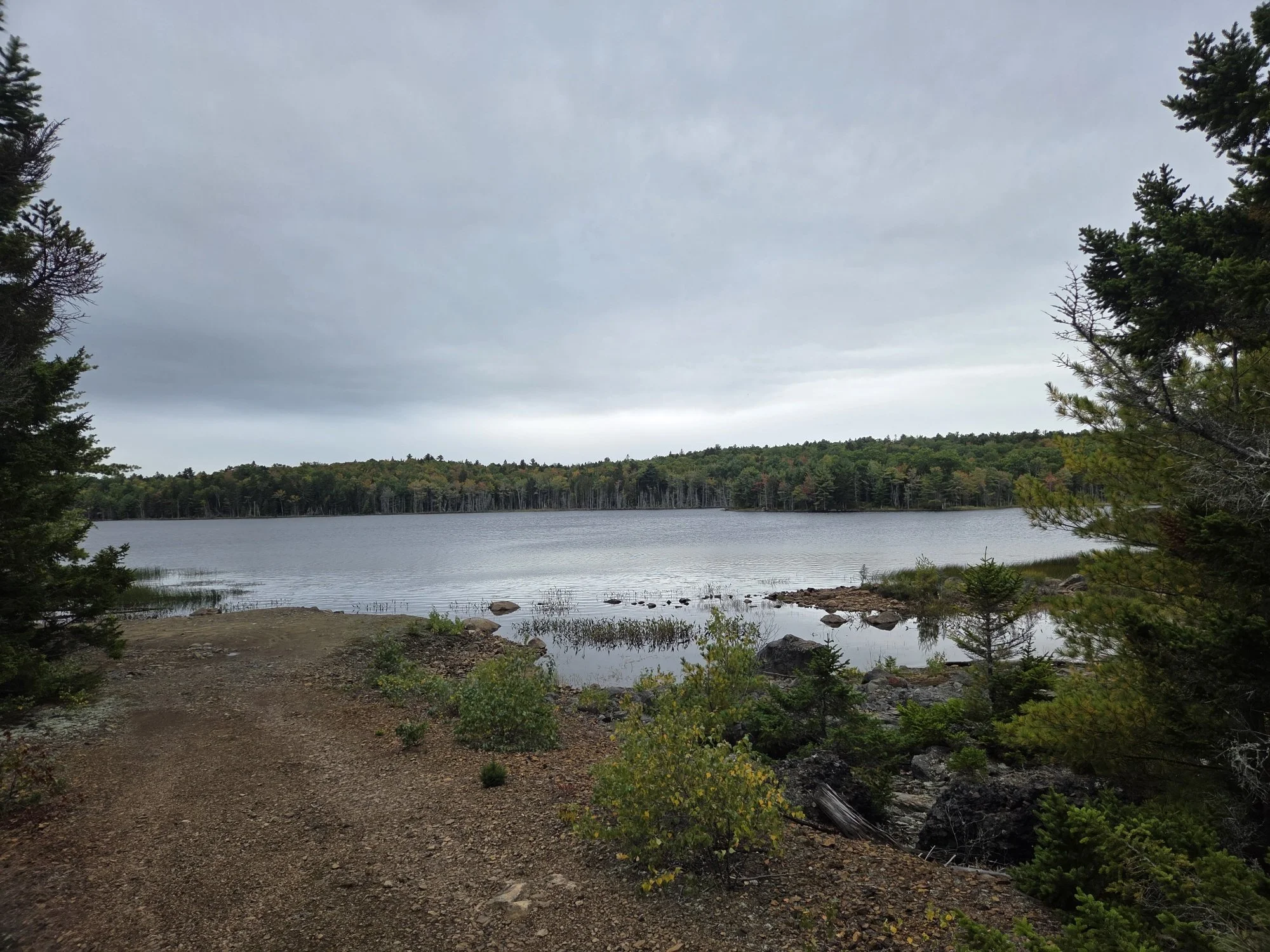
Looking southeast across Blue Hill's Douglas Pond (also known as Second Pond), where the Kerr American Mining Company once operated a mine until 1978. Photo by John Epstein.
Sept. 28, 2026
By John Epstein
In early October, people living on the Blue Hill Peninsula should expect to see Sargent Corporation dump trucks driving along Route 176. The trucks will be carrying loads of stone and other material to finally remediate the hazards at the Callahan Mine, the Superfund site in Cape Rosier.
The work is expected to take close to a year to complete. When it’s done, Brooksville and the rest of the peninsula may close the books on its mining history. As recently reported in The Rising Tide, the Blue Hill area had a mining tradition since the 1880s.
Even today, there are residents here who still have vivid memories of life when mines were in full operation, over 50 years ago.
Audrey Peasley
Audrey Peasley met her late husband, Berwyn, in Brooksville’s grammar school. She tells a story about how he introduced himself to her by pulling her braids while sitting behind her in class. They married soon after high school and lived for decades together at the corner of Ferry and Coastal Roads, until Berwyn died a couple of years ago.
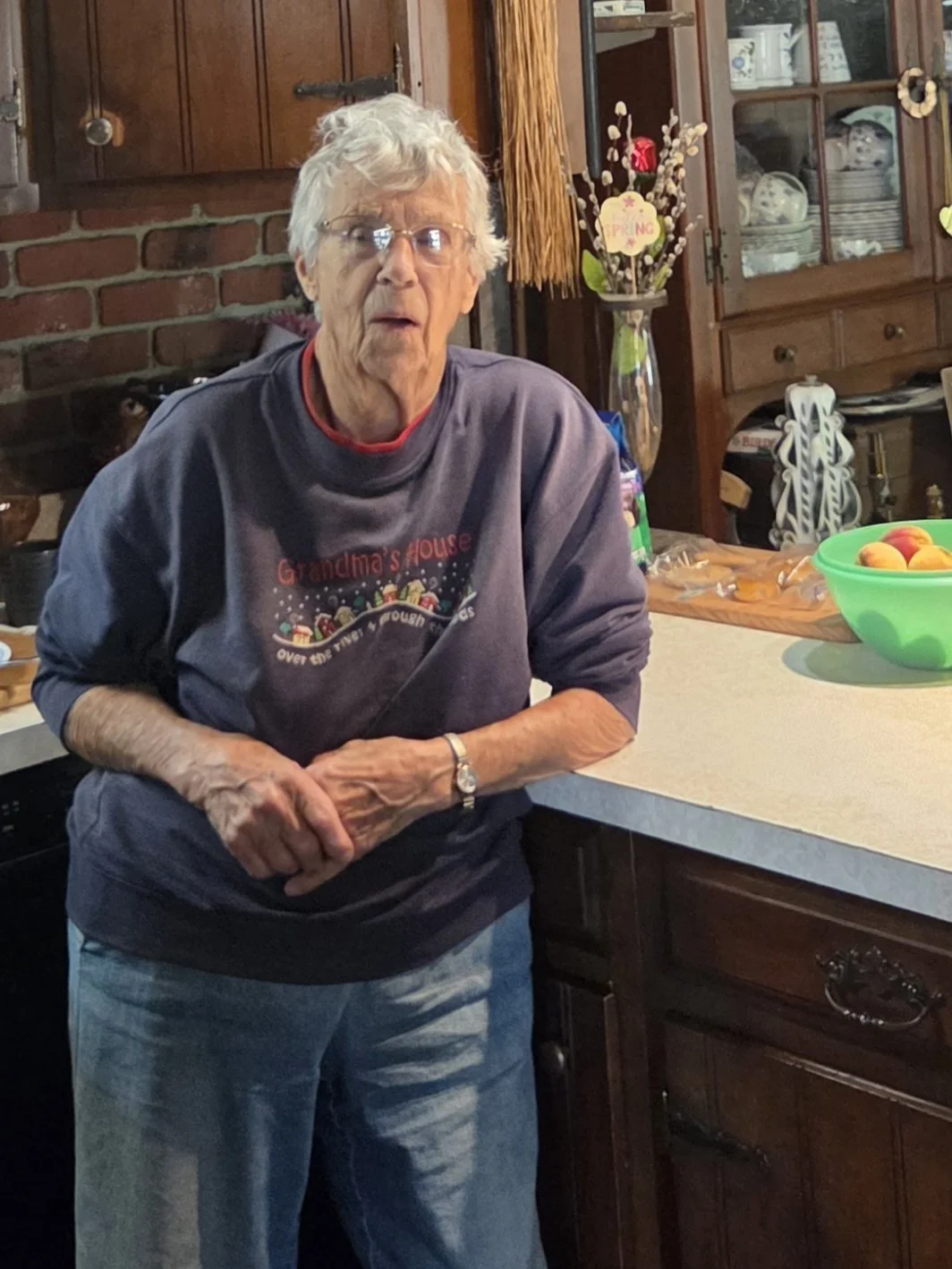
Audrey Peasley in her kitchen at her home on Ferry Road, where she lived with her late husband, Berwyn, who worked for both the Callahan and Kerr American mines. Photo by John Epstein.
For years, Berwyn operated an automobile and truck repair shop. But according to Peasley, there was a time when he worked as a mine equipment mechanic, first at the Cape Rosier mine operated by the Callahan Mining Company, and then for Kerr American at their mine in Blue Hill.
“The big boss came and asked Berwyn if he wanted a job,” Peasley said, who still lives at the family home that was built in the 19th century. “But Berwyn said, ‘I already have a job.’”
She said that her husband was plenty busy operating his repair shop.
“Well, the boss said they’d pay Berwyn twice as much, so Berwyn accepted the offer,” Peasley said.
Peasley was glad that Berwyn’s job repairing machinery for the mining companies did not typically involve going down in the mines. “But sometimes he had to, and he didn’t like it,” she said.
“The mining jobs were good jobs. People were glad to get them around here and lots of people wanted to get them. It was a big loss to the community when the mines closed…Many of the men that worked on the mines came down here from Canada. But there weren’t many places around for them to get food, so Berwyn would invite them over to our house when their shift was over…They would sit at the kitchen table or at the dining room table, and watch TV, but they weren’t speaking English, so I said, ‘Wait a minute – I have no idea what you’re talking about,’” Peasley said.
The Canadians, who were Quebecois, spoke English in her house from then on, she said.
“We had an extra refrigerator that we kept full of beer, and our house was always full of miners when their shift ended,” Peasley said. “They would sit around, laugh, relax and watch the TV.”
John Gray
John Gray, 83, the long-time chair of the Brooksville Select Board and founder of John Gray H. Gray Electrical, Plumbing and Heating, Inc., worked for the Callahan Mining Company, starting in 1970 as an assayer. The Rising Tide spoke with him at his Brooksville home, built by his great-grandfather in 1828.
“We’d work in a lab analyzing the ore retrieved from the core drilling samples to see whether it was worth mining,” Gray said. “We were looking for copper and zinc.”
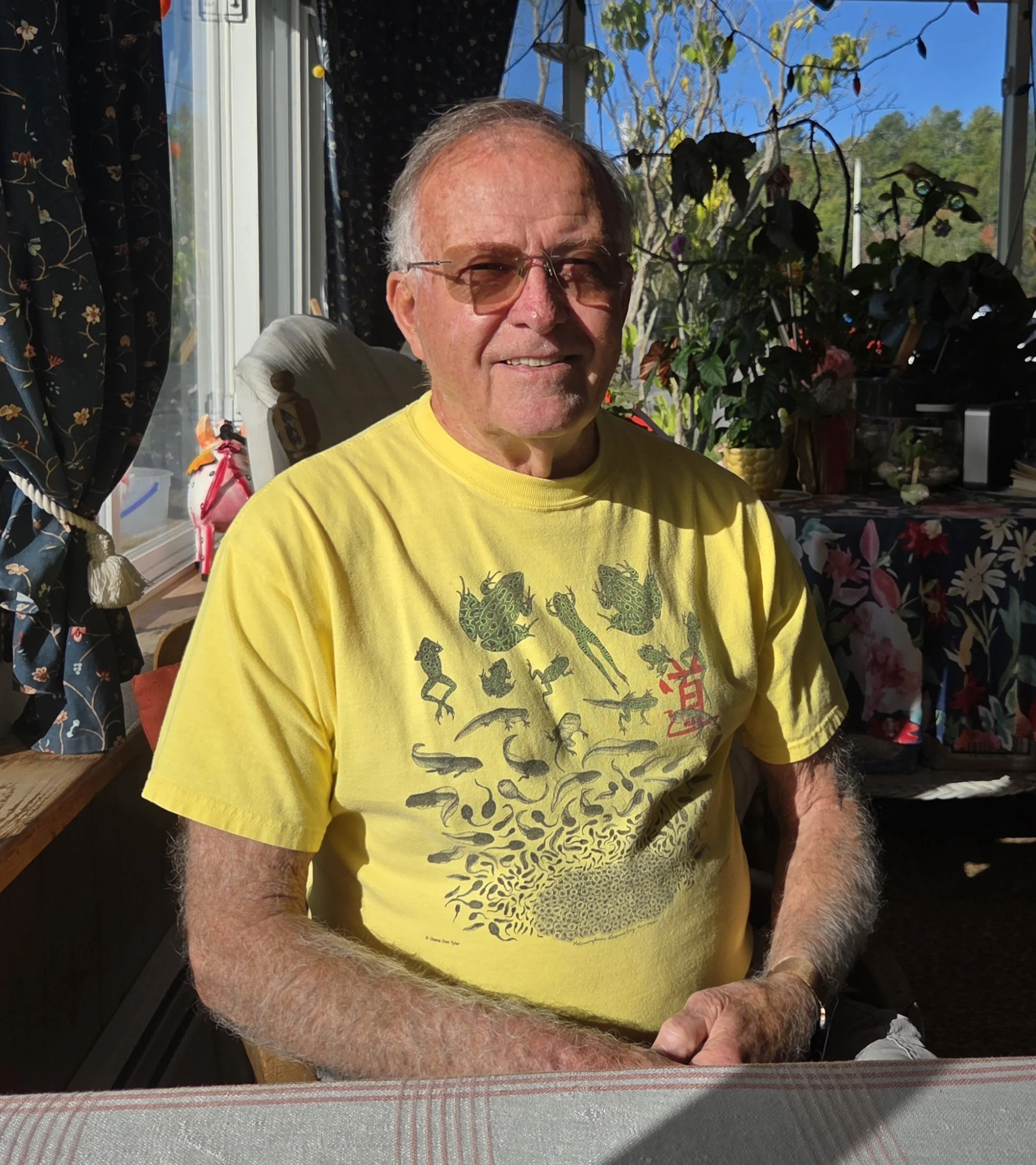
John Gray, Chair of the Brooksville Select Board. He worked as an assayer at the Callahan Mine and later as an assayer and metallurgist at the Kerr American mine in Blue Hill during the 1970's. Photo by John Epstein.
Part of his work involved analyzing whether subjecting the ore to a different milling process would improve the grade of the product that came from Callahan’s 300-foot-deep pit mine.
Gray said the mine provided a real economic benefit to the area: “They paid quite well, so it was good for the people that worked there.” But the company, Gray said, had a difficult time turning a profit on the mine. The salable product barely met the cost of extraction.
Mishaps during the mining operation did not help.
“There was a huge hauling truck that carried rocks up to a pile called Callahan Mountain, but on its way down the driver forgot to lower the dump bed, which pulled down the power lines,” said Gray, “and that took quite a while to repair.”
And then there was the Stink Cove incident.
“It was a small cove near the mining pit that filled up with mud, rotting rockweed, and debris, that really smelled,” said Gray. “There was a big rain that caused a huge mudslide of this stuff down into the mining pit.”
It took weeks to haul the material out and pile it up in a stable and dry location. But during remediation of the mine site over the last few years, Gray said the old Stink Cove “stuff” proved quite useful as a site covering, saving both time and money.
He said that Callahan, when closing down the mine, slowly flooded the huge mine pit by gradually releasing the saline water that sat behind a dam. According to Gray, questions about chemical hazards leaching from the mine did not come to the fore until 15 years after Callahan closed it.
“There were wells that went bad because of salt water infiltration,” Gray said, and mentioned that Callahan dug new wells for homeowners that needed them.
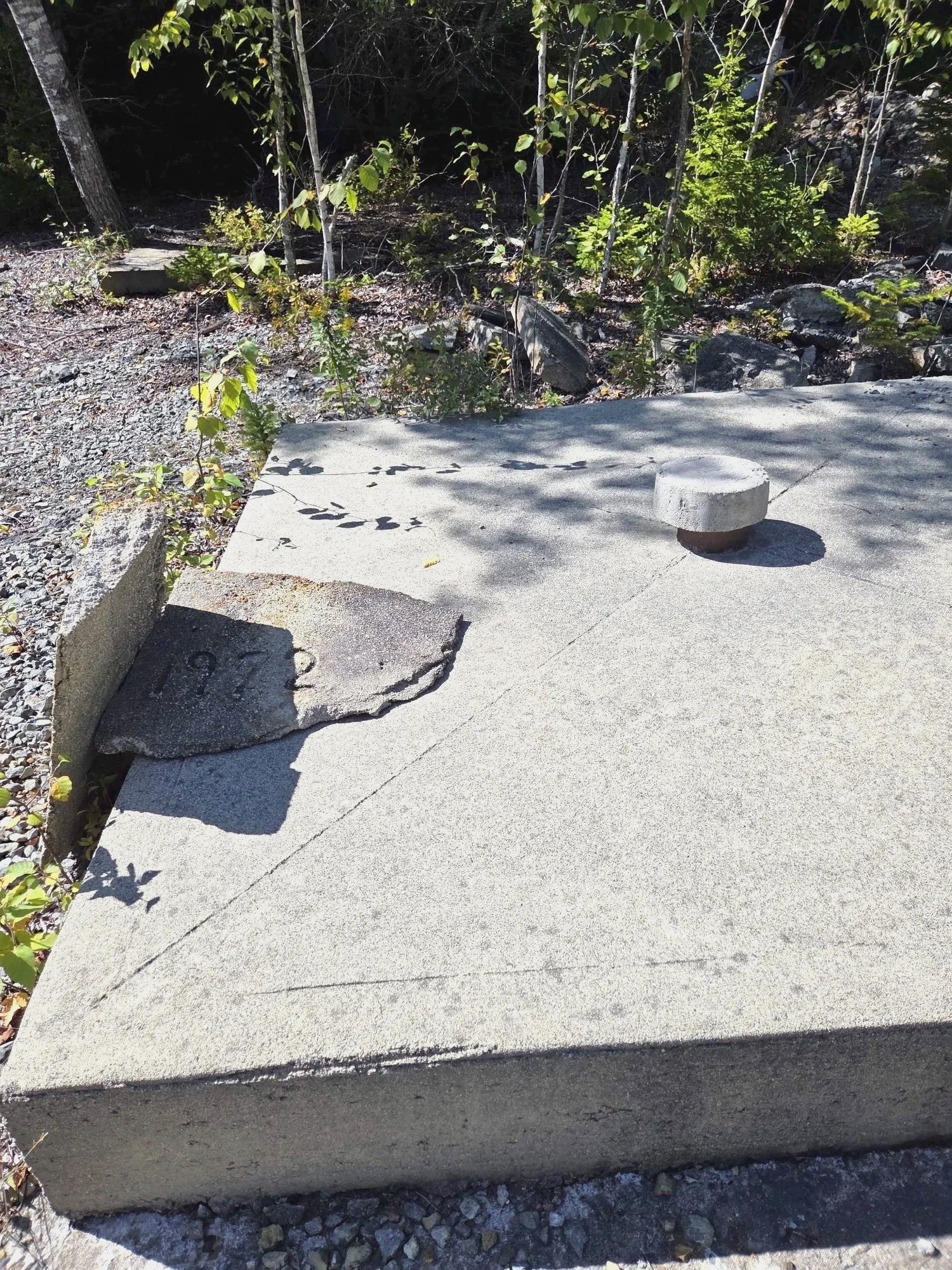
The concrete cover was placed by the Callahan Mining Company over a mine shaft where an accident killed Penobscot's John Montgomery and badly injured Brooksville's Darrell Fowler and Marlin Osgood. Photo by John Epstein.
He also mentioned an accident at the Callahan Mine, when a large rock encountered while digging a mine shaft fell on three miners. One, John Montgomery from Penobscot, was killed. Two others were injured, including Darrell Fowler and Marlin Osgood, both from Brooksville. A large concrete slab now covers the mine shaft where the accident occurred. It bears the date 1972, the year Callahan ended mining operations on Cape Rosier.
When the Callahan mine stopped operating, Gray took a position with Kerr American, an Idaho-based mining company that was operating a mine in Blue Hill on the southeast side of Douglas Pond, also known as Second Pond. He worked initially as an assayer, and then switched over to metallurgy.
But according to Gray, Kerr was beginning to wind down their operations at the Blue Hill around 1975 to 1976.
“They offered me a job if I moved to Idaho, but I really didn’t want to move around,” Gray said. He started working for a plumbing company in Castine, later branching into heating and electrical work, and finally starting his own business in 1984.
