

Penobscot lands $4.6M in funds for Mill Creek restoration
Funds represent largest amount ever received by Penobscot, outpacing even its annual budget

Mill Creek in Penobscot, with the town’s current salt shed and Wallamatogus Mountain in the background. Photo by Tate Yoder.
By John Boit
The town of Penobscot has landed a group of major grants totaling $4.6 million for major reconstruction and ecological projects
The combined grants from state, federal and conservation groups represent the largest amount of outside funding the town of 1,100 residents has ever received, and even surpasses the town’s annual budget of $3 million.
The money will be used to relocate the town’s salt shed along Mill Creek and Bayview Road to a new building that will be built along the Western County Road several miles away. Ultimately, the site of the town’s current sand and salt storage will be returned to its natural state, with the exception of a small parking lot to connect a hiking trail from the creek to the top of Wallamatogus Mountain. A new culvert will be built at Mill Creek to improve alewife passage.
The grants represent a shift in the thinking of town leadership, which once balked at the idea of taking federal grant money and was “always proud to say that we did it on our own,” said Harold Hatch, chair of the town’s select board.
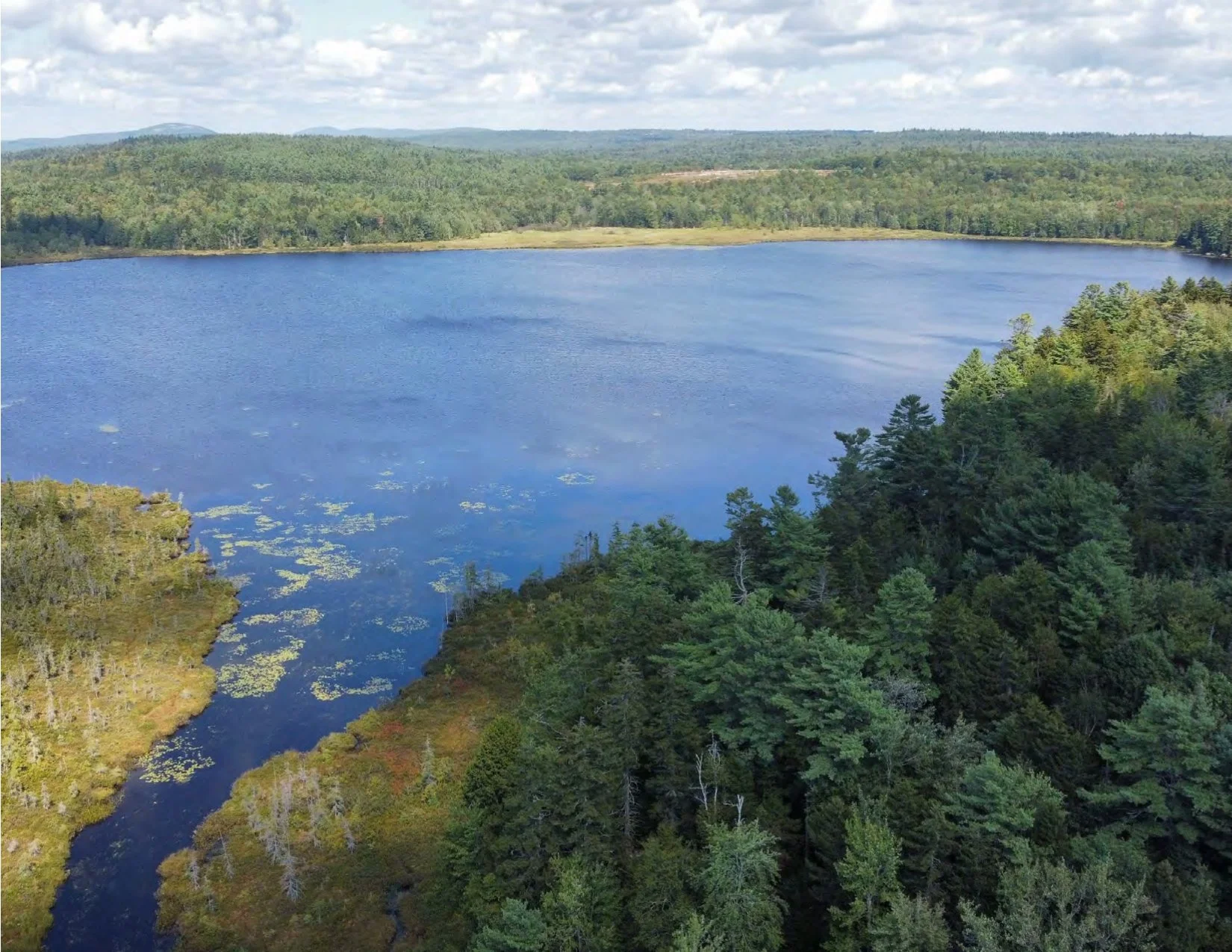
Pierce’s Pond, where thousands of alewives come to spawn each spring. Photo courtesy of Linkel Environmental Construction.
“It’s a lot of money for a small community,” Hatch said of the funding. “We didn’t have a gun to our head to do any of it,” Hatch said of the projects. “But we were concerned about the salt intrusion into Mill Creek, putting things back to nature, helping the alewife passage, and maybe righting the wrong when we started putting sand there 75 years ago.”
Much of the effort was driven by the town’s shellfish committee chair, Bailey Bowden, who is credited with envisioning a return of alewives to the area through environmental restoration.
“It is so exciting to have the funding in place to tackle the final projects focused around Pierce's Pond and Mill Creek,” Bowden said. “These funds are an investment in our future. Replacing the culvert and raising the road will keep traffic flowing in spite of sea level rise. Extending the fishway will increase the number of alewives entering the pond which provides food for countless creatures. Relocating the salt and sand pile will remove a major source of pollution that enters the Bagaduce River. Once complete, this mega-project will be a great example of what can be done when people work together.”
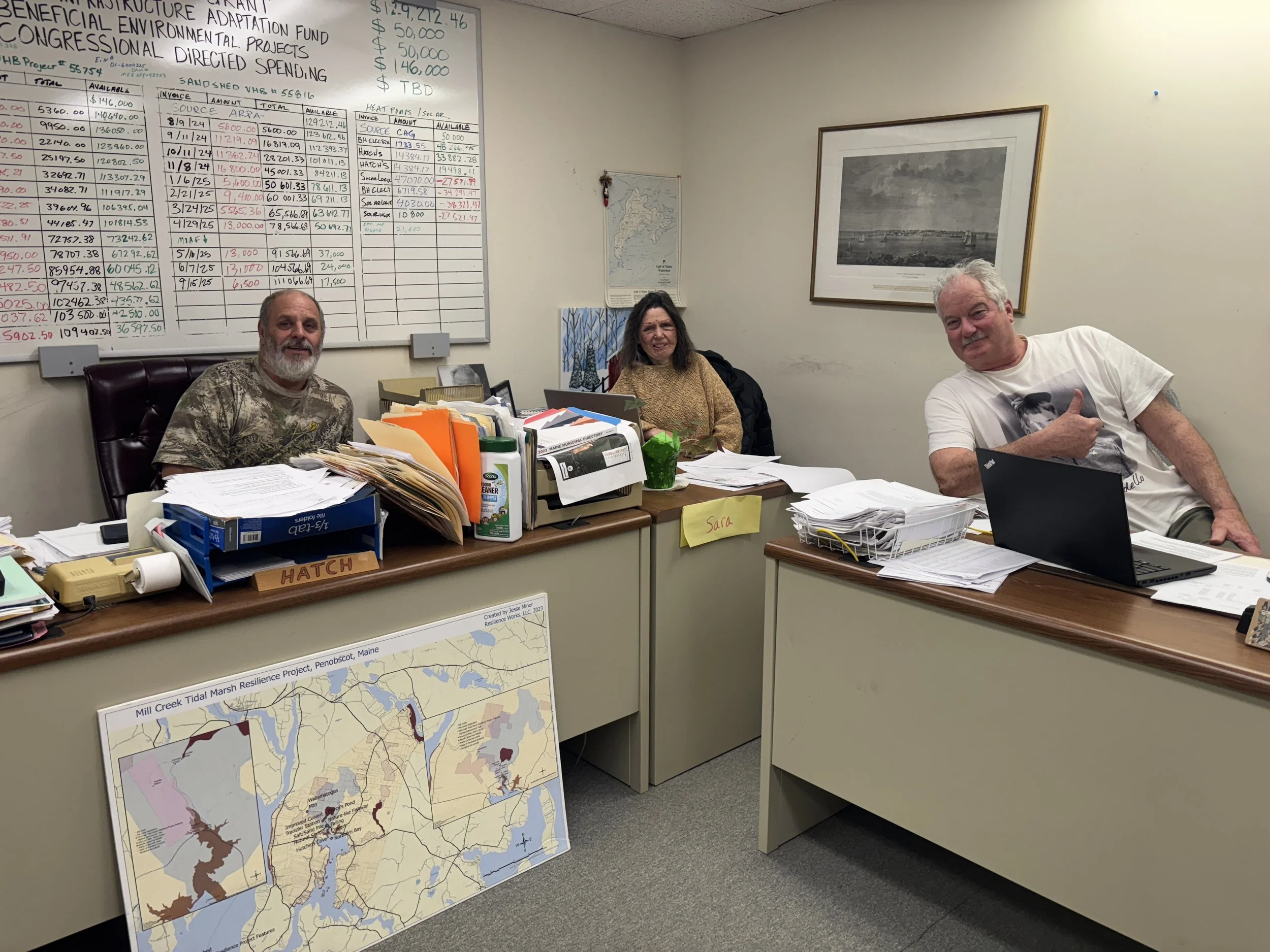
Members of the Penobscot select board, from left: Harold Hatch (chair), Sara Leighton and Phil Rapp. Photo by John Boit.
Bowden also gave thanks Maine’s congressional delegation and their Maine staffers.
“A special thank you goes to Senator Susan Collins for believing in the value of this project,” Bowden said. “Small rural communities cannot afford to raise this level of funding through taxation and must rely on grants and federal assistance.”
Others who were instrumental in the grant process were consultant Allen Kratz, as well as Ciona Ulbrich, the associate director of partnerships at Maine Coast Heritage Trust (MCHT), who gave special praise for Bowden’s efforts.
“Penobscot has a long and proud heritage of close ties to its natural resources,” Ulbrich said. “One person who has played a key role in making it a priority for the town to protect those resources is Bailey Bowden. Bailey takes the responsibility of being a town citizen seriously, engaging in so many ways and giving countless hours of time to the town and place he cares about. His energetic and dogged focus, combined with the town government’s willingness to collaborate, have really shown us all how exciting things can get done in a small town.”
‘These funds are an investment in our future.’
—Bailey Bowden, chair of the Penobscot Shellfish Committee
The funding sources include: $2.09 Million from the National Fish and Wildlife Foundation for fishway construction, a grant that will pass through MCHT; $1.49 million in federal Congressional funds to build a new salt shed; $900,000 from the Maine Department of Transportation for roadway construction; and $145,000 from the Greenfield Penobscot Estuary Project Trust, which is part of a court settlement to remediate mercury contamination in the Penobscot River watershed.
The project will take place in four phases, Hatch said.
Phase 1, which includes the creation of additional fish pools along Mill Creek for spawning alewives, was completed this past summer.
Phase 2 will replace the culvert where Mill Creek crosses under Bayview Road. That phase is moving quickly, with bids for that project due on Dec. 12. Construction work would start in the winter and will be completed by mid-2026.
Phase 3 involves the construction of a new salt shed on the Western County Road. Bids for that project are expected to go out in the spring of 2026 to be completed that fall.
Phase 4 envisions revitalizing the former sand lot along Mill Creek and restoring it to its natural state, with the exception of a small parking lot to act as a trail head for a path that will ultimately connect with another hiking trail to the top of Wallamatogus. That work will be completed by 2027.
“This is a great example of how a small town with a clear vision to protect and enhance natural resources, and which is willing to collaborate and be creative, can undertake a major project,” Ulbrich said. “One of the key reasons that these projects in Penobscot have been awarded major funding is the series of successful fish passage restoration projects completed in the watershed over the past few years. Another reason is the close collaboration among many community members who are actively helping on these – the select board members who attend every meeting, the landowners involved, the professors and students from Maine Maritime Academy doing monitoring, the Island Soundscape Project, and the many contractors helping in so many ways from tree cutting to vegetation monitoring. That active community involvement is really important to every funder.”
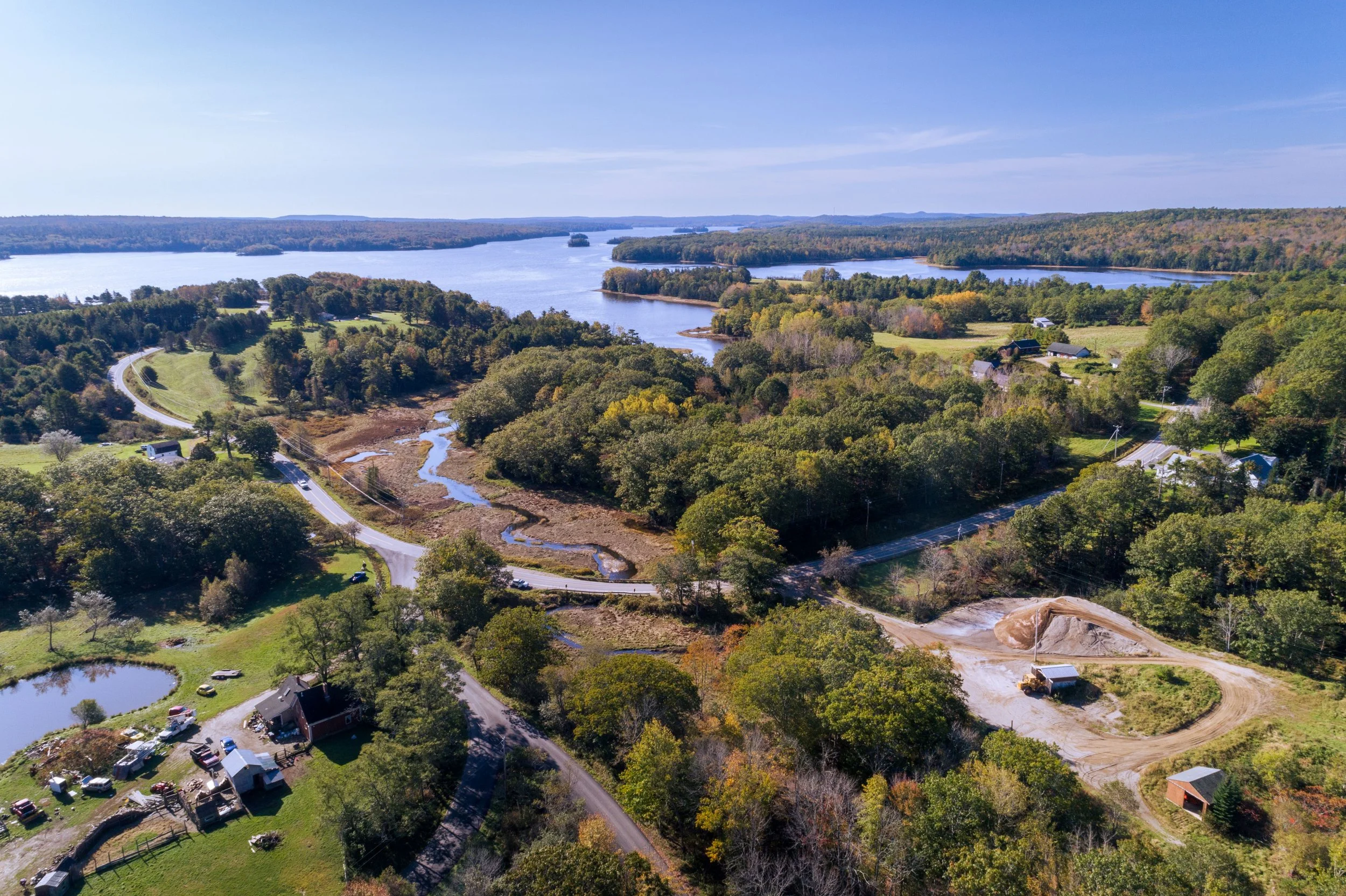
Mill Creek drains into Northern Bay on the Bagaduce River. Photo by Tate Yoder.
