

Feds briefly floated idea of borrowing ship, MMA president says
In Q&A, MMA president discusses his vision for the academy, its nuclear coursework, and the time the Shah of Iran bought oil for its ship
Oct. 27, 2026
By John Boit
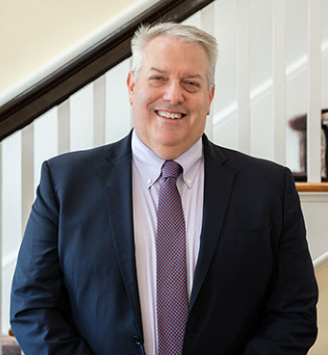
Craig Johnson, president of Maine Maritime Academy. Photo courtesy of MMA.
Craig Johnson has been president of Maine Maritime Academy for about 18 months. In that time, he has taken possession of MMA’s new training ship and seen enrollment rise. At the same time, some programs are under pressure to attract more students. Rising Tide editor John Boit sat down with Johnson on Oct. 23 for an interview, presented here in Q&A format. Johnson’s answers have been only lightly edited for the sake of clarity or brevity.
Maine Maritime Academy took possession of its new training ship this year. The ship is the third of five identical ships designated as National Security Multi-Mission Vessels. How has it performed?
We had a very successful first training mission. To take a ship in six weeks, turn that around, and take that out on a training cruise was amazing.
The training capacity is incredible. The living conditions are better. You have a live bridge and a training bridge below it. So you're training twice as many deck students at the same time. You have two engine rooms, two control rooms. The training spaces are amazing.
And the ship is being used for training even while docked in Castine?
That's the important part people forget. It's still used. Students are actually doing maintenance on the ship. It's a running ship right now. The ship's not plugged into shore power. It's active. So the diesel engine is running. It produces its own power, fresh water, et cetera. So it's in full operation right now.
Years ago, MMA used to run regular tours for the public on board the training ship, at least in the summertime. Are you going to run any tours?
We’ll be able to do that next year. The pier has been under construction. “Work in progress” are our favorite three words around here.
And when will the pier be completed?
June or July of 2027.
The federal government recently requisitioned SUNY Maritime College's training ship, identical to MMA’s, for a possible overseas mission. Several reports said it was headed to the Middle East for 170 days. Could the same thing happen to Maine Maritime's ship?
We just got word that it’s heading back to SUNY in the next 24 hours. It’s new news. We’re 90 percent sure they are headed back to SUNY Maritime.
The importance of this ship, when it's pier-side, is actually just as important at sea. For the students getting on and off every day, doing their maintenance and training, that's ship familiarization. That's their livelihood going forward. Having that exposure day in, day out is paramount.
Does MMA own the ship or does the US government own the ship?
The US government.
Did the federal government approach Maine Maritime about using its ship?
They came to us asked us, “Hey, why don’t we take your ship? It’s already running.” I said, “Well, we have an overload of warranty items due from the shipyard and our students are making up their requirements from not having a ship the last couple of years.”
They [the Maritime Administration] didn't officially ask me. I think they just took a look at things as to what they were. That was a couple months ago. I’m surprised they didn’t take it anyway.
They’d be within their right, I guess. You must have practiced some good diplomacy.
I didn’t do anything diplomatic. If it’s for the good of the country, I certainly stand behind it.
What would happen if the government needed the ship during Maine Maritime's summer training cruise?
We’d ship share. There's money allocated in the federal budget for ship sharing. If something like that happened, if it was a major emergency, we'd probably borrow a Mass Maritime ship. Because they do a winter cruise.
You always have to have a plan. There have to be contingencies.
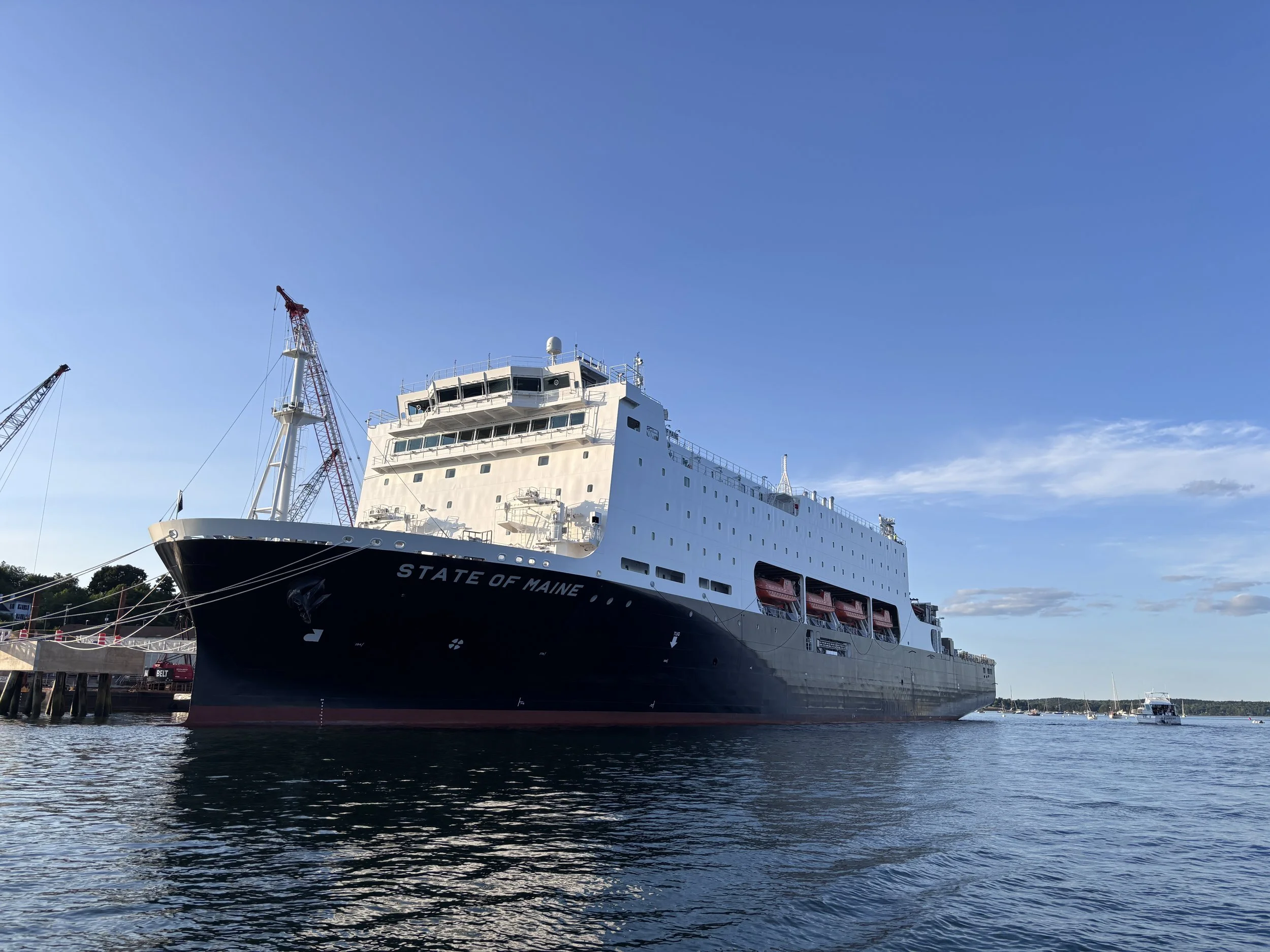
Maine Maritime Academy’s new training ship, State of Maine, in Castine. Photo by John Boit.
How is enrollment doing?
A couple of years ago, we were down in the lower 800s in enrollment after COVID, and now we're up around mid to upper 900s, starting here in the fall north of 960 right now. And hoping we'll get up into the 1,000 range next year.
This school, this town and this campus can hold about between 1,000 to 1,100, if they're spread equally amongst the programs.
In a perfect world, our business program could grow, our marine science programs will grow. Engineering's growing at a pretty good pace right now. Marine transportation, the small vessel programs, they're all experiencing some growth.
I think we're growing like 5 percent year on year, which is a pretty good number.
There are six state maritime academies in the United States, plus the U.S. Merchant Marine Academy. What distinguishes Maine Maritime to prospective students?
The big difference for us versus any of the other maritimes is–and this isn't just the U.S., it's the world–I think we have the greatest waterfront of any maritime academy in the world. Hands down.
All the hands-on experience. If any of those vessels are leaving the dock and coming back, they are being driven by a student. Monitored by a professor, but driven by a student.
And you just can't make that up. The other schools have decent waterfronts, but they don't have that level of hands-on tug and barge training.
We had a company come up here a few years ago and it was snowing cats and dogs outside and they said, “Oh, I guess the tug isn’t going out today. “ And we said, “Oh, yes it is.” The folks that run our tug and barge program are exceptional.
It’s hands-on experiential learning. Our diesel labs, our simulation, all that sort of thing, our science vessel, small vessel program, the small vessel boats. You just can't get that in a classroom.
The Coastal and Marine Environmental Science program has been placed on probation. What will determine whether it survives? Is it just enrollment?
It's enrollment. Yes.
Right now, the marine science faculty worked hard this summer in developing some criteria to keep the program going and grow it. So I'm very keen at keeping it–that and marine biology, which is growing very, very well. We took in over 25 additional marine biology students this fall.
[Editor’s note: Both the Marine Biology program and Coastal and Marine Environmental Sciences program are under the Ocean Studies Department at MMA.]
Is it your intention to keep this kind of “whole ecosystem” of all things maritime and marine? Is that your vision for the school?
If I had a template to do this all over, I'd do it exactly how it is now. I think you need to be diversified.
You are committed to keeping the science part of it as well as the “drive ships” part of it?
Yes.
What do you hope Maine Maritime looks like five years from now?
Hopefully in five years, it looks like north of 1,000 students and a pretty similar mix to what we've got now.
I think the real key, if I'm speaking to the marine science folks, is that two-thirds of them are coming out with a marine credential now. That is their advantage in getting a job. Our folks are getting a marine credential with the Coast Guard that could get them on a research vessel, and that's going to give them an edge getting in a door.
I wouldn't mind seeing some of the business folks getting those credentials. We took a couple of the business students out on the training cruise this summer and they were really helpful. Some of them were doing logistics for the supply chain for the food in the mess hall, and others were operating other parts of the ship. It would be pretty cool to have a training mission with a science piece to it, a business piece to it at the ports and terminals we go to.
Maine Maritime is expanding into nuclear engineering. Where do you see that leading?
We've got a grant from the Department of Energy. So we're partnering with the American Bureau of Shipping, the Coast Guard, and the Department of Energy’s Office of Naval Reactors, in developing a curriculum for maritime nuclear power. Whether that happens [that nuclear powered ships become a reality] in the next five years or not, I don't know. But that curriculum can work for maritime nuclear engineering, or can work for shoreside nuclear, and work for Navy nuclear.
Could commercial cargo ships eventually be powered by nuclear reactors?
It's a possibility. The Navy's been doing it for 60 years now, very safely. It's hard to tell. But, you know, 40 years ago or 50 years ago, they said LNG wasn't safe to use on a ship and that industry operates very safely. So I never say never.
How are Maine Maritime graduates performing in the Navy's nuclear training program?
We had a call with Naval Reactors this morning and realized the last batch of folks from Maine Maritime that went to Naval Reactor School were seven for seven, meaning a 100 percent pass rate. That's a good number. I think their general number [of a passing rate] is 60 to 70%.
You recently returned from Croatia, where you attended a meeting of the International Association of Maritime Universities. You will also be the executive director of this organization from 2027-29. Why are those international relationships important?
We’ve always had a certain number of international students. You go back to the 1970s before the hostage crisis, and the Shah of Iran actually bought oil for the training ship when the school needed financial help.
We’ve had Kuwaiti students, Panamanian students, some folks from Indonesia and India.
I think to keep MMA on the international stage, I think it's key. It's keeping us current with what's going on in the world.
Artificial intelligence and robotics are transforming many industries. How confident are you that there will still be jobs for mariners in the decades ahead?
I think the next few decades are pretty safe.
The reality of a ship is that you're lucky if you can go a night without an alarm. Whether it's a clogged strainer on the diesel line or a short in the electrical, it's just not that simple.
There's a lot of autonomous vessel stuff coming on. I think if we enhance it ... I think you'll see people managing these different robotic types of things.
The world is never going to run out of engineering jobs. You're never going to get rid of the people. When ships start moving, it all changes.
