

Tech talk: Library event focuses on AI uses for local businesses
Rick Seeger presents on how humans can use AI to their advantage
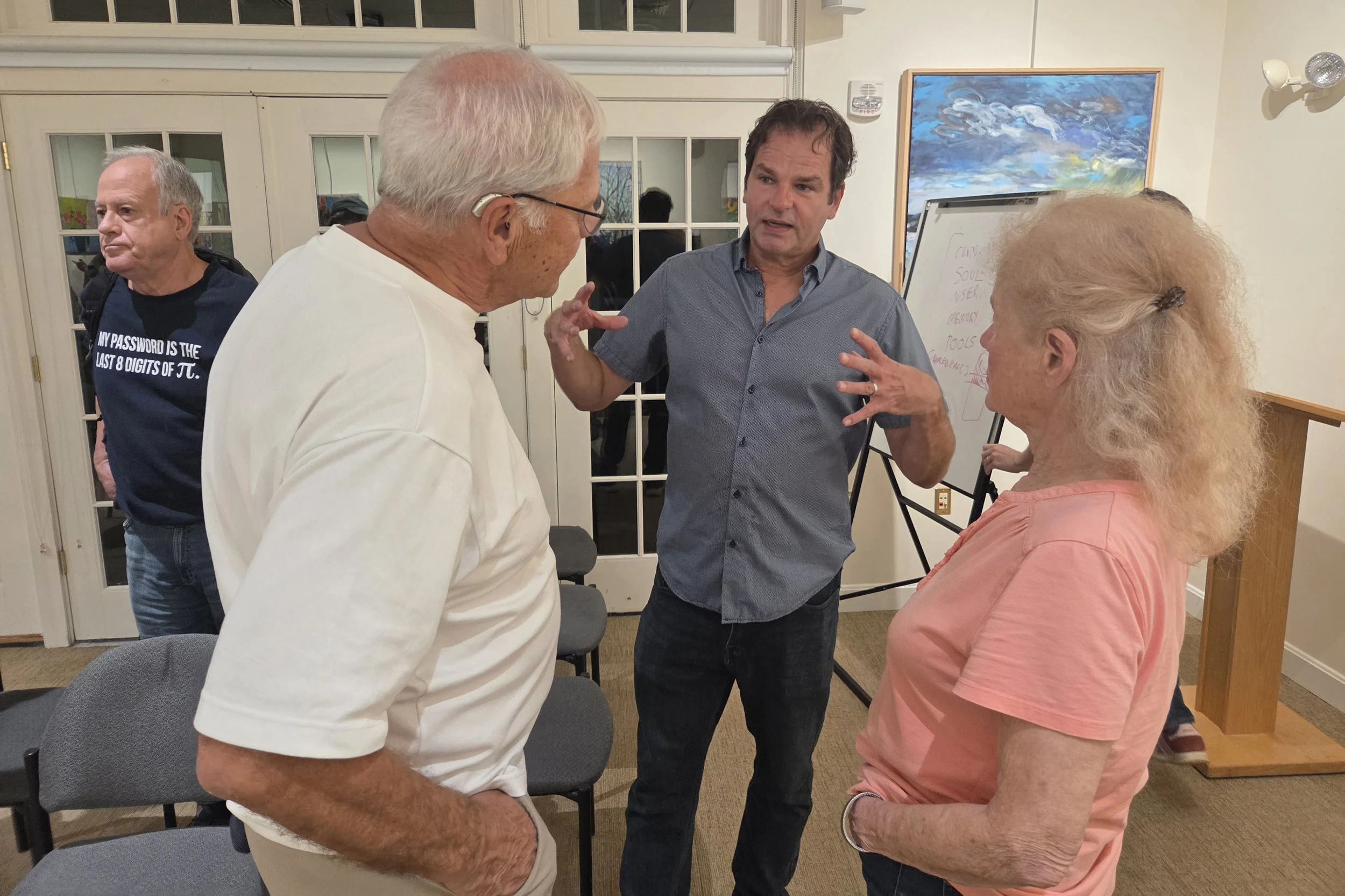
Attendees continued to pepper Rick Seeger with AI questions well past the library’s usual Thursday night closing time. Photo by John Epstein.
Sept. 22, 2026
By John Epstein
BLUE HILL — Artificial intelligence has been at the top of the news over the last few weeks, with dire warnings that the human race could be destroyed by rogue systems. whistle-blowing analysts have sounded alarms, and tech moguls are calling for government oversight.
But on Sept. 17 at the Blue Hill Public Library, local technology expert Rick Seeger hosted a presentation on how AI can actually benefit humanity to a crowd of almost 40 people.
Seeger, who grew up in Blue Hill, has a bachelor’s degree in cognitive and computer science from Carnegie Mellon, as well as a master’s in evolutionary and adaptive systems from England’s Sussex University. He worked in Silicon Valley and ran a web development company in NYC, and now runs Track 3 Consulting, a firm that helps small businesses take advantage of AI.
His goal for the evening was to explain how software, known as AI agents, works by enabling AI to perform specific tasks as directed by human users.
“AI is as important a development for humanity as electricity, telephones, airplanes or the internet – it’s here to stay,” Seeger said, “and the sooner people understand and use AI, the better.”
Seeger presented a slide describing what he sees as the three tracks of human endeavor in the 21st century: work that is done by humans only; work that requires computer skills to perform the work; and work that is done completely by AI.
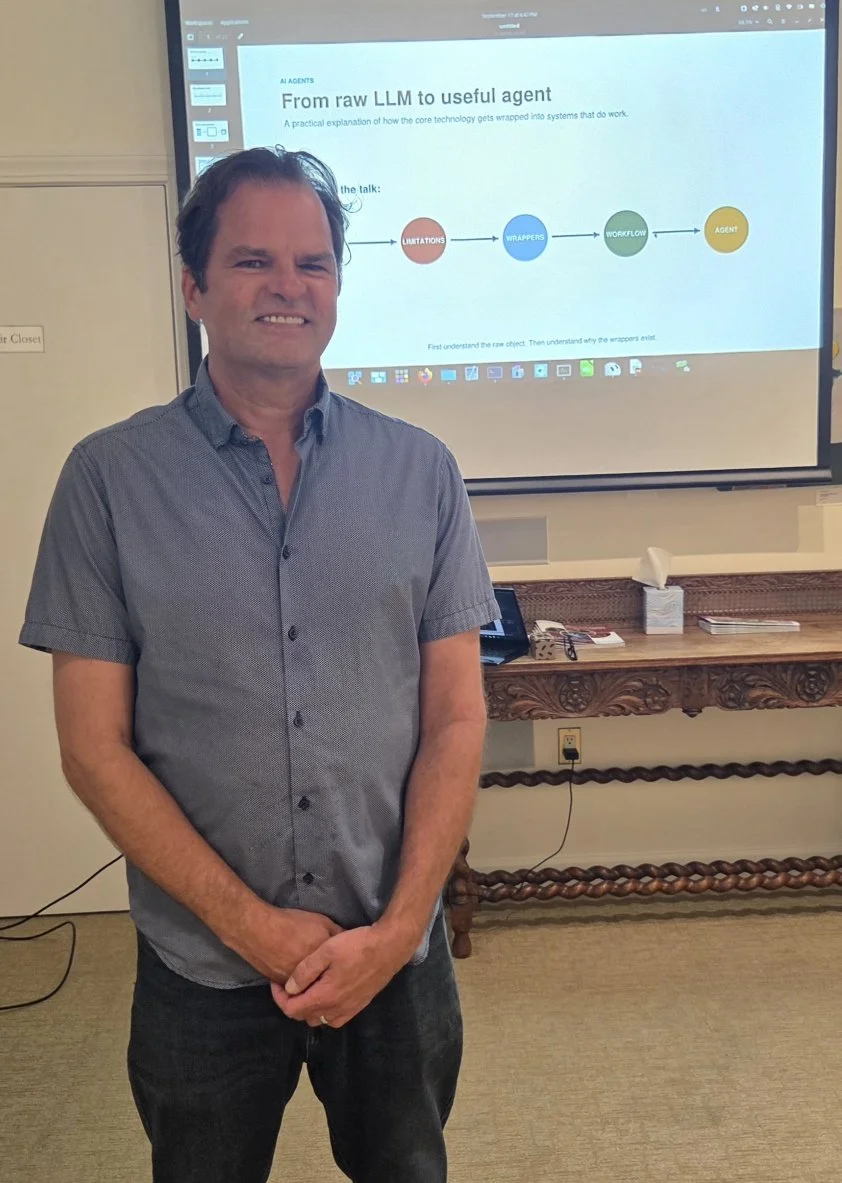
Rick Seeger explains how AI agents work during a presentation at the Blue Hill Public Library. Photo by John Epstein.
As a simple example of an AI agent’s usefulness, Seeger described how he employs it in his business to sort and prioritize his daily emails and set up his work calendar.
“What used to take me 30 minutes, now gets done in three,” he said.
Seeger mentioned that when AI agents take on instructions to perform complicated research projects, “they can take a while to finish them, and so I use an extra server to perform those tasks, so I don’t tie up my desktop,” Seeger said.
Many in the audience were retirees with backgrounds in math, science and information technology, who were already starting to use AI agents. There was a cascade of questions and comments that kept the meeting in session until well after the usual Thursday night closing time of 8 p.m.
“I went to Stanford Business School, and I started working for IBM 70 years ago,” said Blue Hill’s Tom Clements. “We used to feed punch cards into the computers and push them around in carts; it’s amazing how the industry has been shaped over time.”
One man noted that a math problem, previously unsolvable by human mathematicians, was solved at New York University by an AI agent.
In response to some who expressed concerns about AI agents becoming too powerful, Seeger said, “AI agents do have basic reasoning…but humans are in control.”
Some attendees brought up the hacking incident that occurred this past July, when AI agents autonomously interfered with Hugging Face, a platform that builds and tests machine learning. Seeger said the incident was likely the result of risk-taking by humans.
“Tech can be used for good or bad,” he said, “but ultimately the problems are caused by bad actors—other humans – not AI.”
There was consensus in the room that government watchdogs were needed for AI.
“It’s the ‘Pogo Principle,” said an attendee at evening’s end, alluding to the Walt Kelly cartoon popular during the Vietnam War era, “We have met the enemy, and he is us.”
To read The Rising Tide’s newly released AI policy, click here.
