

Rowantrees owner envisions co-op for artists in former pottery studio
Barn set on new foundation for future gallery space, owner says
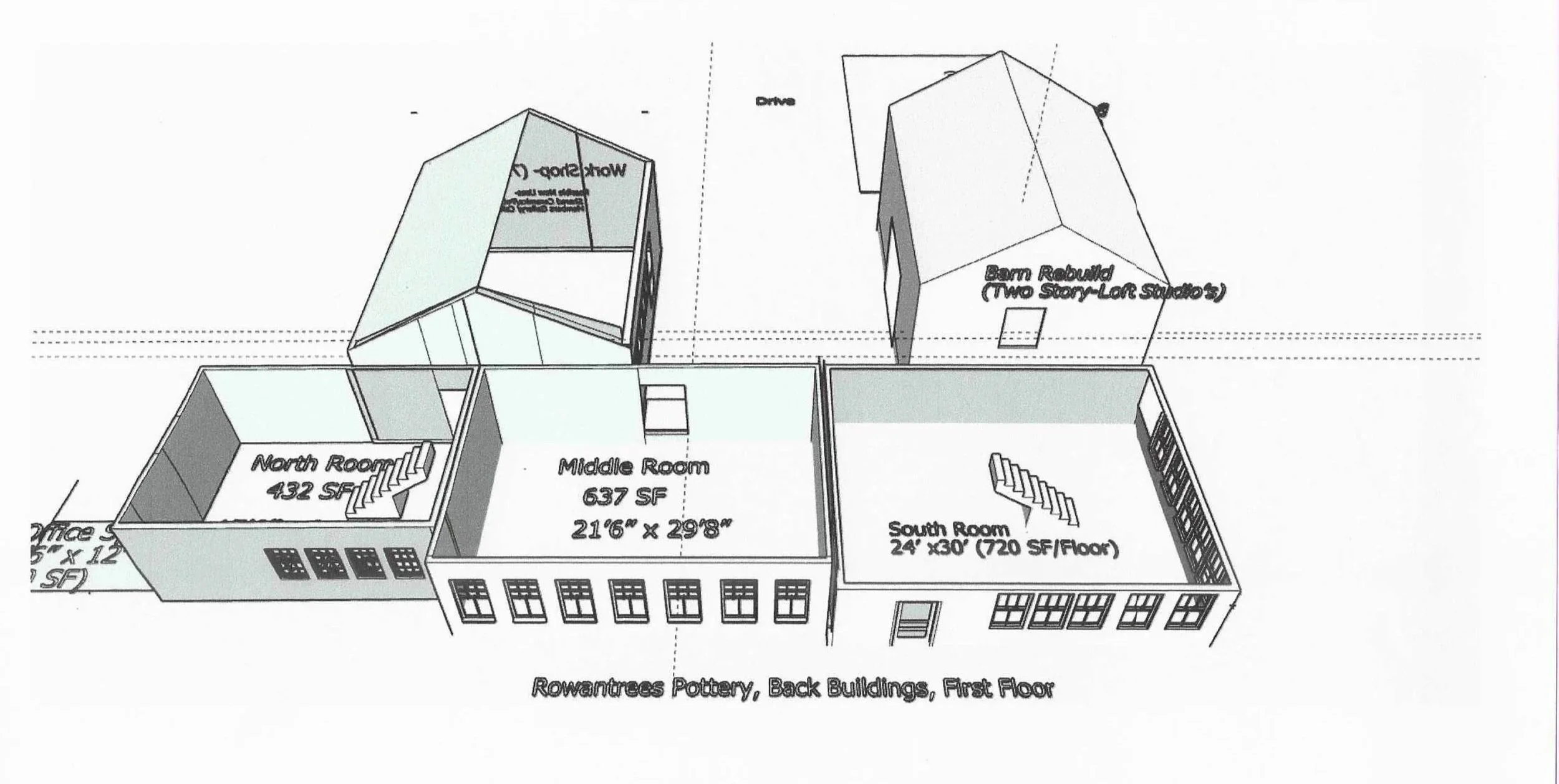
A sketch of the Rowantrees campus as envisioned by property owner John Warren. Graphic courtesy of John Warren.
Aug. 4, 2026
By Steele Hays
The empty buildings of the former Rowantrees Pottery in Blue Hill could again become a busy hub of creative activity with artists’ studios and a gallery space if the vision and goals of owner and historic property developer John Warren are realized.
After years of planning and discussions between Warren and local artists, his idea for an artists’ cooperative recently moved closer to being realized.
Between July 27-29, a construction crew lifted and moved the 22-by-31-foot 1930s-era barn at the rear of the 84 Union Street property so that a new foundation can be laid and the barn can be renovated into a gallery and multi-purpose event space.
Warren’s goal is to establish a nonprofit artists cooperative association that will give artists low-cost studio space in the renovated buildings, he said in an interview with The Rising Tide on July 31. In previous meetings, virtually all of the artists with whom Warren met stressed the desire to have a gallery and exhibit space, he said, so he’s initiating that work first.
A newly-erected sign at the driveway entrance says “Invitation to Artists” and advertises “private studio work space, classroom/meeting space, a shared pottery studio, a gallery! Maybe a small café?”
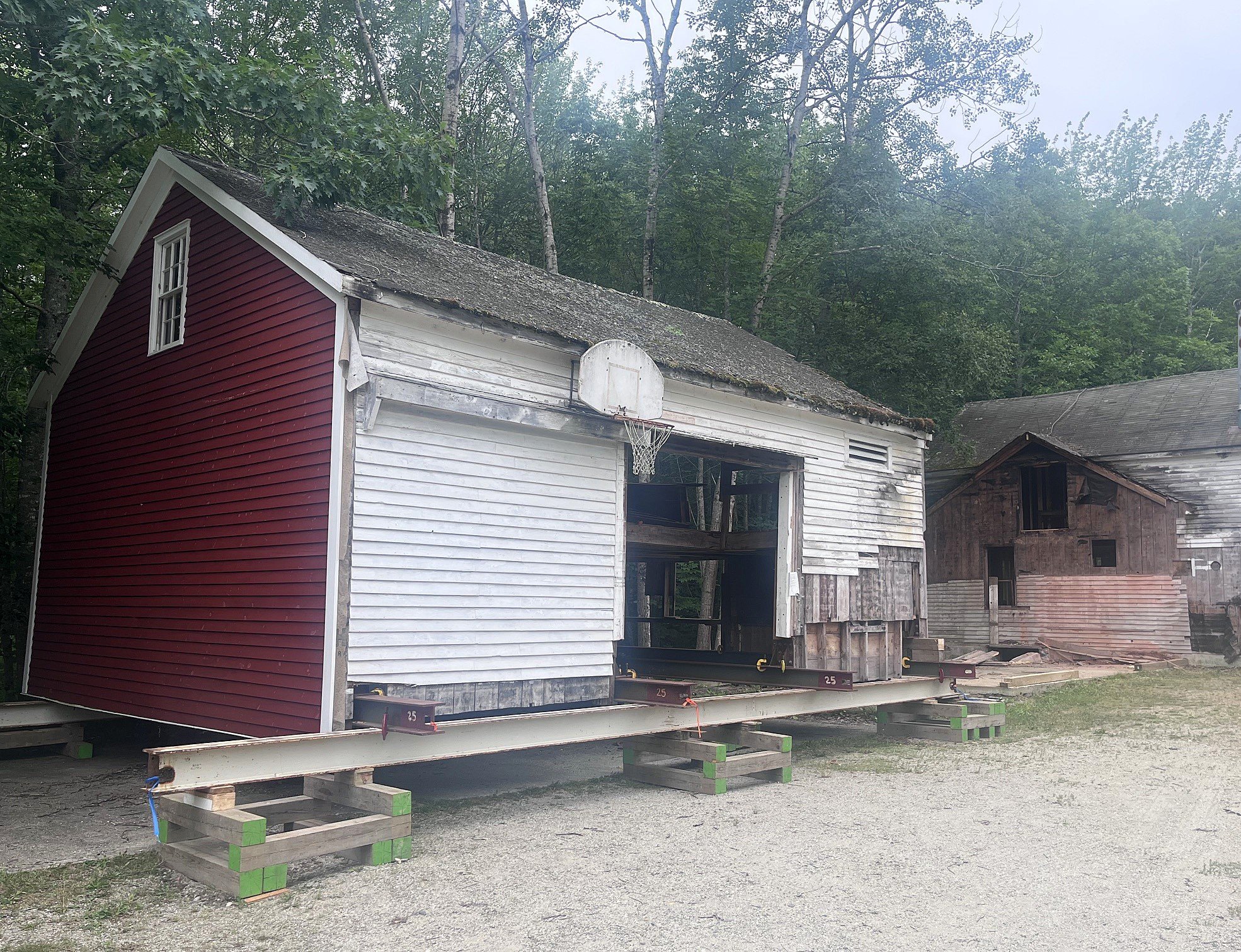
The raised barn at Rowantrees. Photo by Steele Hays.
“With the history that art has in Blue Hill and in that building, it seems like a great opportunity to strengthen the art community in Blue Hill and strengthen the economy,” Warren said.
He stressed that the plans for developing the former pottery buildings will be driven by the artists who want to set up studio space there. Currently, there is just one artist working there regularly: Penny Ricker, who rents space from Warren for $1 per year. Ricker’s aunt, Sheila Varnum, was a longtime Rowantree Pottery employee and managed the business in its last years of operation.
Warren declined to define a target date for completion of the renovation work on the former barn, but said he’s “committed to doing this.”
Warren, whose primary residence is in St. Petersburg, Florida, has led other projects that involved redeveloping historic properties into studio and commercial workspaces for artists. He owns multiple properties in Blue Hill, including the buildings now leased to Devil’s Half Acre Beer Garden and Blaze Brewing Company.
Rowantrees Pottery was founded in the 1930s by Adelaide Pearson, a summer resident from Boston. It offered summer classes in drawing, clay modeling, wood carving, print making and puppetry. In response to strong demand for the pottery being produced by the students and teachers, Rowantrees shifted its focus to producing ceramics.
Production boomed in the late 1940s, when up to 30 employees worked there and the organization’s pottery was sold in leading department stores in major cities and its own retail store in Manhattan.
Rowantrees grew to become one of the top commercial pottery firms in the country. Its tableware was a popular choice for wedding gifts and other occasions. President Eisenhower and his wife were presented with a set of Rowantrees tableware on a vacation visit to Maine in the 1950s and used it in their home at Gettysburg, Pennsylvania.
But over the next few decades, tastes changed and competition grew. Pearson died in 1960 and several successive owners kept production going at a much smaller scale for many years. Rowantree’s staff shrunk year by year until there were only a few employees left by the mid-1970s. In 2008, the operation finally closed down for good.
Today, the house and outbuildings remain largely intact. The name “Rowantree Kiln” is still visible painted on the exterior wall of one of its buildings.
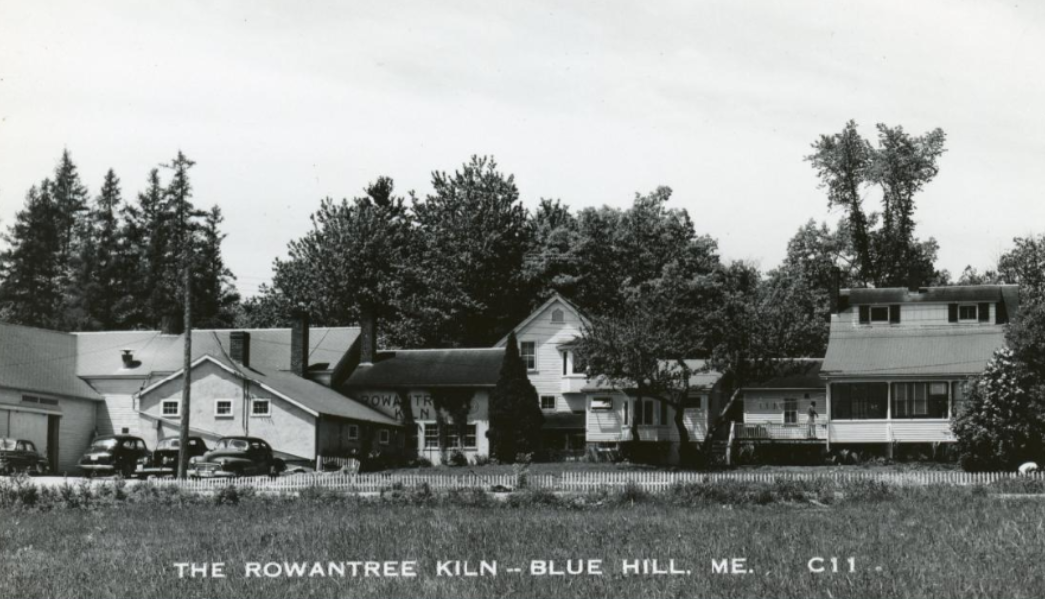
Rowantrees in the mid-1900s. Photo courtesy of the Maine Memory Network.
