

Seahorses and their habitat now on display in Blue Hill
Vulnerable ‘lined’ seahorses, native to the Atlantic Ocean, are part of Shaw Institute’s educational offerings
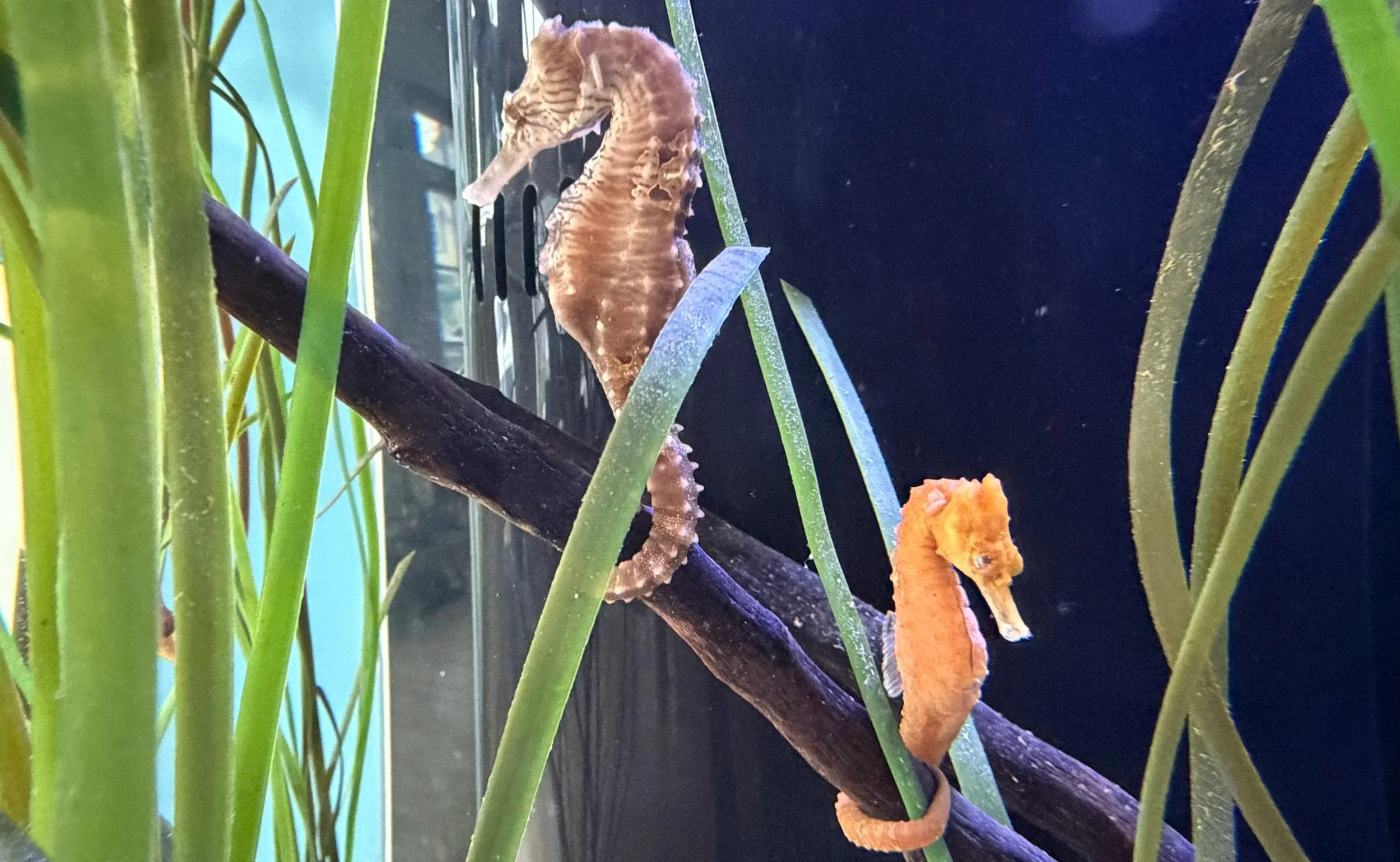
‘Lined’ seahorses, are known for their distinctive markings and that, surprisingly, males of the species that carry and give birth to baby seahorses. Photo courtesy of the Shaw Insitute.
June 24, 2026
By Tricia Thomas
BLUE HILL—Downtown Blue Hill is now home to eight unusual new residents—a group of seahorses that are on display at the Shaw Institute’s Environmental Education Center on Main Street.
The tiny newcomers, gliding around a 70-gallon, salt-water aquarium in the institute’s main exhibit room, are called “lined” seahorses because of their distinctive markings. All males, they arrived in Blue Hill on June 16.
Lined seahorses like the eight that are now on permanent display are native to the Atlantic Ocean, living along eastern coastlines from as far south as Argentina and as far north as Nova Scotia, said Dr. Charlie Rolsky, the institute’s executive director and senior research scientist.
While small in size, the seahorses have a big task ahead of them. On public display from Wednesday through Saturday each week, they’ll play an important role in educating visitors about their increasing rarity and fragility while simultaneously raising awareness about the dire state of their natural habitat.
“We feature sea horses, but the focal point of this exhibit is eelgrass, which is what they depend on. Eelgrass has declined by almost 60 percent in the last few years in Maine, potentially because of climate change, green crabs [which uproot eelgrass as they forage], and nutrient pollution,” Rolsky said.
Eelgrass’ slender, ribbon-like leaves grow from roots under the seabed, and provide gently undulating shelter, camouflage and protection for seahorses and myriad other sea life, including bi-valves such as clams, mussels and oysters, Rolsky said.
Because they’re home to so many sea creatures, eelgrass meadows also provide teeming sources of the food—including zooplankton and tiny crustaceans and fish—that seahorses like to eat.
“Seahorses depend very heavily on eelgrass, as do many other creatures,” Rolsky said. “Our hope is that, if people connect to the seahorses, they’ll then understand that their ecosystem needs to be preserved and saved.”
The seahorses’ timing as tiny educators couldn’t be better. According to an institute press release, the Maine Department of Environmental Protection has reported that eelgrass in Casco Bay declined by roughly 54 percent between 2018 and 2022—shrinking from about 5,000 acres to fewer than 2,300 in just four years. Scientists have called the recent drop in eelgrass “staggering.”
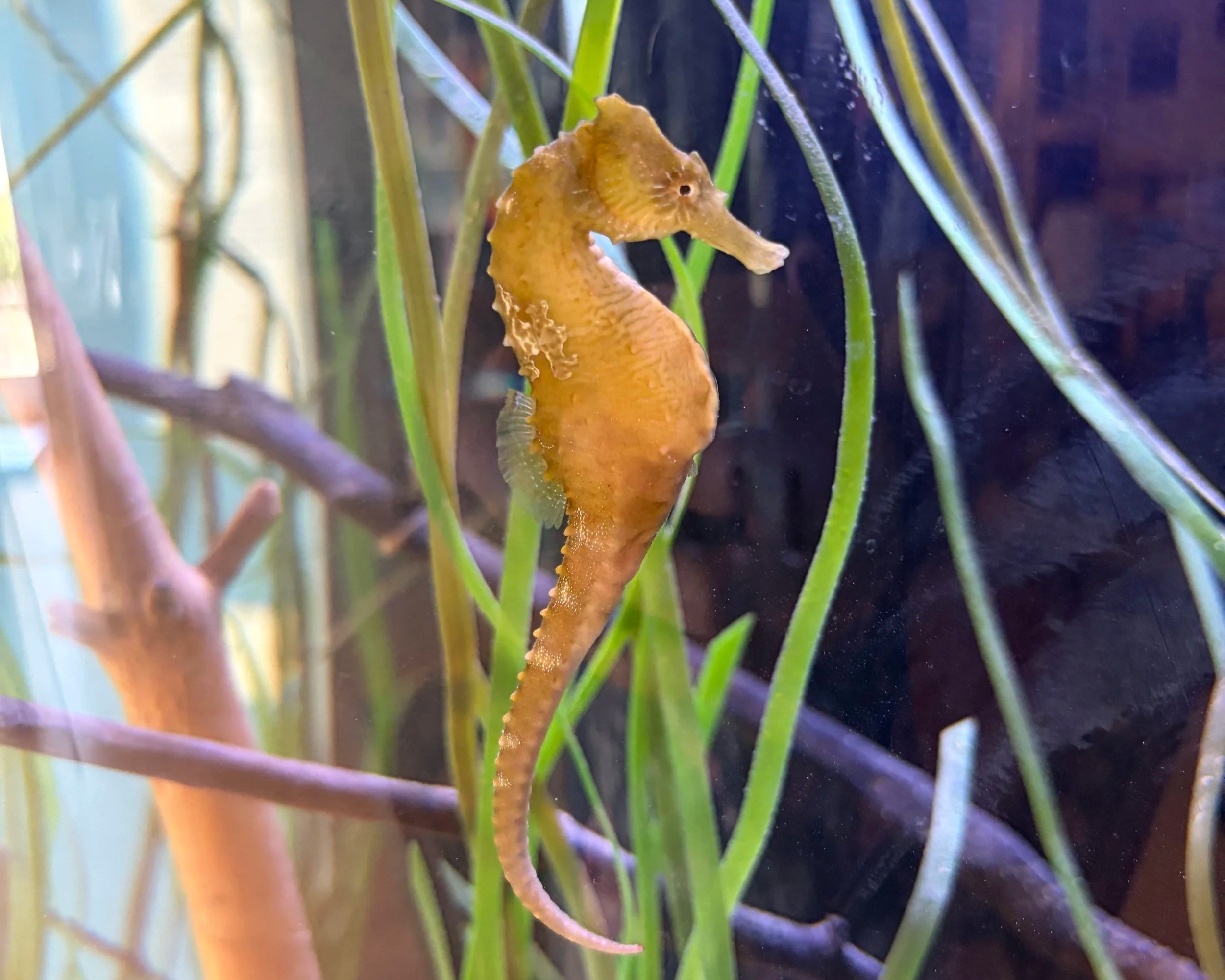
According to Shaw Institute, the new seahorse aquarium is the only one of its kind in the state. To get here, the seahorses were flown overnight from Hawaii. Photo courtesy of the Shaw Institute.
That drop, in turn, is putting the populations of lined seahorses and other sea creatures along the coast in jeopardy, Rolsky said.
“It’s a crisis that affects everything from the food on our plate to the health of our entire ecosystem,” he said.
The species’ vulnerability was a primary factor in the institute’s decision to highlight them, and drove them to procure them from a renowned breeder in Hawaii rather than removing seahorses from the Gulf of Maine. Similarly, the institute opted to fill the aquarium with synthetic eelgrass, rather than removing the endangered plant from the wild, Rolsky added.
The seahorse aquarium is the only one of its kind in the state, Rolsky said. To get here, the seahorses were flown overnight from Hawaii to Portland, Maine, and then driven the rest of the way. So far, they seem to be acclimating well to their new, convex tank, which was funded by donor Clearview Energy. The seahorses soon will be joined by a group of Pipefish, their affable underwater “cousins,” which also thrive in eelgrass, Rolsky said.
In the interim, Rolsky and his staff will be watching the graceful underwater steeds very closely for signs of pregnancy. Surprisingly, it’s the male of the species that carries and gives birth after the female hands over her eggs for fertilization and safekeeping, Rolsky said. The male carries the eggs in a pouch that is similar to a kangaroo’s.
“The males had been around females recently, so there’s a slight chance that one or two of them might be pregnant,” Rolsky said.
The staff will know within several days whether any of the new residents are expectant fathers.
Unlike the underwater creatures in the institute’s popular, 200-gallon touch tank, the seahorses can’t be held or touched.
“They’re just too fragile,” Rolsky explained. “But, I hope that kids will feel an emotional connection to these animals, and understand that seahorses rely 100 percent on this vegetation as a sort of nursery or a cover.”
In addition to the sea horse exhibit and the touch tank, the center features marine mammal skeletons, other interactive exhibits, and lab tours, along with original artwork and a gift shop.
“The whole place is about making an emotional connection to things, and understanding that it’s important that they all stay clean and healthy,” Rolsky said. That’s the goal of all of this.”
The Center is open 10 a.m. to 4 p.m., Wednesday through Saturday. Admission is free, but donations are welcomed “and needed,” Rolsky said. More information is available at shawinstitute.org.