

Bennett calls for revitalizing Maine's manufactured housing industry
Independent who once served as Maine Senate president says incentives will help solve housing shortage of 80,000 homes
EDITOR’S NOTE: The Rising Tide has asked all gubernatorial candidates to complete the following questionnaire. The Rising Tide will publish responses of candidates when received. These profiles are not paid advertisements. They are offered purely as a voter education tool. The Rising Tide does not endorse candidates for any office.
Below are responses from independent candidate Rick Bennett. The primary is June 9.
June 5, 2026
1. Background
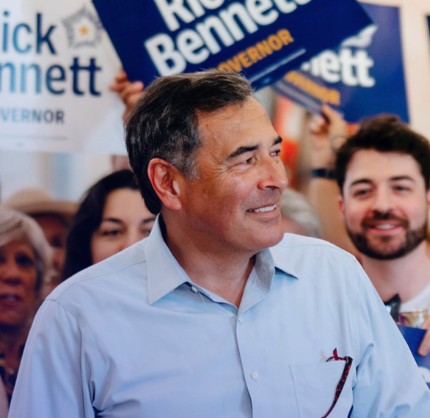
Rick Bennett. Courtesy photo.
Tell us about your background: Where did you grow up and where did you go to school? Tell us about your career (or careers). Why do you want to be governor, and how have your past experiences prepared you for this role?
I grew up in Yarmouth, the son of a public school teacher and a retail sales clerk. My family has been in western Maine for over two centuries. I live in Oxford today with my wife Karen. We have two adult children, and a rescue dog and cat.
I have served nine terms in the Maine Legislature, including as President of the Maine Senate — unanimously elected by my peers through a genuine power-sharing arrangement across party lines. I built and led companies, met payroll, and learned what it actually takes to create jobs in Maine.
I’m running for Governor because our political system is failing us. For a generation, politicians have put their parties ahead of the people and got better at winning arguments than fixing problems. I've done the opposite my whole career, transcending party lines to make life better for Maine people.
I don't answer to a party or special interests. I answer to Mainers. And I'm running to do the one thing the others won't: heal the divide and deliver results.
2. Housing and Affordability
Maine faces rising housing costs, increasing property taxes and a shortage of workforce housing. What specific policies would you pursue in your first two years to make Maine more affordable for working families, young people and seniors?
Housing solutions are a top priority for me because it's the number one problem faced by Mainers and employers. You can't hire if workers can't find a place to live. You can't keep young people here if they can't afford to stay. Older Mainers can’t downsize because there is nowhere for them to go.
Maine needs to build roughly 80,000 more homes to meet demand. I'll revive Maine's manufactured housing industry through production incentives, and conduct a statewide bottleneck audit to find and fix where lawful projects stall, and I will reduce down payment barriers for first-time buyers through state-backed guarantees, and launch direct mortgage support so monthly payments are manageable.
On property taxes, I'd deliver the Property Tax Fairness Credit directly against bills as they arrive, not months later at tax time, and model an income-sensitive cap so no one on a fixed income or struggling to make ends meet gets taxed out of their home. Relief has to be real and reach people when they need it.
3. Rural Maine
Many rural communities are struggling with aging populations, school enrollment declines, workforce shortages and limited access to health care. What is your long-term vision for rural Maine, and how would your administration help small towns remain economically and socially viable? What specifically will you do for rural Maine?
Rural Maine has pronounced affordability challenges, and communities need a genuine state partner that understands the real costs of providing necessary services like schools, emergency services, healthcare systems, and the pressure on property taxes to provide what rural communities need.
The state-local relationship should be built on mutual respect and shared problem-solving, not mandates that drive up local costs without support to match. I pushed back on that pattern in the Legislature, and I'll push back on it as governor.
I’ll fund revenue sharing so towns can deliver services without raising property taxes; provide adequate funding to the counties; expand broadband for remote work, telehealth, and distance learning; and protect forestry, fishing, and farming, the industries that define rural Maine.
4. Education and Workforce Development
Maine has slipped dramatically in delivery of quality education, and now ranks in the bottom 10 states in the nation. What is your plan to reverse this trend?
This disturbing trend demands urgent leadership from the next administration. Literacy and numeracy are non-negotiable foundations — parents expect their kids to learn to read and do math in school, and right now only 1 out of 4 Maine fourth graders read proficiently. Students who can't read by third grade fall behind and stay behind.
I believe that Maine can have the best schools in the country, where every child learns to read, teachers are trusted and supported by strong leaders, and learning is engaging and connected to real opportunity. The state's job is to set clear expectations, provide the resources to meet them, and measure outcomes honestly.
That also means investing in the conditions that make learning possible. Kids who show up hungry, distracted, without healthcare, or in crisis can't learn, and teachers can't be asked to solve that alone. Teachers are paid far below what they are worth in increasingly challenging environments. They deserve better, and so do Maine's kids.
5. Energy
Maine has some of the highest electricity rates in the nation. What is your plan to reduce electricity rates, and will you promise to lower it by a certain amount?
Maine sends more than $4.5 billion out of state every year to pay for imported fossil fuels — roughly $3,300 per Mainer — instead of investing in energy we produce ourselves. That has to change.
My plan targets every part of your electric bill: right-size utility profits so returns flow back to Maine communities, not out of state; create a Maine Generation Authority to build and own renewable energy and storage resources and stabilize prices; and scale weatherization and energy efficiency measures through bond funding, not utility surcharges.
Energy prices are largely set by volatile, global fossil fuel markets, not by governors. But a governor can lead the push for energy independence that breaks Maine free from that uncertainty, and that's exactly what I intend to do.
6. Economy.
Maine has always struggled with a year-round economy. But seasonal states like Florida are booming, thanks to economic development plans that are business friendly and aim to lower income and property taxes. What’s your plan to spur economic development? Do you have any outside-the-box ideas you’d like to propose?
I am bullish on Maine’s future, and we need to be proactive in recruiting businesses and talent to our state. My administration will have positions dedicated solely to bringing in and supporting businesses. Maine's potential is extraordinary and the only thing standing in the way is our broken politics.
My plan starts with affordability as an economic strategy, as well as a moral one. When housing is out of reach, employers can't hire. When young Mainers can't see a path to staying, they leave, and every departure is a loss we can't easily absorb. When businesses face regulatory friction and can't find workers, they go elsewhere. Maine is a very special place. What draws people here to visit is the same thing that draws them to stay and build a life. That's a built-in competitive advantage no other state can manufacture.
7. Trust in Government and Civic Life.
Americans increasingly distrust institutions, including government and the media. What would you do as governor to improve transparency, restore public trust and encourage more civil political dialogue in Maine?
Good government isn't complicated. It’s responsive to the needs of the people it serves.It tells the truth, spends carefully, and accounts for every dollar. It listens before it decides. Good policy too often gets sacrificed to protect political relationships or appease powerful interests. I'm running as an independent because I want to govern as an independent. I will answer to the people of this state, and to no one else.
As Governor I will bring daylight to our democracy. We need to open legislative caucuses to public scrutiny, require real-time lobbyist disclosure, make the state budget readable by anyone, not just insiders, and require agencies to respond to public records requests within 30 days. I will repair our corrupt campaign finance system. Partisan systems reward conflict over compromise and loyalty over results. I’m here to change that and restore trust in our government by showing how it can work.
