

Power surge: Brooklin company sees bright future for electric boats
Hylan & Brown building reputation for a quiet revolution on the water
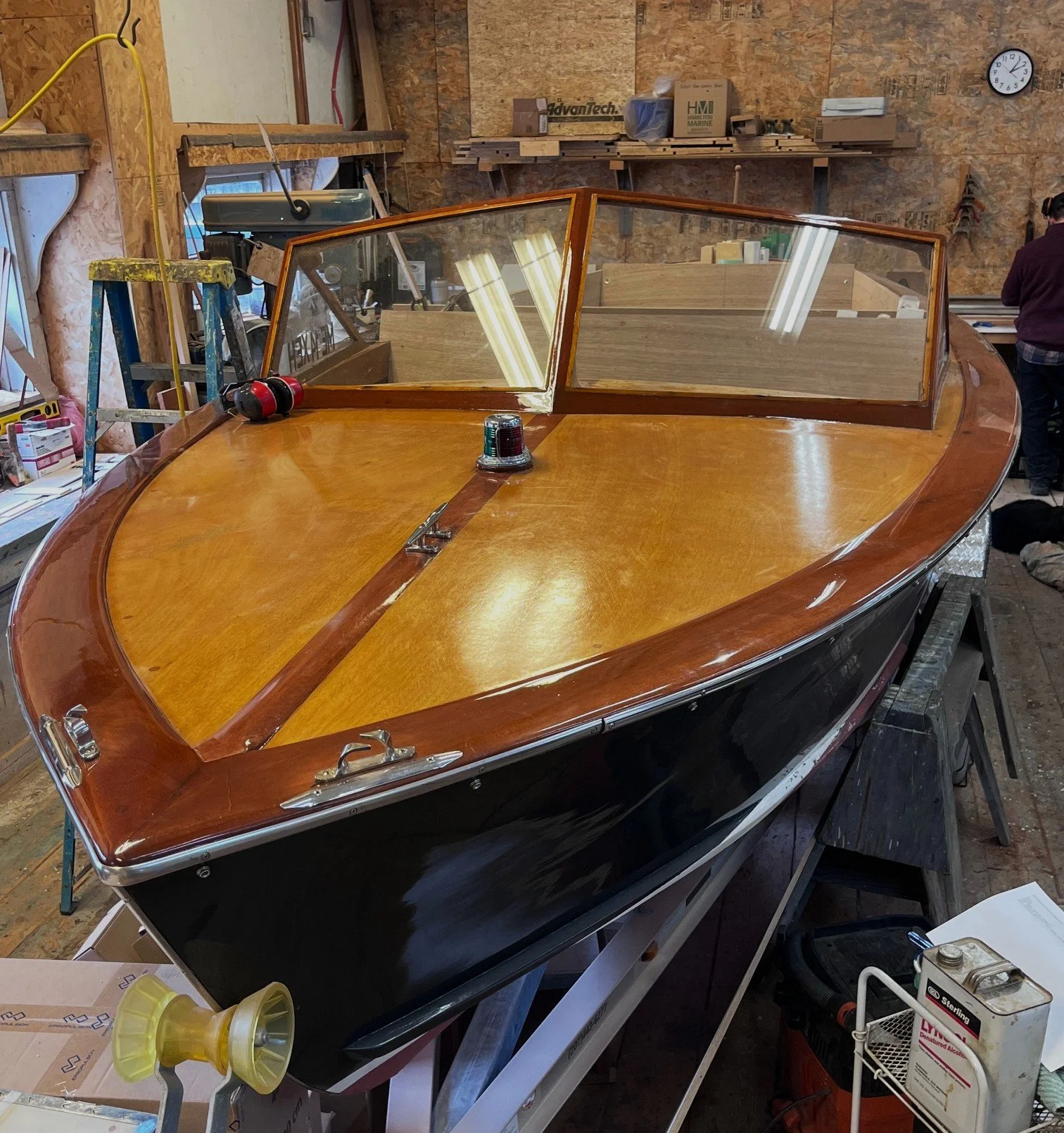
This sleek powerboat is being converted to electric power with a 40-kilowatt motor that will push it to 20 knots or more. Photo by Steele Hays.
March 24, 2026
By Steele Hays
Down a winding gravel road on the east side of Benjamin River Harbor in Brooklin, Hylan & Brown Boatbuilders is quietly building a reputation as one of the most knowledgeable and experienced boat yards in Maine in the design and installation of electric propulsion systems–at a time when market demand for electric-powered boats is surging.
Hylan & Brown’s experience with electric power got started in 2020 with a commission from one of the owners of Irving Oil, building a custom-designed pleasure boat for use on Craig Pond in Orland. When Kenneth Irving sold his house on 483 acres for $8.2 million, the new owner was so smitten by Irving’s boat that he commissioned a similar electric-powered vessel from the boat yard.
“It’s been ticking up pretty steadily since then,” Ellery Brown, one of the boat yard’s two owners, said of the company’s electric power work. “It’s now the main event for our winter work.”
“The big advancement has been solid state batteries,” Brown said. "Lithium batteries changed the game and they’re always making progress, making improvements. Electrification has become mainstream, and the clientele who are finding us are early adopters.”

Co-owner Ellery Brown with Fred, a co-worker's dog. Photo by Steele Hays.
Brown talked at length about the yard’s work, which employs eight additional workers in addition to the owners, in an interview with The Rising Tide. His partner, Doug Hylan, was on vacation and unavailable.
“The aesthetic aspect of the experience is a huge selling point for electric–quiet, smooth, environmentally friendly,” but it may not be a fit for all boat owners, Brown said. To be satisfied with electric power, a boat owner needs to be comfortable moving “at sailboat speed” of six to seven knots, at least much of the time. It’s not that electric-powered boats can’t move fast. They can, but to do so, they need a lot of power and they consume that power quickly. That demands a lot of battery capacity which means weight, which works against speed and performance.
"It isn't really possible to make any general statement about range,” Brown said. “It's really best to talk about each individual boat. A good example is our own yard skift. It has a six kilowatt motor and six kilowatt battery. At full throttle it will run for an hour at about 10 knots, so that's its range, about 10 nautical miles. But if you slow down to half throttle, you can go 5 knots for about three hours. The slower you go, the greater your range."
Hylan & Brown has four electric power installation or conversion projects under way in the yard right now.
In addition to supervising work on individual client projects, Brown is launching a new marine industry event focused on electric-powered boats. He’s attracted two co-sponsors or partners so far and hopes to draw attendees–marine suppliers, boat builders, engine manufacturers and others–from all over the world. The event, called the Electric Watercraft Forum, will be held Oct. 21-23 at Lyman Morse’s rigging shop and in a large tent on the Camden waterfront.
“It’s meant to support Maine boatbuilders generally,” Brown said. “A lot of cutting-edge electric propulsion projects are happening here and the goal is to have a small but really high-quality event.”
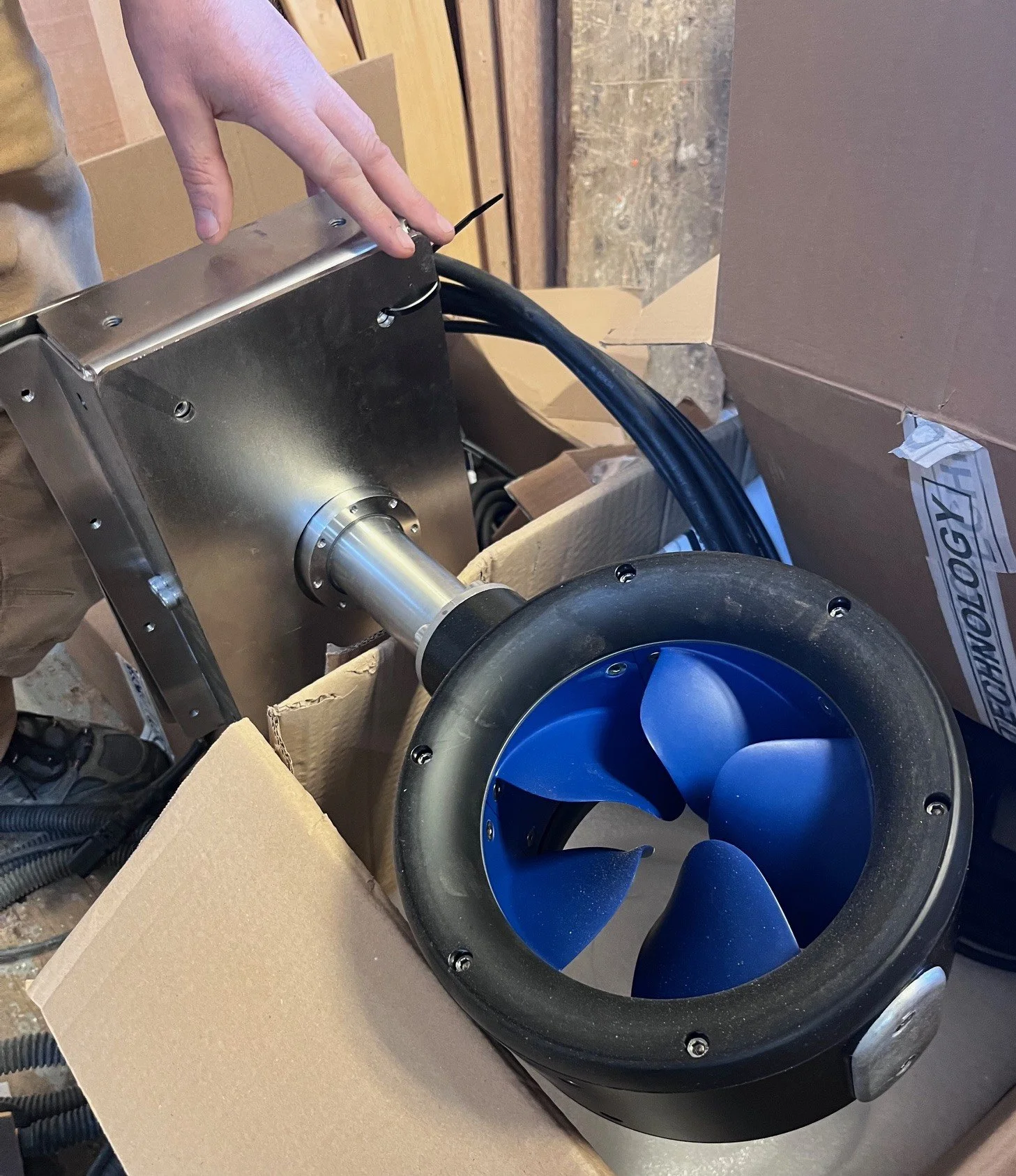
This rim drive cylinder contains both the motor itself and the propeller, which will be mounted below waterline underneath a refitted 110-year old launch, and will serve yacht owners in Buck's Harbor. Photo by Steele Hays.
In addition to advances in battery and solar panel technology, growth is being driven by changing attitudes among boat owners, both pleasure and commercial boaters. The Maine-based Island Institute has made electrification of working waterfront boats a priority and is distributing grant funds to a range of projects that advance that cause. While there has not been much movement yet to electrify Maine’s 5,000-boat lobster fleet, electric power is being explored for a range of commercial uses, such as harbor boats, tenders, launches and aquaculture watercraft.
Brown said that California recently passed legislation providing state funding for public watercraft using electric power, such as ferries, public harbor boats, fire fighting watercraft and others. “That’s a big deal,” he said, one that could help accelerate growth in the market.
One of the boats in Hylan & Brown’s yard will be cruising quietly and probably turning heads in Bucks Harbor this summer: a 1906 Faye & Bowen harbor launch, which will be carrying boat owners to their yachts in the harbor. The electric motor powering the 23-foot boat will actually be below the waterline underneath the boat, using what’s called a rim drive, which is a cylinder roughly a foot in diameter with a multi-blade propeller in the center. The cylinder will pivot on a shaft that comes through the boat’s hull to the control system in the cockpit.
Another eye-catching boat is a sleek Glen-L powerboat being converted from gasoline or diesel power to electric. It will feature a 40-kilowatt outboard, made by a leading Chinese manufacturer under the EPropulsion brand. That engine will be the equivalent of a 60-horsepower gas engine, and is the largest electric engine Hylan & Brown has installed to date, capable of a speed of 20 knots or more. It will be powered by two 400-pound batteries, one tucked under the foredeck and one in the stern, where the gas engine formerly sat.
“We’ve learned some things and have developed some formulas that allow us to predict boat performance with electric power,” Brown said. “We tend to be a little conservative so actual performance has exceeded our predictions every time.”
