

WHEEL WATCH: March Hill – and that ‘safely out to sea’ thing
No matter how cold it is or how hard the wind’s blowing, somewhere, somebody is out in the thick of it

Brian Robbins.
March 16, 2026
By Brian Robbins
The first person I ever heard refer to “March Hill” was Nanny Robbins. I was just a kid and really didn’t think about things in great depth at the time–back then I was mostly concerned about when the next batch of Nanny’s biscuits was coming out of the belly of that old Clarion stove.
Years later, though, I figured out what she was talking about: The hard slog of the year when you’ve had just about enough of winter, but it keeps hanging on, with roaring roundhouse rights (storms that vacillate between full-on blizzards and periods of freezing rain) and quick, sneaky punches (that rotten one-two combo of early morning black ice and frost heaves, for instance).
If you could make it up March Hill without your spirit being totally broken, then chances were good you’d last out the winter.
I can vouch for the fact that March Hill is a real thing: I have science on my side.
Well, maybe not science, but I did do a study years ago. Ok, maybe not a study as such–I mean, I didn’t have a grant or anything. But I did witness the phenomenon of March Hill first hand.
Back in the late 1970s, I was renting a little house across the street from the funeral parlor in Stonington. I didn’t require much for a space of my own and that house was just right–walking distance to Bartlett’s Market (just down over the hill) and plenty of parking space in the funeral home lot (as long as there wasn’t a service; if there was activity over there, I’d tuck my vehicle on my side of the street up against the house). It was a place to be if I wasn’t on an offshore lobster trip with my brother Stevie.
At times, I’d have company over, many of them fellow fishermen, so the socializing was very much in sync with the weather. A side note: A stroke of genius (for me at the time) inspired the stocking of my cupboard with Mason jars for drinking glasses–cheap, yet heavy duty–and the gatherings at the little house across from the funeral parlor became known, with apologies and all due respect to the world’s oldest and largest fraternity, as “Mason meetings.”
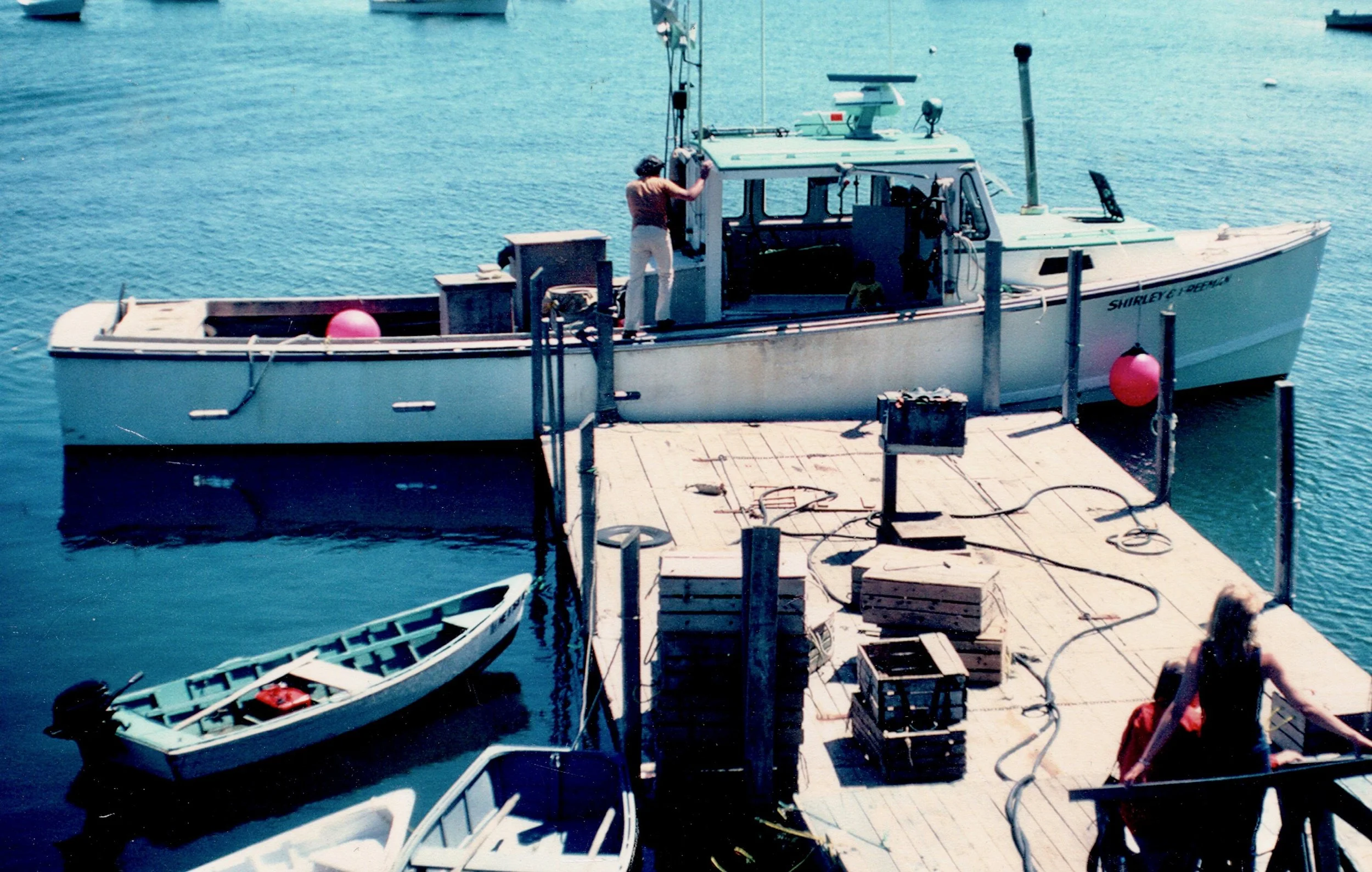
The next time someone says a storm is “safely out to sea,” writes Wheel Watch columnist Brian Robbins, remember that someone is somewhere out there in the thick of it, like his brother Stevie Robbins’ Shirley & Freeman, which fished for lobsters 180 miles offshore–an 18-hour steam from Stonington to the gear. The 44-foot vessel is seen here in the late 1970s or early 1980s tied up at Clyde Conary’s lobster car, now Greenhead Lobster. Photo courtesy of Brian Robbins.
So it wasn’t just me who was aware of the activity at the funeral parlor. As mentioned, my buddies had to keep clear of the big parking lot when there were visiting hours or an actual service going on.
And we couldn’t help but notice something over the several 12-month cycles I lived there. There often was an uptick in business at the funeral home during the month of March. And the harder the winter, the busier March was. Maybe you’d have the heft of the snowfall and bitter cold in January and February, but if there wasn’t a break to be had in March, well, I guess folks had just had enough.
March Hill was just too much of a climb.
While we’re talking about weather, I’d like to mention a pet peeve of mine: “The storm has gone safely out to sea.”
I guarantee anyone who uses that phrase has never been out to sea when said storm arrived there.
I remember hearing those words crackling out of the speaker of the VHF radio just as a sea crashed over top of our old 44’ Shirley & Freeman, thanking the Great Spirits that we’d replaced the original safety-glass-mounted-in-rubber-frame windows with Lexan that was through-bolted just weeks before.
Thankfully, the old WOU forecast that was broadcast over the single sideband radio through the Boston Marine Operator years ago (the only report we could get when we were down in Georges Basin) was generated specifically for mariners, so they knew better than to use that phrase.
Remember this: Someone is always out in that “safely out to sea” space. Thanksgiving, Christmas, and no matter how cold it is or how hard the wind’s blowing, somewhere, somebody is out.
Whether they misjudged the weather and made one tow too many or maybe they’re having engine trouble and couldn’t outrun the weather...somebody is always out.
Think about that the next time you hear the weather person talk about “safely out to sea.”
And good luck with March Hill.
—Robbins, who grew up in Stonington and now lives in Nobleboro, writes his monthly column “Wheel Watch” for The Rising Tide.
