

Local farmers gear up for farm-to-table holidays
These three couples are some of the area’s best-known farmers. And none of them even grew up on a farm.
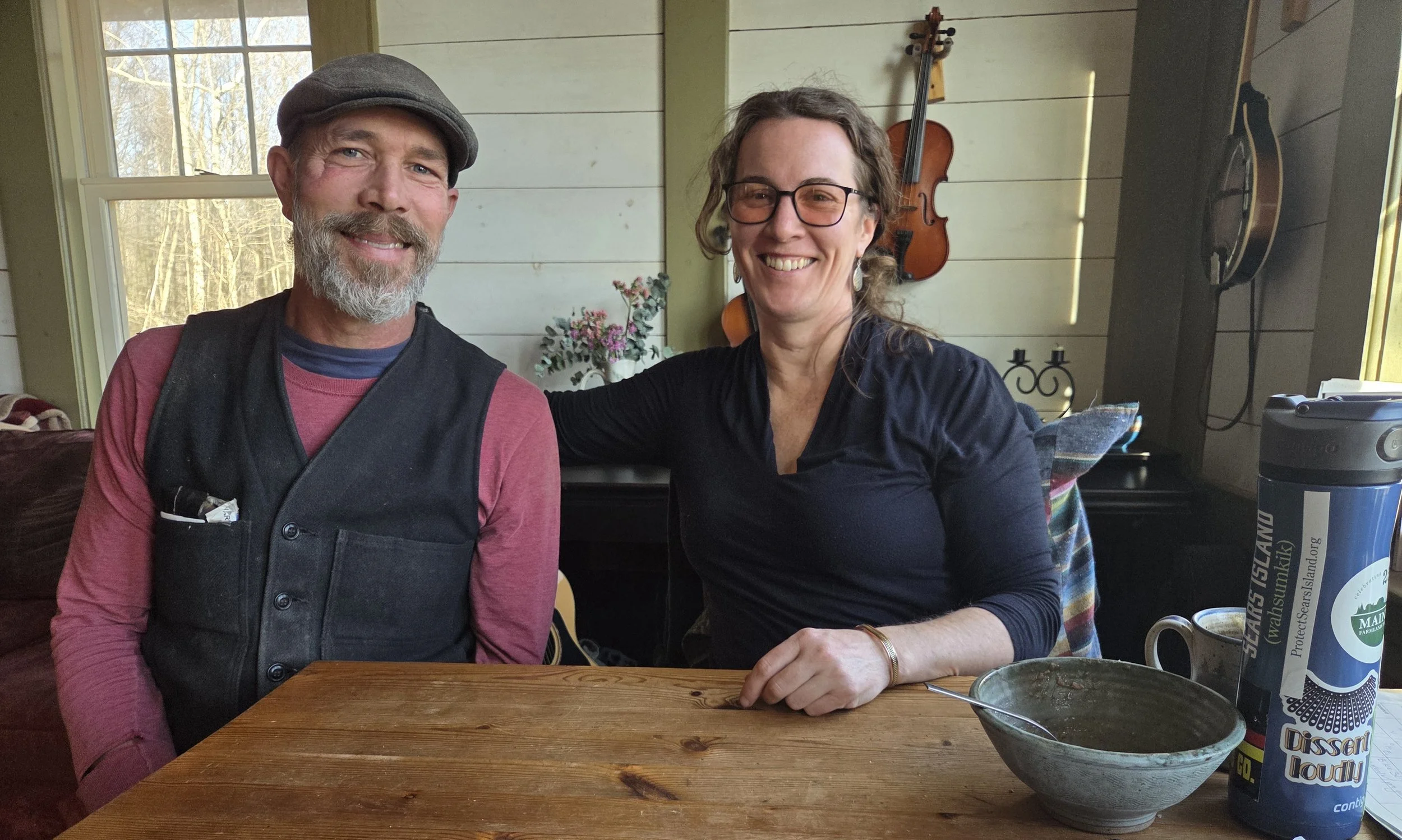
Phil and Heather Retberg of Quill’s End Farm in Penobscot, named for the porcupines that once inhabited their home. Photo by John Epstein.
By John Epstein
With the winter holidays fast approaching along with thoughts of dining tables laden with harvest foods, The Rising Tide decided to check in with some of the local farms who provide us with holiday fare
In addition to the commonality of enjoying the farming life, they also share another trait: None of these farmers actually grew up on farms themselves, learning instead from the generations before them and the advice of others.
Rainbow Farm
Along Route 15 and just over the Penobscot line after entering Orland, a farm presents a tableau reminiscent of the 19th century.

Noah and Lorelei Cimeno of Rainbow Farm. Photo by John Epstein.
On 210 acres of rolling fields and pasture, Rainbow Farm’s young owners, Noah and Lorelei Cimeno, raise Hereford, Black Angus and the distinctive-looking Highland cattle, as well as heirloom white Cheviot and multi-hued Icelandic sheep. Mixed breed sows and a huge Berkshire boar named Rocky root around in pens set up near wooded areas. Depending on the time of year, turkeys and chickens can be seen pecking around in large enclosures. All the while, three huge Great Pyrenees dogs keep coyotes and other predators at bay.
The couple raise 26 cattle, 60 pigs and 50 sheep a year.
“All are raised for meat,” Lorelei says. The farm is a provisioner for several upscale Maine restaurants, including the Brooklin Inn, Sammy’s Deluxe in Rockland, and Northeast Harbor’s Copita.
But as Thanksgiving approaches, it’s mostly about turkeys. “We’ve got 143 free-range turkeys in the freezers right now, ready to sell,” Lorelei says. At Christmas time, the farm will sell plenty of beef and pork roasts, too. She and her husband are certified to butcher their poultry, but send their cattle, sheep and pigs to licensed butchers.
“We also sell lots of squash, garlic, carrots and beets at this time of year at the Blue Hill Winter Market on Saturdays,” Lorelei says. Their crops are grown organically on one-acre tracts that they rotate annually, as well as in greenhouses.
Rainbow Farm also has a farmstand on the premises, run on an honor system, where the couple sells their meats and vegetables as well as products from other farms and local provisioners, including homemade pickles and spiced beets.
Neither of the Cimenos grew up on a working farm.
“Noah always loved farm animals and raised goats when he was kid,” Lorelei said. “He learned to farm from other farmers,” she added.
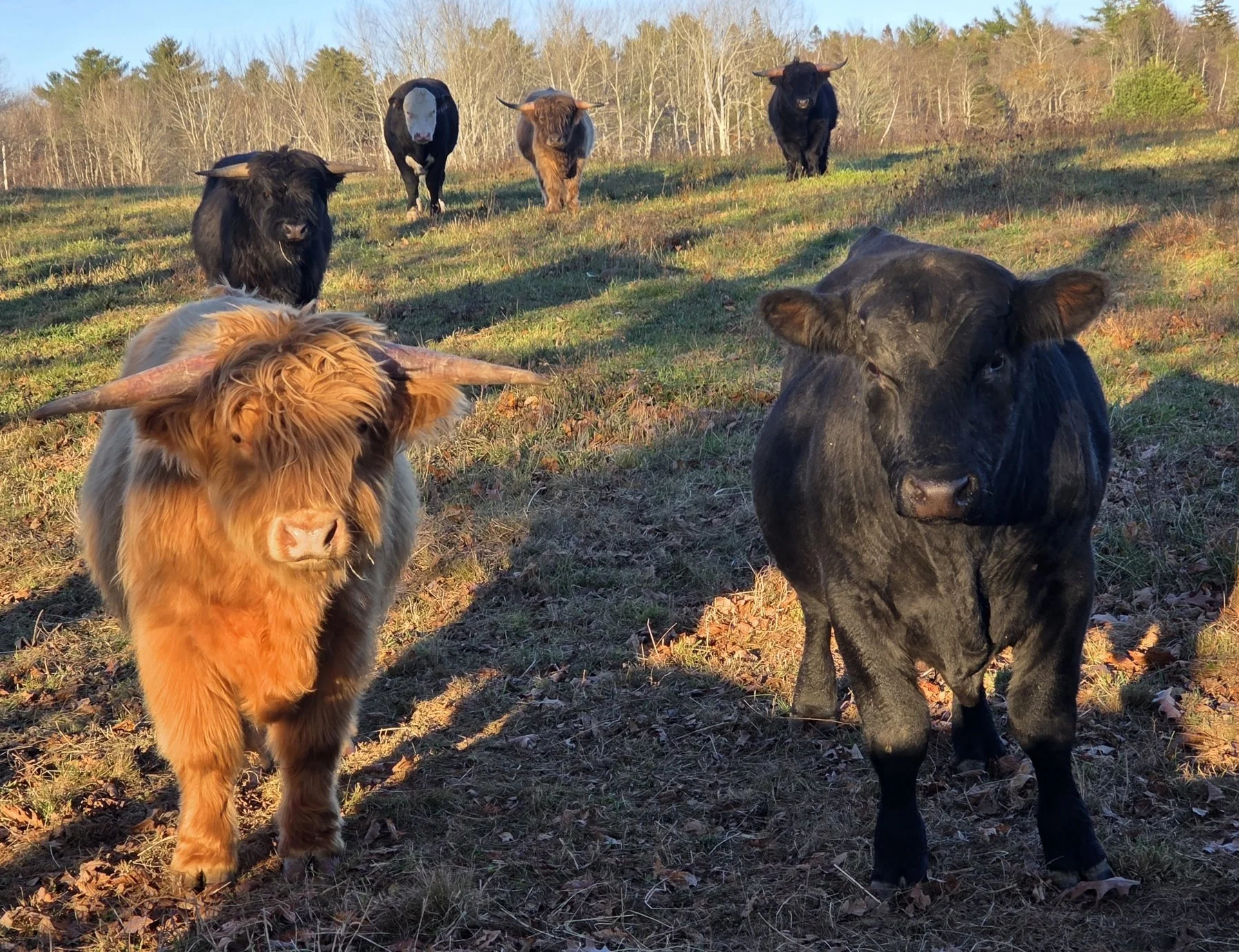
Cattle at Rainbow Farm. Photo by John Epstein.
When she met Noah through mutual friends, Lorelei was a professional gardener who had apprenticed at a farm in Vermont, and Noah was farming leased land near Bar Harbor. The couple married in 2018 and bought 25 acres of farmable land in Stockton Springs. There they built a house, cultivated a small farm and had their son, Amanzo.
The Cimenos sold that farmstead in 2021 and used the proceeds to help buy an Orland hayfield with bordering woods that has become Rainbow Farm. With Lorelei’s assistance, Noah–using lumber milled from trees on their property–constructed a salt-box style house, as well as multiple barn structures and three greenhouses. Amanzo, now 6, is starting to help with the chores.
Quill’s End Farm
Just south of Rainbow Farm on Route 15 in North Penobscot is Quill’s End Farm, 105-acres of mixed pasture and woods owned and operated by Phil and Heather Retberg. There, for the better part of 20 years, they have raised cows, goats, pigs, and chickens and grown fruit and vegetables, making a living selling products from the farm.
The couple runs a farm store attached to their residence. They also sell their farm products at buying clubs in the area, including one at Fair Mount Farm across from the Blue Hill Fairgrounds on Saturdays.
“Right now, we have lots of what you need for a Thanksgiving meal–hams, pumpkins, squash, garlic, potatoes, and heavy cream,” Heather said. The Retbergs also will soon be selling plenty of pork roasts and veal for Christmas dinners.
“We do pop ups on Fridays where we offer baked goods made in our kitchen,” said Heather, who gets baking help from her Brooksville friend, Anna Trowbridge.
The Retbergs did not come from farming families before choosing a life in agriculture. Phil and Heather knew each other in high school in Michigan and later met up in Minnesota when they attended colleges near each other.
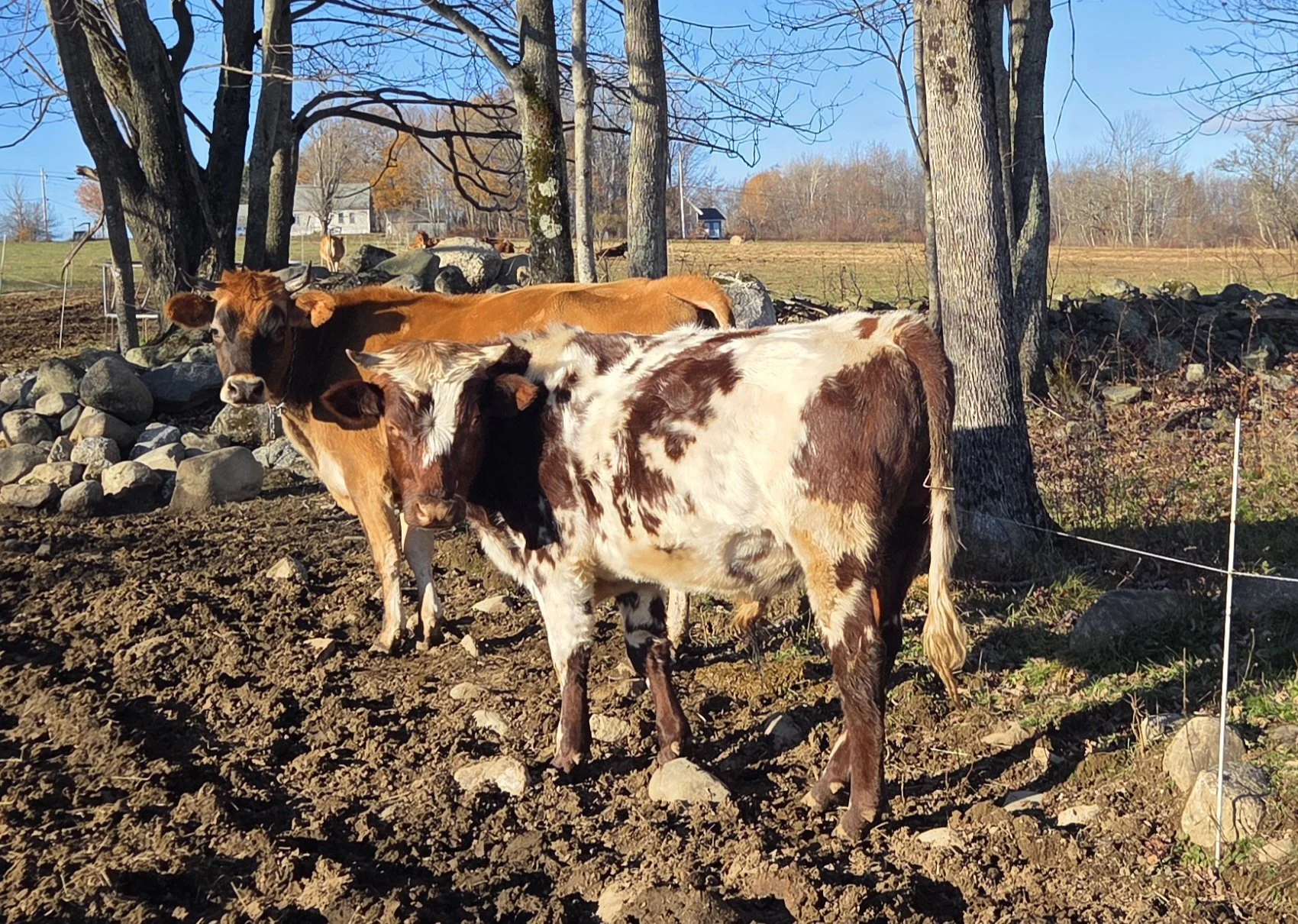
A cow and bull at Quill’s End Farm in Penobscot. Photo by John Epstein.
“We started farming in Lonsdale, Minnesota,” said Phil, who had read a lot of books about agriculture and animal husbandry and talked to many old farmers. “Then I jumped right off the deep end.”
The couple made their way east to Maine, first living in Brooksville. Phil worked as a carpenter and a contractor, but they were looking to farm.
“We thought a farm would be a great place to have kids,” Heather said.
In 2004, the couple purchased from the late Paul Birdsall, founder of Horsepower Farm, a dormant farmstead that had been abandoned for 30 years.
“The farmhouse had a lot of creatures living there, especially porcupines,” Heather said. After clearing out the animal squatters, the Retberg’s came up with their name for the farm–Quill’s End.
Phil rebuilt the farmhouse, which was then moved to a better site on the farmstead. He constructed a barn and out buildings and cleared land to open up enough pasture acreage for the Jersey/Guernsey/Shorthorn cross-bred cows and veal calves that he and Heather raised, along with Alpine and Saanen goats. He also built pens for the Gloucestershire Old Spot pigs and coops for the chickens.
Along the way Phil and Heather’s farm did become a great place to have children. They raised three, all of whom grew up happily involved in the farm’s day to day work. Alexander, who became a carpenter like his father, is now building a cabin in which to live on the farm. Benjamin, who has studied agricultural science, has planted a three-acre orchard of various fruit and nut trees, and has been plowing the fields with the Belgian and Percheron draft horses stabled on the farm. Carolyn, now away at music school in Sweden, for many years tended and milked the goats and made dairy products from their milk.
The Retberg’s believe small farms underpin a healthy society, but it is hard work.
“We work 90 hours a week,” Phil said.
Their family farm is in conservation trust and can’t be turned into tract housing. To bring wholesome food to their community, they maintain a food security fund supported by donations, which is available to hungry folks who are struggling financially.
The Roaring Lion Farm and Market
On Route 175 in Sedgwick, on a ridge overlooking fields and woods, The Roaring Lion Farm and Market bustles with energy on weekends. There, owners Arianna and Colin Smorawski cook and serve breakfasts in their storefront space on Saturday and Sunday mornings and burgers on Saturday evenings.
“On Thanksgiving weekend, we’re really busy,” said Arianna, who also serves as a board member of The Rising Tide. “Lots of people here have family visiting for the holiday and they want to go out and have breakfast or have burgers together on Saturday.”
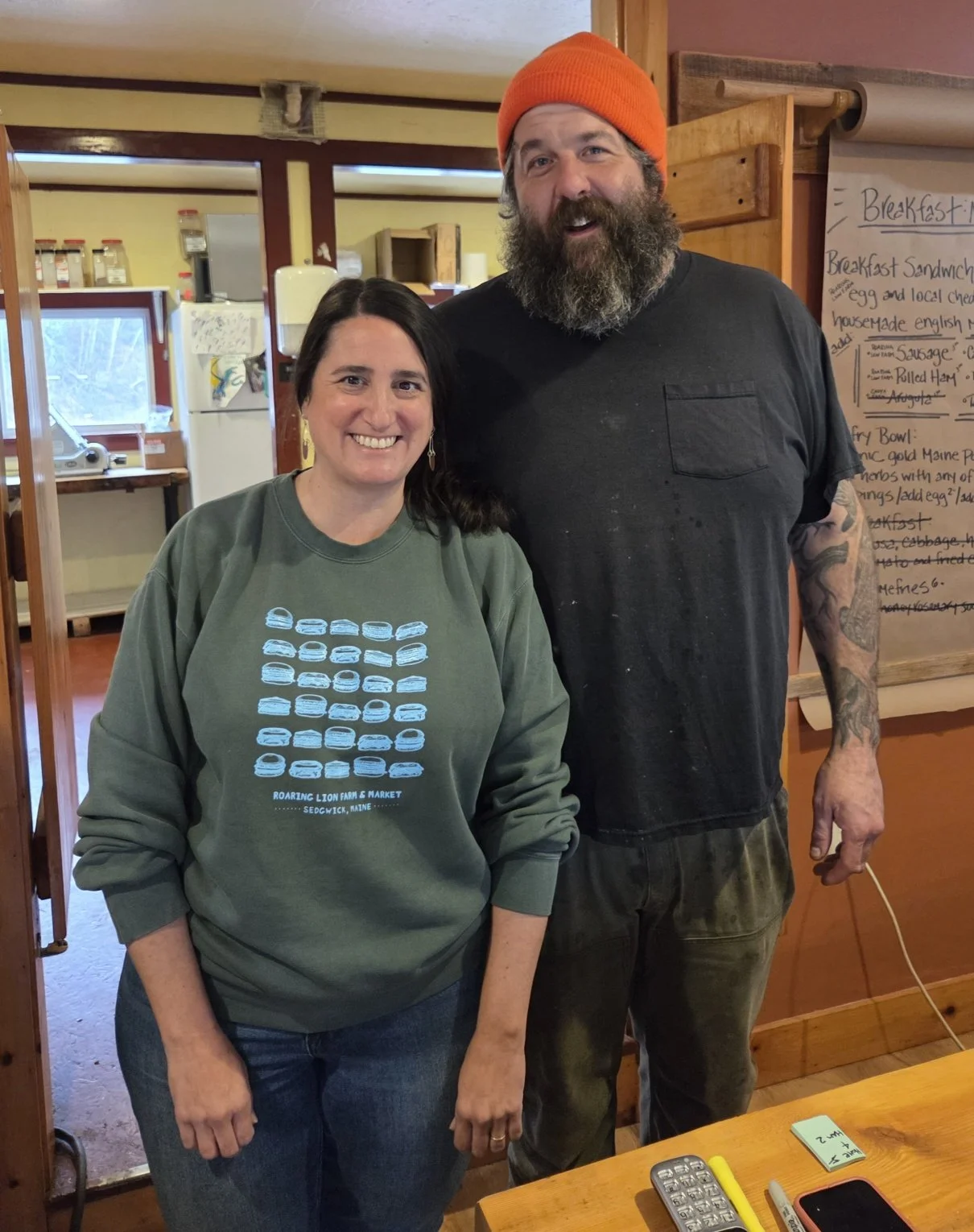
Arianna and Colin Smorawski, whose burger nights at their adjacent restaurant is a crowd-pleaser. Photo courtesy of Roaring Lion Farm.
The key ingredients for these meals come from the Smorawskis’ 95-acre organic farm, bought in 2019, that slopes down to the Bagaduce River from behind the market. There the couple annually raise 10 to 16 Hereford, Angus, and Murray Grey cattle, 40 to 60 Meishan pigs, and 15 to 20 Katahdin sheep. “All raised for meat,” she said. They expect to sell plenty of custom cuts at Christmas time.
“We also use our pork to make sausage for our breakfasts. It’s really good,” Arianna said.
The farm has 60 laying hens that provide the eggs to go along with the sausage. In addition, they cultivate a large plot of land to grow the potatoes and onions they use for their home fries and hand-cut French fries.
Before establishing The Roaring Lion Farm in Sedgwick, the farming couple owned a successful 97-acre farm near Rumsford of the same name. Arianna said that the earlier farm got its name from the roaring sounds emanating from a cliff behind the farmhouse during thunderstorms. Since they already had a good reputation as a provisioner for restaurants in Portland, they decided to continue the name on the Blue Hill Peninsula, farming land that hadn’t been used for agriculture since the 19th century.
Neither Arianna nor Colin grew up on farms. They learned about agriculture helping a friend on a farm in Vermont, reading about farming techniques, and asking older farmers for advice. Their honed skills are reflected in their success.
“Every year since we’ve opened, we break our sales records from the year before,” Arianna said.
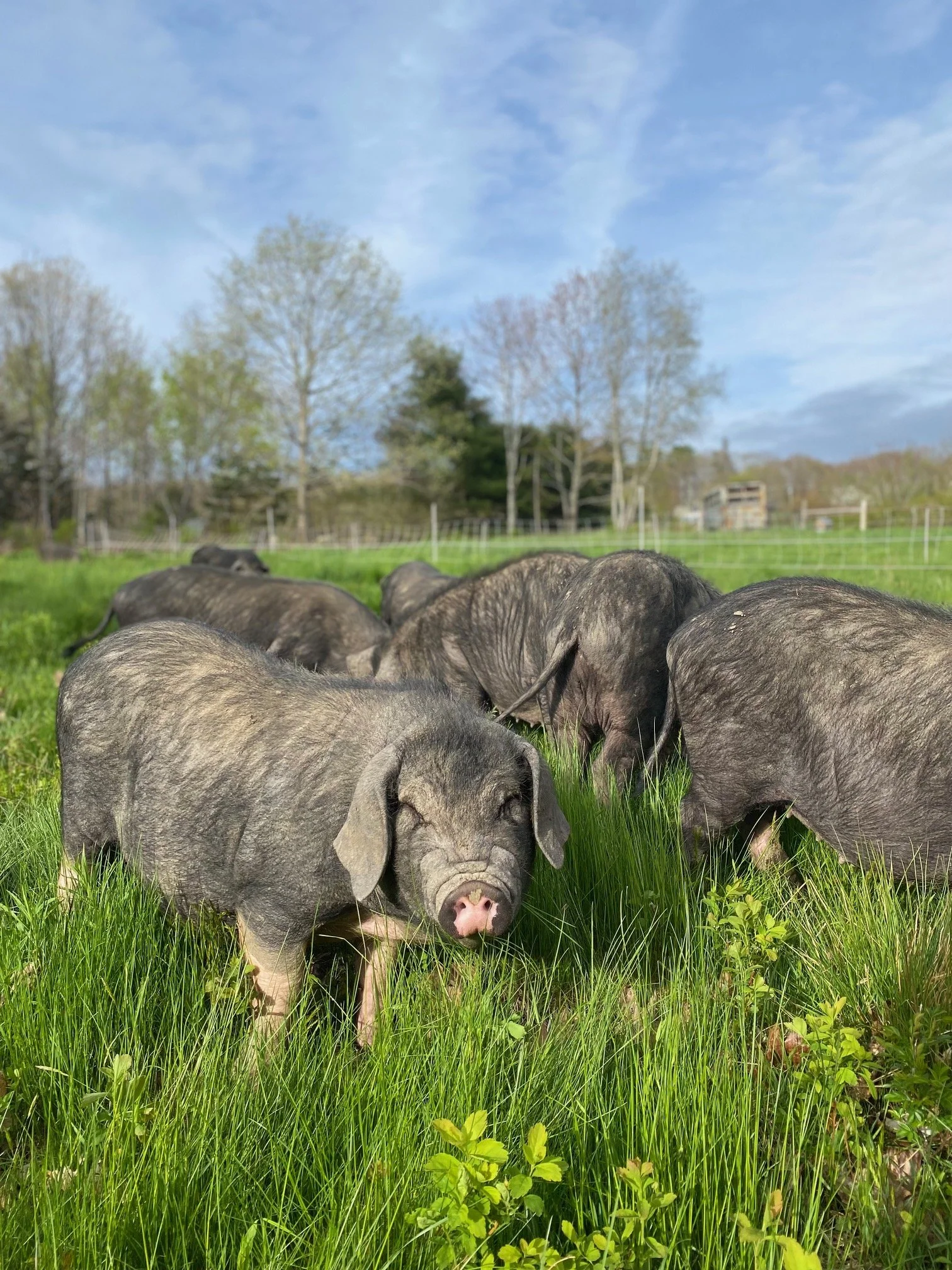
Meishan pigs at The Roaring Lion Farm. Photo courtesy of Roaring Lion.
