

Task force starts with the numbers to tackle housing problem on Island
Draft housing report shows results only 4 in 10 houses are affordable for median income residents, while 50% of surveyed Island businesses now provide housing
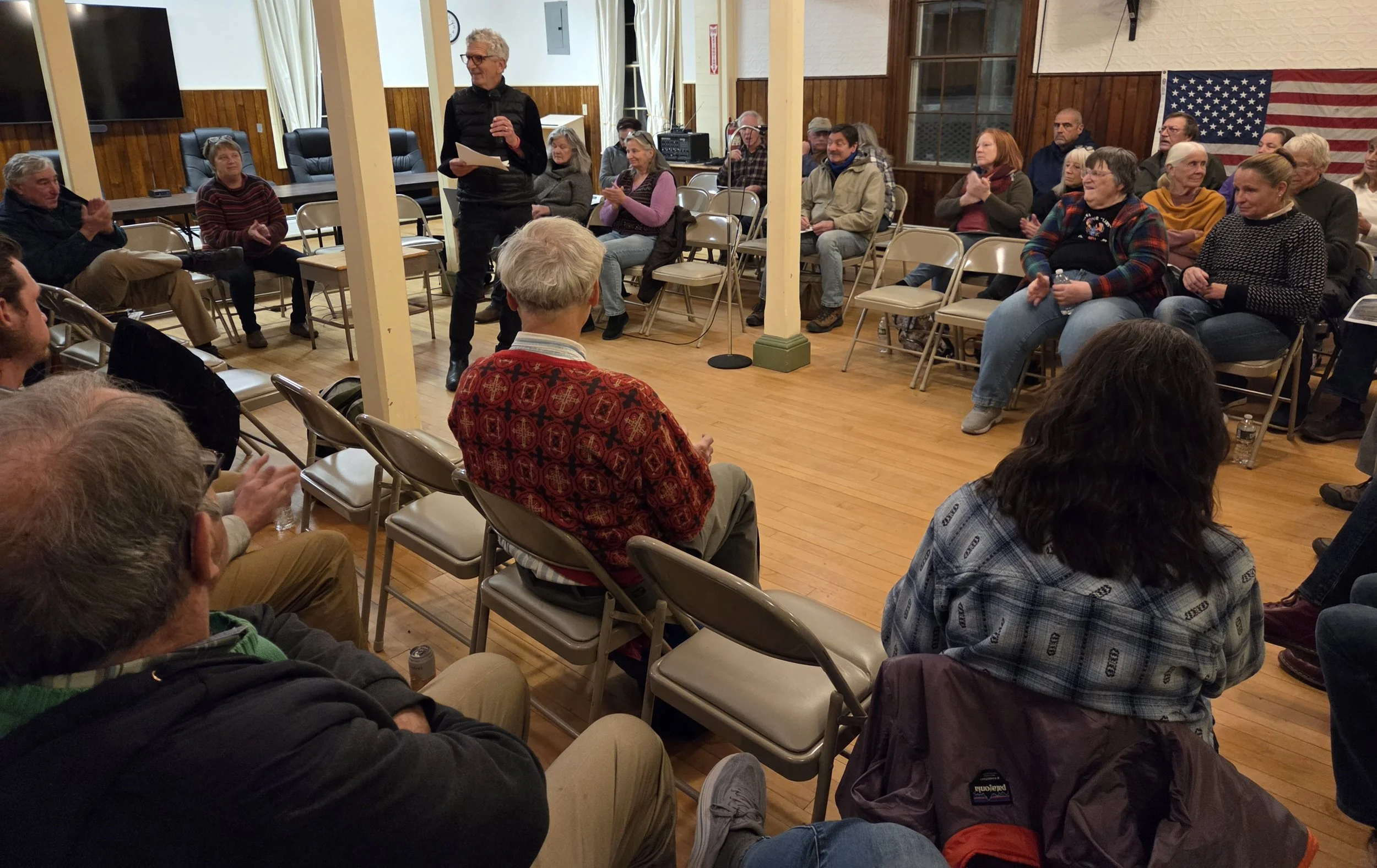
Stuart Kestenbaum, chair of the Interlocal Housing Task Force, addresses the Talk of the Towns' audience in Stonington on Nov. 19. Photo by John Epstein.
By John Epstein
A little over a year ago, the towns of Stonington and Deer Isle agreed to form a special advisory group to develop remedies for the island’s critical shortage of affordable housing. The resulting Interlocal Housing Task Force–a dozen people from the island’s two towns with a wide range of relevant professional skills and experience–met frequently over the next 12 months to gather data and develop strategies to address the housing challenge.
At a Talk of the Towns event held Nov. 19 in Stonington’s Town Hall, over 50 people met to discuss the task force’s findings, which are outlined in a draft 25-page report provided to The Rising Tide.
Linda Nelson, Stonington’s Economic & Community Development Director, opened the discussion. “We know what the problem is. Now is the time for action,” she said.
Some not-so-fun facts about the island’s housing challenges
Before getting to some ideas for solutions, Nelson and the task force’s chair, Stuart Kestenbaum, shared data about several concerning housing trends and their repercussions on the island’s economy.
“Maine has the highest percentage of dwellings that are second homes in the United States,” Nelson said. Citing the draft report, she noted that 46% of the homes in Deer Isle and 42% in Stonington are seasonally occupied, with most sitting vacant in the winter months. The draft report stated that one in 10 people who work on the island have to drive at least 50 miles to get to work because they can’t afford housing on the island.
Kestenbaum, a nonprofit consultant and former director of the Haystack School of Crafts, mentioned an analysis conducted by Ned Hill, an economist on the task force who interviewed 33 employers on the island who had three or more workers.
“He learned that the employers could keep their longtime workers, but they had a hard time keeping new ones because they couldn’t find housing on the island,” Kestenbaum said. Hill estimated that the 33 businesses needed 102 more employees, but couldn’t attract that number of workers because of the housing shortage.
“That’s just those 33 businesses. It doesn’t include smaller ones on the island,” Kestenbaum added.
The draft report found that “[n]early 50% of surveyed employers now provide some form of year-round housing or seasonal housing to their employees.” The report also noted that the housing market on the island has tightened “with only 39% of homes [being] affordable to a median-income household.” The median house price in Hancock County is $350,000.
Kestenbaum pointed out that the unstable housing situation impacts the student population in the schools when parents can’t find year-round housing on the island. The report advises that “[w]ithout expanding access to stable and affordable homes, local employers will continue to face workforce shortages, and the long-term resilience of the island’s year-round community will remain at risk.”
An assortment of solutions
Kestenbaum and Nelson opened up the discussion to talk with those organizations who had spearheaded successful efforts at building affordable housing in the region.
Sherry Billings, executive director of Island Housing Trust on Mount Desert Island described methods her not-for-profit has used to help working families buy homes in her area.
“We’ve built houses that we sell to people for $320,000 that cost us $600,000 to build,” she said. Billings said that her organization funds the construction with donations from foundations. Prospective buyers must be employed in the area and have incomes within a median range for Mount Desert Island.
“It’s a community investment we have to make,” Billings said. “To keep the property affordable in the future we have covenants written into the sales agreements that cap the price a buyer can sell the house for in the future.” Billings also said that covenant restrictions apply to the next buyer who would also have to fall within the median income range required by the trust.
Another strategy the trust uses is to sell donated land for a small sum to someone seeking affordable housing. That allows the landowner to have sufficient equity to receive a mortgage for the house that the trust then builds on the property.
“We do have land on the island owned by people with the capacity to donate, which they might do if you talk about how important housing is for the community,” Nelson said. “I hope you all leave here tonight as evangelists,” she joked.
Others in the audience mentioned that landowners qualify for tax deductions if they donate land.
Island Workforce Housing, a Deer Isle-based nonprofit, has had recent success on the island building affordable housing. The land conservation organization, Island Heritage Trust, provided the land on Deer Isle and IWH built rental housing there for island workers, a development known as Oliver’s Ridge.
“We were able to build five stick-built buildings containing 10 apartments during Covid,” said Pamela Dewell, IWH’s executive director and a member of the Task Force. “We fundraised two-thirds of the cost and got a conventional mortgage for the one-third,” she added. Dewell said the rents are $700 to $1300 monthly depending on whether the apartment is a one- or two-bedroom unit, and the tenants must earn between 70 and 120 percent of the island’s median income.
Dewell said there are no time limits on the rentals, but some people have moved out.
“We are looking for turnover, hoping that people will save money to buy a house and move out after three to five years,” she said.
Median incomes can vary from town to town. One audience member said that, across Hancock County, the median income is $67,000 for one person, $77,000 for two people, and $96,000 for a family of four. Hill, the task force economist, said those median incomes are “a little higher on the island,” he said, referring to Deer Isle.
Island Workforce Housing is now developing affordable housing on land adjacent to Cemetery Road in Stonington. The new development is named Thurlow’s Way.
Thinking outside the box
Nelson said it is important to look at a mix of solutions.
“We can’t just build our way out of this problem,” she said.
That is something the draft report acknowledges, providing other creative solutions for expanding housing to keep more workers and their families on the island. Among the ideas: converting existing structures into housing, such as the Homeport project that is turning the former Island Nursing Home into senior living apartments; configuring land use and zoning restrictions so people can build additional dwellings on their land; developing sites for manufactured, mobile and RV homes in mixed-income neighborhoods; and encouraging owners who rarely occupy their residences to allow their properties to be used for year-round housing.
According to Kestenbaum, the final Housing Task Force Report will be available to the public by the end of November. A key request in the report is for the two island towns to each provide $20,000 to fund a housing manager to help implement the actions recommended by the task force.
