

GSA announces new cell phone policy
Students mixed on the "bell-to-bell" ban for student devices
Aug. 25, 2026
By Jessi Hardy
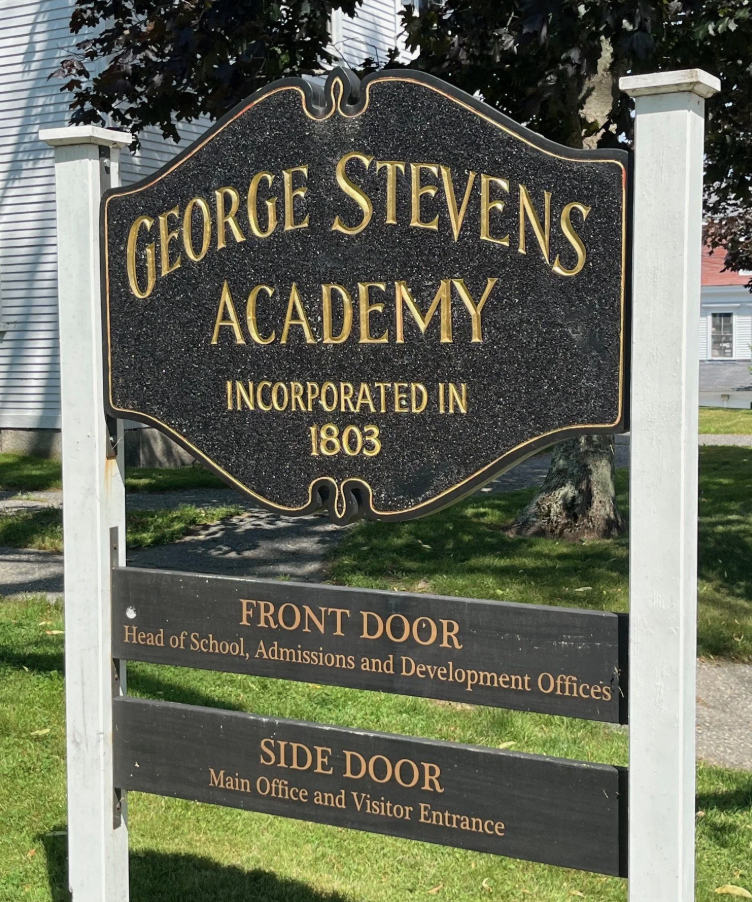
GSA students will leave their devices outside of the classroom. File photo.
For the 2026-27 school year, George Stevens Academy is implementing a cell phone ban. In compliance with a May 2026 directive from the Maine Department of Education, the school is launching a strict "bell-to-bell" ban on personal electronic devices.
The mandate, effective Aug. 1, 2026, requires all students to power off and stow personal devices—including phones, smartwatches, earbuds, headphones and smart glasses—in their lockers from the first bell of the day until the final dismissal bell.
"Our goal is straightforward: we want every student fully present in the classroom, focused on their teachers and each other rather than a screen," the administration stated in a recent email to families. The ban aims to limit digital distractions, increase student interaction, and strengthen the sense of community within GSA, school officials say.
Other area schools have also enacted bans. Deer Isle-Stonington schools recently adopted a policy with clear consequences for not abiding by the ban. Bucksport and Orland, which last year allowed their students to access their phones at lunch, will now have a “bell to bell” policy of no phones allowed during the school day per state law, according Josh Tripp, the superintendent for RSU 25.
For some students, the cell phone ban raises questions about the future of digital projects. Asa Alley-Neblett, an incoming junior at GSA, said that in classes like Intro to Literature, phones were used as creative tools.
“We made a lot of short films... we used our phones to record and edit for these projects, making them essential,” Alley-Neblett said. “With this ban bill, unless there are some workarounds, we will no longer be able to do these fun, creative projects, and that is really sad”.
Others express concern over the social adjustment of a device-free campus. Incoming junior Dean McBride emphasized the reliance students have on their devices for personal connectivity.
“Banning them completely is very unnecessary,” McBride said.
Gilbert Rieff, a rising sophomore at GSA, said that he is supportive of the ban.
“Honestly, I think it’s a pretty good idea, because I do, quite often, see people on their phone all the time during school. And I think it would be great to have more time to talk to others, and for students to engage,” Rieff said.
However, Rieff does have concerns about the logistics of phone storage and GSA’s tight bus schedule. Sometimes students have just three minutes to get from their last class to their bus at the end of the school day he said.
“Buses leave really quickly… I know I’ve missed the bus just having to go back and get something. So if everybody has to go for their phones in lockers all the time, there could be a lot more bus-missing,” Rieff said. [Full disclosure: Rieff contributes to The Rising Tide as a sports writer.]
To ensure the transition is as smooth as possible, the school has outlined specific storage protocols:
Morning Routine: Students must secure their devices in their designated, combination-locked lockers before the first bell.
Late Arrivals: Students arriving after the first bell, or those with planned early dismissals (excluding sports), are required to check their devices in at the main office upon arrival.
Senior Privilege: Seniors who have earned Senior Privilege — meaning they are allowed to leave campus during they day — may retrieve their phones from their lockers, but must keep them powered off until they have officially left campus. If returning to school during the day, devices must be promptly returned to their lockers.
Student Non-Usage: If a student does not bring a device to school, parents are asked to communicate this directly to the school to streamline the daily storage routine.
Any device found in a student's possession between the start and end of the school day will be confiscated and held in the main office. To get the device back, a parent or guardian must visit the campus themselves. Repeated violations of the policy will result in further disciplinary action.
In regard to student and device safety, the administration said that the locker system is fully secured with combination locks and monitored by cameras. In the event of a school emergency, the school has an established protocol to communicate directly with families.
GSA has also noted that it assumes no liability for loss, theft, or damage to devices brought onto school property, urging families to carefully consider the necessity of students carrying devices to campus.
In accordance with state guidance, GSA has established some exceptions to the ban. These apply to students who require devices for medical monitoring, student’s with an Individualized Education Program, accommodations under Section 504 of the federal Rehabilitation Act, or language and translation support for those learning English.
"We know this is a change for many students and families, and we're grateful for your partnership as we put these new expectations into practice together," the administration said in a newsletter.
