

Halibut season opens May 18
Short season runs through June 13, allowing fishing only five days each week
May 12, 2026
By Steele Hays
STONINGTON–Maine’s halibut fishing season opens May 18, generating excitement for both fishermen and seafood lovers.
It is a short season, running only until June 13 and allowing fishing only five days each week. Wednesdays and Thursdays are closed for all fishermen. Commercial fishing boats are allowed a maximum harvest of 25 fish during the season.
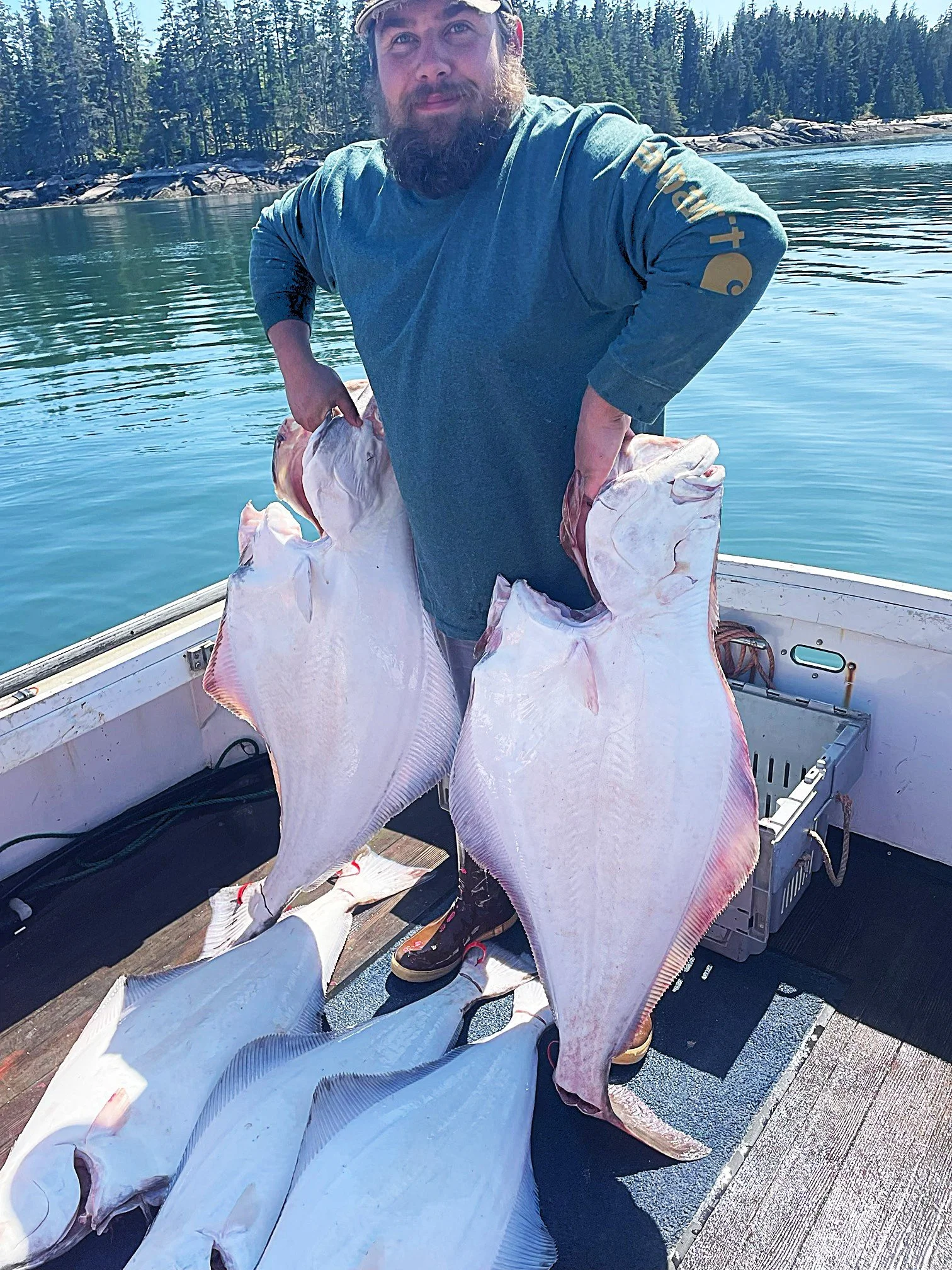
Brooksville fisherman Marshal Lebel with his catch of five halibut at the end of a good fishing day in 2025. Photo courtesy of David Tarr.
Many local lobstermen based in Stonington, Deer Isle and on the Blue Hill Peninsula supplement their income by putting out trawl lines for halibut, running their lobster traps and then checking their halibut lines at the end of each day.
Halibut in the Gulf of Maine average 20 to 50 pounds, according to The Island Institute, a non-profit organization that monitors coastal fisheries in Maine, but much larger fish are caught as well. At $7.78 per pound, the average price in the state in 2025, a 65-pound halibut is worth more than $500. The largest halibut caught in Maine last year was a whopping 177 pounds and it was caught on Cashes Ledge about 100 miles off Mount Desert Island by a 13-year-old fisherman on a charter boat.
The minimum legal size for halibut in Maine is 41 inches head to tail, which equates to an average weight of about 32 pounds.
The retail availability of locally-caught halibut in our area can be affected by severe weather, poor fishing conditions and other factors. Nevertheless, a number of local retail merchants will be offering locally-caught halibut and all of those contacted by The Rising Tide said they were confident that they will be able to source halibut on most shopping days. Before heading to your preferred fish market on any given day, it’s advisable to call ahead to check on availability.
These markets say they will be offering locally caught halibut:
Johnson’s Shellfish in Blue Hill – Owner Debbie Johnson said she sources fish from two local fishermen and also buys halibut from Canada as a back-up supply. Johnson’s opens for the season on May 19. Johnson said her daily blackboard listing of fish always notes where the fish were caught.
Hannaford Supermarkets in Blue Hill and Bucksport – “We expect to offer Maine-caught halibut in our stores this summer,” said Caitlin Cortelyou, external communications manager with Hannaford’s corporate office. “All halibut sold in our stores is sourced from the Gulf of Maine.”
Coldwater Seafood in Stonington – Employee Nena Harmon said Coldwater Seafood relies on five to six Stonington fishermen to supply the store with halibut, just as they did last year. “This year might be a little bit trickier,” she said. “Last year, numbers were down a bit in both average size and quantity, but we are optimistic we’ll have good supply.”
Overall, Maine’s 2025 halibut catch was a good one, coming in at 44,504 pounds and $346,300 in value, up 13 percent in volume compared to 2024, according to preliminary statistics from the Maine Department of Marine Resources. The last time the state catch exceeded 100,000 pounds was in 2016, but if you go back to the 1950s, total catch levels exceeded 100,000 pounds virtually every year. Fishing regulations are far more restrictive today.
With a short four-week season and a total season limit of 25 fish, no commercial fishermen can afford to focus exclusively on halibut to make a living, according to local fisherman David Tarr of Brooklin. Tarr plans to fish recreationally for halibut a few times this year, but not commercially.
“With the high cost of fuel and bait, fishing for halibut is a supplement, an addition for some lobstermen,” he said. “They can drop their trawl line out in the morning then run their lobster traps and come back to check the trawl line later in the day and maybe rebait and leave it out overnight.”
A trawl line usually contains 50 to 200 hooks, weighted on each end to hold it in place and using floats to mark each end. It’s usually baited with alewives, mackerel or squid.
Maine requires licensed commercial fishermen to report every week on their halibut catch, days fished and other information.