

Local groups look to new technique to kill invasive plant
Growing 10 feet tall, Japanese knotweed is ‘spreading way faster than anything else that is a threat to it,’ says UMaine horticulturalist
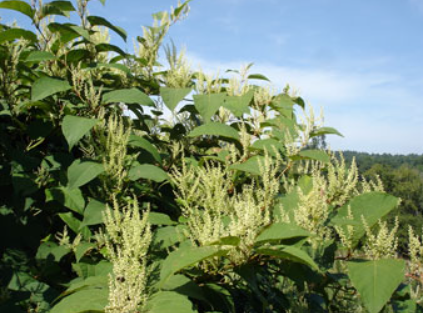
Knotweed, a persistant invasive plant. Photo courtesy of the University of Maine Cooperative Extension Service.
March 24, 2026
By Steele Hays
BLUE HILL—Japanese knotweed, one of the most aggressive, hard-to-kill and ecologically disruptive invasive plants in Maine, can be found in multiple locations across the Blue Hill Peninsula and Deer Isle. But researchers have recently developed a new method for combatting it and a local conversation group and a local native plant expert are planning to try the new technique this growing season.
The plant (Fallopia japonica) grows up to 10 feet tall and can transform streamside forests into homogeneous thickets, shading out native plants, reducing plant and wildlife diversity, and hindering the growth of other species.
“It’s spreading way faster than anything else that is a threat to it,” said Jonathan Foster, a horticulturist with the University of Maine Cooperative Extension Service, who runs the “Ask the Expert” advice program. “It is probably the top of the list in terms of questions we get about invasive plants.”
The new treatment method–called “mesh tech”–was developed in England and was publicized last month in the Maine Department of Agriculture, Conservation and Forestry (DACF) newsletter. It calls for cutting the knotweed plants off at ground level and laying down sections of half-inch wire mesh, often called “hardware cloth.” As the plant’s stems grow up through the holes and expand, they effectively choke themselves, weakening the plant. Homeowners and gardeners still have to actively manage the process and continue to cut back the plant, but using wire mesh reduces the number of cuttings needed and can save significant labor and time.
“If you do want to fight it without using herbicides, this is a good solution,” said Cathy Rees, executive director of the Native Gardens of Blue Hill. “I am really looking for some opportunities to try this method this year. We need test cases.”
“You do have to monitor it,” Rees said. “Before this, my advice was just to do repeated and frequent cutting, meaning almost weekly, not just a few times a year.”
“It’s exciting,” Foster said of the new technique. “It’s low impact to the environment and it has the potential to really help towns with big [knotweed] challenges.”
For severe cases, another option is hiring professional herbicide applicators to apply glyphosate, available under the brand name Round Up, but that carries environmental risks and may not be allowed by state or local regulations along waterways and in other areas. The DACF website has extensive information on the regulations and a list of licensed applicators as well as other helpful information about fighting invasive plants.
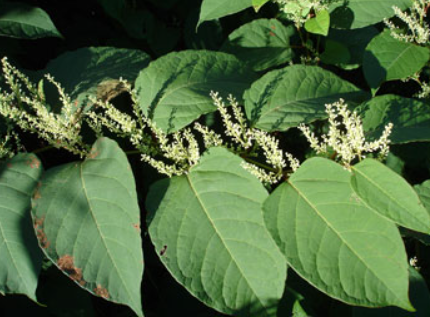
Close-up of knotweed leaves. Photo courtesy of the University of Maine Cooperative Extension Service.
Alex Drenga, conservation director with Island Heritage Trust (IHT), said he plans to test the new method at IHT’s Pine Hill Preserve on Little Deer Isle.
“I’m intrigued by it,” Drenga said in an interview. “The challenge is that if you have an area that’s hilly or rocky, it can be hard to get the wire to match the contour.”
Drenga said he sees infestations of knotweed all over the Blue Hill Peninsula and Deer Isle. There’s an extensive area, for example, around the mouth of Mill Stream where it enters Blue Hill Harbor.
“Once it gets going, it’s really hard to contain,” Drenga said. "But there’s still hope to keep it from taking over here. It’s helpful to build public awareness about this.”
Two attributes that make Japanese knotweed so threatening are its persistence and its ability to spread easily, allowing even small stem or root fragments to establish new colonies. Flooding and human activities like roadside mowing facilitate its spread. Cold winter temperatures don’t seem to faze it.
Scarborough Land Trust (SLT) is one of the first Maine organizations to try the mesh tech method.
“We started using this method in 2025 and the knotweed plants were very, very stressed,” Sami Wolf, SLT stewardship director, told The Rising Tide in an interview. “They were being girdled to the extent that you could just push them over and they’d break. This will be Year Two for us to do this and we hope to see even smaller, weaker plants this year.”
Even with the new technique, eliminating knotweed demands a long-term, labor-intensive effort.
“Instead of a timeline of 10 years to eliminate it, I anticipate being able to bring it down to five years,” Wolf said.
Native Gardens of Blue Hill plans to offer an all-day workshop this spring on fighting invasive species, Rees said. No date has been set yet, but information will be posted as soon as available on the NGBH website.
