

Plan ahead: Penobscot road closure date set for April
The timing of road work that will cut Penobscot in half is now set. Officials outline emergency services plans and school bus routes.
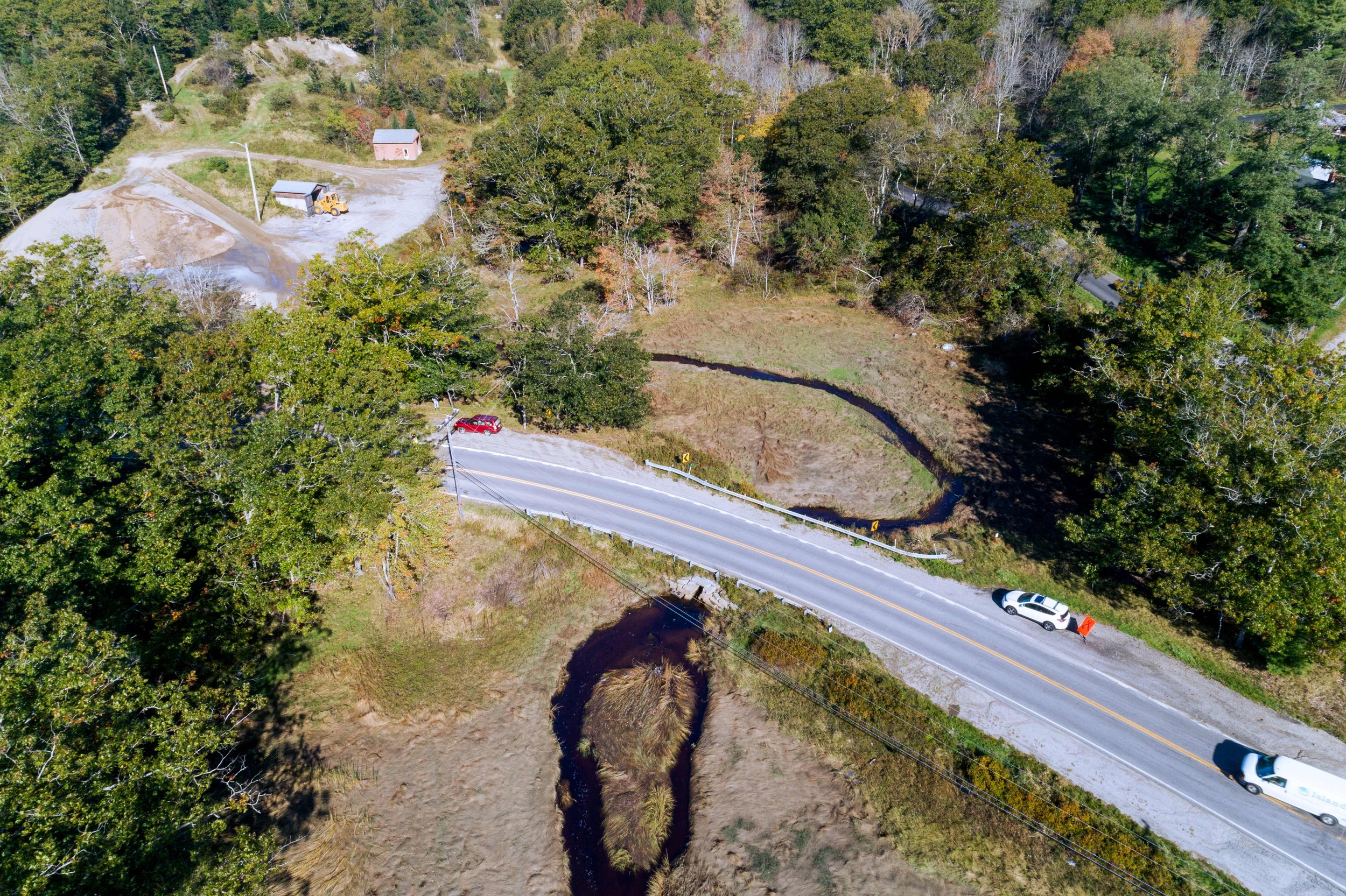
An aerial view of Mill Creek, where work will bifurcate Penobscot for up to 30 days. Photo by Tate Yoder.
March 24, 2026
By John Boit
PENOBSCOT–Road work that will close Bayview Road (Route 175) for up to a month is now set to begin April 20.
The closure will effectively cut the town in half while work is underway to replace a culvert and rebuild a road at Mill Creek, the outlet to Pierce’s Pond. The work will ultimately raise the height of the road, which is prone to flooding during storms and king tides.
Town officials and project partners say the upgrade, which is fully funded by grants, “will deliver long-term benefits for transportation safety, climate resilience, and the ecological health of Mill Creek and the Bagaduce River,” according to a joint press release from the town, Maine Coast Heritage Trust, and project engineers.
The project will replace a failing granite culvert with a modern, larger-capacity concrete structure and raise the roadway to reduce future flooding. The work is funded entirely through state and federal grants, with no direct cost to Penobscot taxpayers.
Detour plan
“Those storms made it clear that we needed to act–and act soon–to protect both the road and the people who rely on it.”
Bayview Road will be closed for up to four weeks from April 20 to May 20 “to allow safe construction and high-quality installation in a sensitive tidal habitat,” according to the release. Traffic will be detoured via Route 199 to Route 15 and back to Route 175 toward Castine.
“Many residents remember the two major storms in January 2024, when saltwater overtopped this road and forced an emergency closure,” said Harold Hatch, chair of the Penobscot select board. “Those storms made it clear that we needed to act–and act soon–to protect both the road and the people who rely on it.”
Select board members emphasized that the closure affects not only commuters but also emergency response, school transportation, and municipal services.
“This will be a significant inconvenience for some residents, and we don’t take that lightly,” Hatch said. “But this short-term disruption will give us a safer, longer-lasting roadway and a healthier stream and marsh system. It’s an investment in the town’s future.”
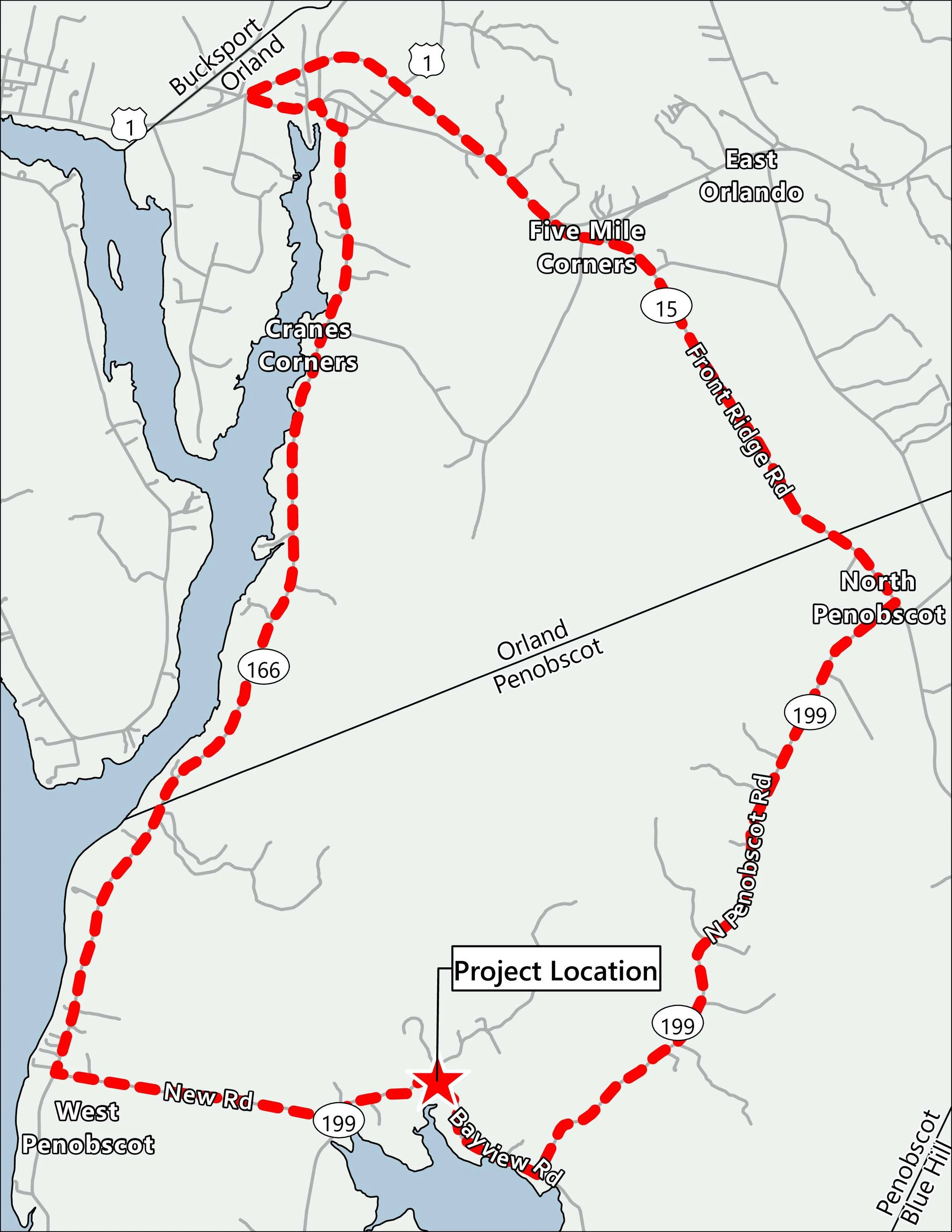
The detour during the Mill Creek project, now set to begin on April 20. Map courtesy of VHB.
School bus plan
While the first week of the project coincides with the April public school break, students will be back in class a week later while work is still ongoing, and while the road is still closed. That poses logistical challenges for school transportation.
Penobscot school officials, in concert with school representatives from Castine, have announced a plan to transport children to the Penobscot Community School, Bucksport High School, and George Stevens Academy during the road closure, according to local school officials.
That plan entails:
In the morning, bus driver Joyce Cyr will drive any students from Castine who attend Bucksport High School directly to BHS after dropping students off at the Adams School.
In Penobscot, bus driver Ed Wardwell will start his route at 6:45 am on the west side of Mill Creek along Bayview Road, then continuing onward to the Dunbar Road and to the Castine Road. He will arrive at the RH Foster on the corner of the New Road and the Castine Road at 7:10 a.m., where any students attending GSA may board the bus. From there, the bus will head toward Orland, taking the Gilpin Road to meet up with Rte. 15, then back to the Penobscot Community School via the North Penobscot Road.
Wardwell’s bus will arrive at the Penobscot Community School at 7:30 a.m., where GSA students will board another bus to head to Blue Hill. Bucksport High School will also have a van at the Penobscot School to take students to Bucksport.
In the afternoon, Ed Wardwell’s bus will pick up students at Bucksport High School and return to Penobscot. He will then run his morning route in reverse, returning back through Orland, down the Castine Road, and finally to Dunbar and Bayview roads.
Another route operated by bus driver James Clarke, who also serves as the town’s fire chief, will remain the same, except that he will be available to pick up any students that need transportation on the eastern side of Mill Creek, including Pierce’s Pond Road.
Emergency services plan
“Out of an abundance of caution, we won’t be issuing any burn permits in Penobscot while the road is closed at Mill Creek.”
Bucksport Fire and EMS will cover ambulance calls to the western side of Mill Creek and Castine, according to Clarke, the town’s fire chief. Castine EMS will also assist in medical calls on the side western side of the creek, he said.
The Penobscot Fire Department will stage one tanker at a location to the west of Mill Creek to respond to any emergencies, Clarke said. Fire departments in Castine and Orland will assist in any fire emergencies on the western side of Mill Creek as well. In addition, Blue Hill’s fire department will be on standby with a tanker for any fire-related calls.
“Ive been in close coordination with these area departments, and we want to thank them and their volunteers for their assistance and willingness to help during this construction,” Clarke said. “Out of an abundance of caution, we won’t be issuing any burn permits in Penobscot while the road is closed at Mill Creek.”
Spring work window
At public meetings leading up to the work, project manager Robert Blunt of the engineering firm VHB said that the construction window is dictated by environmental considerations.
“Tidal, in-water work in Maine typically has to occur between November 15 and April 15 to minimize impacts on fish and shellfish habitat, but this project received a one-month extension to that work window” Blunt said. “This schedule is the best way to meet federal and state permitting requirements while ensuring the project is built safely and correctly.”
The timing will align better with seasonal warming and paving material being available, so that the roadway will likely be paved during this closure period as well, the press release said.
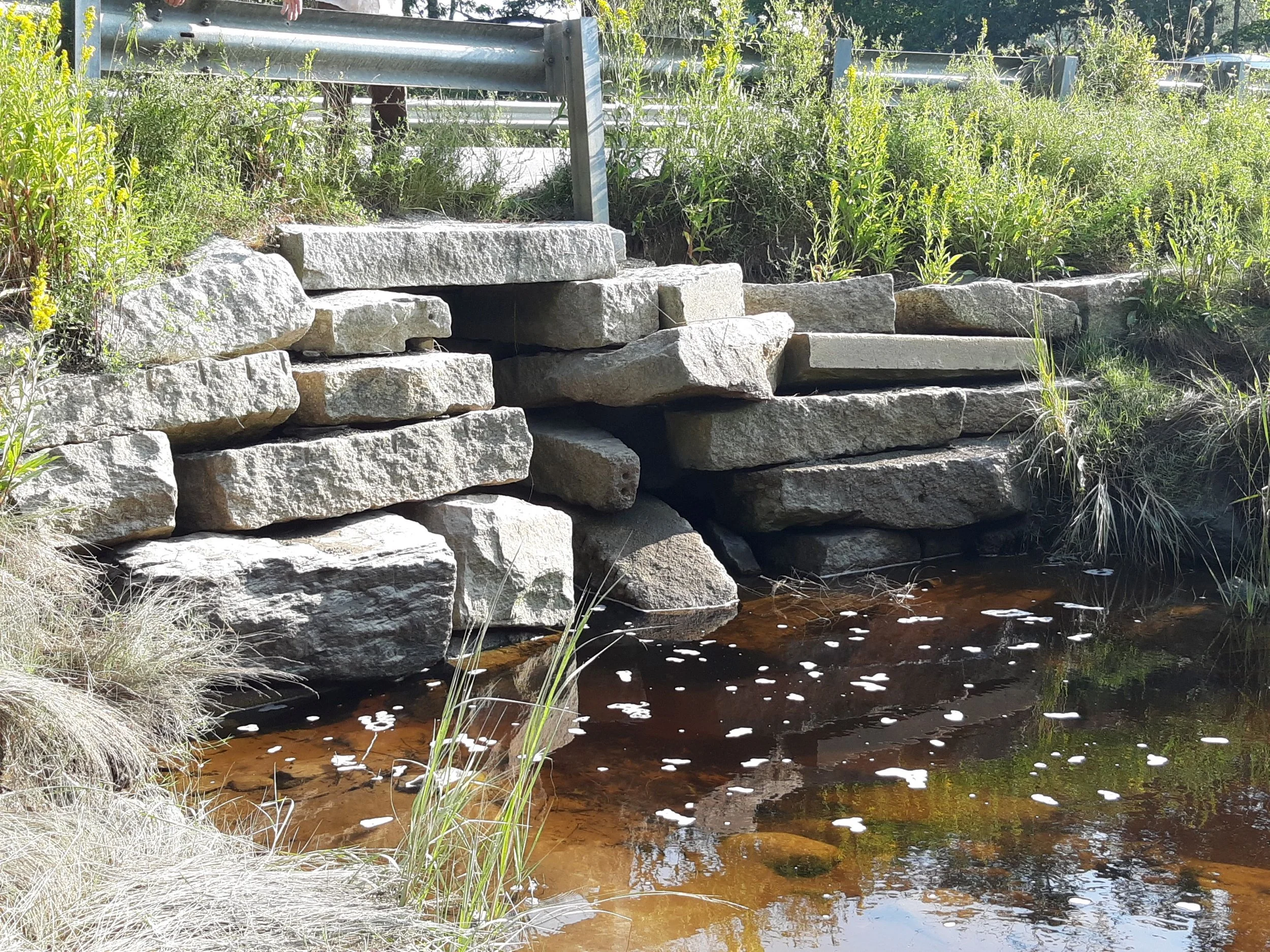
The current culvert at Mill Creek, made of granite blocks, will be replaced with a square culvert made of concrete. Photo by Ciona Ulbrich.
Fully funded project
With engineering and construction costs exceeding $1 million, the project would have been out of reach for the town without external funding, local officials said. Instead, a combination of state and federal grants will cover the entire cost.
“Funding a project of this size would be a huge lift for a small town like Penobscot,” Hatch said. “We’re extremely fortunate to have the partnerships that made this possible. This project improves safety, strengthens resilience, restores habitat, and does it all without increasing the local tax burden.”
The project qualified as a Municipal Partnership Initiative through the Maine Department of Transportation (MDOT), which will fund a significant portion of the work.
“This partnership helps towns advance priority road projects that might otherwise sit on a waiting list for years,” said Lisa Sekulich, MDOT region engineer. “It’s a smart investment in infrastructure and community resilience.”
In addition, Maine Coast Heritage Trust (MCHT) secured a grant from the National Coastal Resilience Fund, administered by the National Fish and Wildlife Foundation.
“This is a great example of a proactive community taking on an infrastructure project with major ecological benefits,” said Ciona Ulbrich, associate director of community relations at MCHT. “The Coastal Resilience Fund exists for exactly this kind of work—projects that protect people, habitat, and infrastructure at the same time.”
Educational partnership with MMA
The project will also serve as a learning laboratory, with monitoring conducted by faculty and students from Maine Maritime Academy’s Corning School of Ocean Studies.
“This project engages our students in real-world coastal resilience work,” said Dr. Kerry Whittaker, an associate professor of coastal and marine environmental science at MMA. “It’s a win-win: Students gain valuable field training, and the town receives quality monitoring that supports long-term ecological health."
“This is another exciting opportunity to help fish populations rebound in the Bagaduce River and the Gulf of Maine while increasing the flood security of a vulnerable roadway,.”
The new crossing will allow tides to move freely, accommodate higher flows during storms, and improve passage for fish and wildlife, the release said.
“This is another exciting opportunity to help fish populations rebound in the Bagaduce River and the Gulf of Maine while increasing the flood security of a vulnerable roadway,” Ulbrich said. “It shows how climate resilience, conservation, and public safety can align.”
Construction will be performed by Sargent Corporation of Orono, using engineering designs developed by VHB.
Town officials have emphasized the extensive coordination required to prepare for the closure.
“It has taken a lot of time, energy, and planning to get to this point,” Hatch said. “We’re grateful to residents, neighboring towns, emergency responders, school staff, and many others for working with us. This project only comes together because so many people are willing to do their part.”
