

Brooksville couple hosts Congressional candidate Matt Dunlap for campaign event
Dunlap’s career in public service started in 1996

“I got into politics because I realized you can actually help people,” Dunlap said at the event. Photo by John Epstein.
April 29, 2026
By John Epstein
BROOKSVILLE–Abbie and Mike McMillanhosted State Auditor Matt Dunlap for an event in their Harborside home on April 23. Dunlap is seeking the Democratic nomination for the open U.S. Congressional seat in Maine’s Second District. Nearly 50 attendees gathered to hear the candidate talk about his campaign.
Abbie McMillan said the event was a private fundraiser and was not indicative of a party endorsement. The local democratic organization does not make endorsements until after the primary, she said.
Libbey Gulliver, chair of the Blue Hill Democrats, and her husband, Jeep Gulliver, said they wanted to hear what Dunlap had to say about why he’d chosen to run.
“I support Matt,” said Carole Beal, also from Blue Hill. “He’s a Maine guy with a great sense of humor and a lot of experience in government,” she said.
Indeed, Dunlap, 61, has had a long career in Maine politics.
He described his childhood in Bar Harbor, where he attended public schools and was the captain of the Mount Desert Island High School track team, as working-class.
“I went to University of Maine and got a degree and an M.A. in history and English, and I thought I would be a high school teacher and a track coach, but it didn’t work out that way,” he said.
Instead, Dunlap spent nearly 20 years working a series of blue- and white-collar jobs before becoming a full-time public servant. “I was a line cook, a bartender, an editorial assistant, and a proof reader for the University of Maine’s print shop,” he said.
Along the way, he volunteered on Democratic state campaigns before deciding to run for state representative from Old Town. He won and served four terms, starting in 1996. The legislature elected him to be Maine’s Secretary of State from 2005 through 2011, and then again from 2013 through 2021. The legislature elected Dunlap to be state auditor in 2021. He served in that capacity for nine months before becoming a certified internal auditor. He has been the state’s auditor since November 2022.
“I got into politics because I realized you can actually help people,” Dunlap said, emphasizing that it’s often the little things that matter. He described the satisfaction he got as Secretary of State when his office was able to retrieve a constituent’s driver’s license that was lost during the renewal process. “The man lived near me, so I decided to drop it off at his house. The pure relief on his face when I put it in his hands was just amazing,” Dunlap said.
He’s also done some big things on behalf of Mainers as Secretary of State.
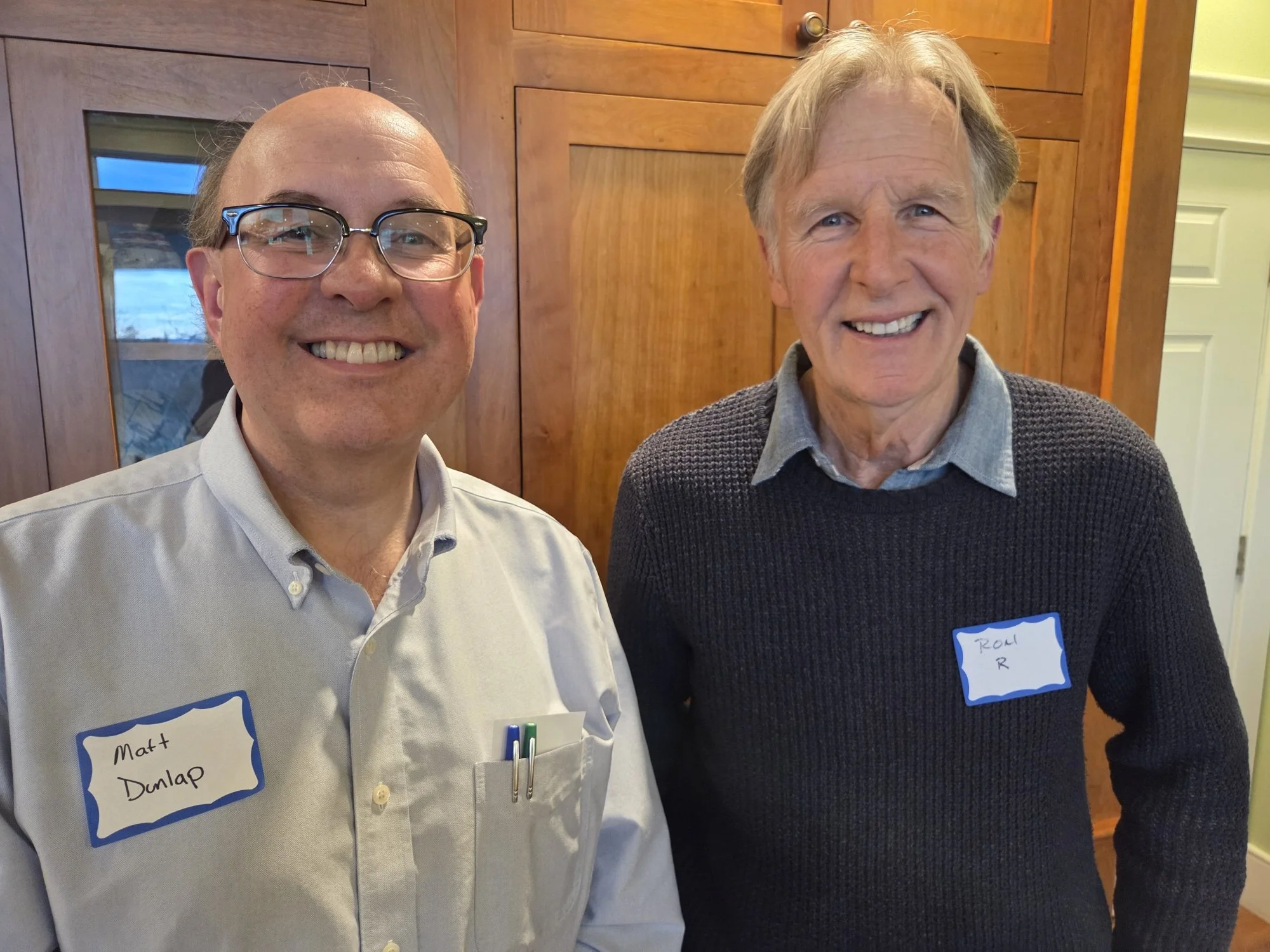
Matt Dunlap and former Maine State Representative Ron Russell, of Verona Island. Photo by John Epstein.
“He was the public face for ranked-choice voting in Maine,” said Brooksville’s Barbara Kourajian. “You were comfortable that he did the job well and efficiently,” she added.
In 2017, Dunlap brought a suit against the first Trump administration for attempting to exclude him from the newly formed Presidential Commission on Election Integrity. As a result of the legal action, a federal judge ordered that records of the commission’s proceeding be turned over to Dunlap’s office. Soon thereafter, Trump disbanded the commission.
As state auditor, Dunlap dug into the “pipes and wires” of state programs. In analyzing the biggest part of the Maine state budget, General Purpose Aid to Education, he discovered that the program was not subjected to an efficiency test. His office set one up.
Dunlap said he decided in October of 2025 to challenge Jared Golden in the 2026 Democratic primary for the Second District Congressional seat. He made the decision after getting a call from Mike Michaud, a Democrat, who served as Maine’s 2nd District Congressman from 2003 to 2015. “We talked about the dissatisfaction and frustration many people had been feeling with Jared Golden,” he said. Michaud and others urged Dunlap to challenge the two-term Congress member.
“I talked to my wife and she said ‘run, even though I won’t see much of you for a year,’” Dunlop said.
When Golden dropped out of the running in December 2025, Dunlap said that while “the race changed,” his “reasons for running have not.” He listed Medicare for All and affordability as key issues, along with the independence of the Federal Reserve.
Regarding the war in Iran, Dunlap said: “How many times do you have to say illegal? Trump is undermining the world’s economy and Congress has to put the brakes on it.”
Allie Ketch, finance director for Dunlap’s campaign, said the campaign has raised $700,000 to date and has $200,000 cash on hand. She added that the campaign will need $5 million heading into the November election.
Two other major candidates are vying for the Democratic nomination in Maine’s 2nd Congressional District: Joe Baldacci, a state senator representing District 9 and former Bangor City Council chair, and Jordan Wood, a former chief of staff to U.S. Rep. Katie Porter of California. Paige Loud, a 29-year-old social worker, is also in the race.
Former Maine Governor Paul LePage, 79, who lost the 2022 governor’s race to Janet Mills, has returned from Florida to run for office. He is running unopposed as the Republican nominee for the 2nd District Congressional seat. LePage’s campaign is expected to be well-funded by his party’s national committee.
So far, the only independent poll concerning the Democratic primary in Maine, The Pan Atlantic Omnibus Poll, showed Baldacci at 36%, Dunlop at 14% and Wood at 12% with 38% undecided. The poll was released in March.
Dunlap said his campaign commissioned a second poll, conducted by Tulchin Research, which showed him gaining traction.
News Center Maine hosted a debate on April 28. A second debate is expected in early May. The primary takes place on June 9.
Dunlap expressed confidence that he would win the Democratic primary and beat LePage, who he criticizes for cutting local revenue sharing to Maine towns and rejecting federal Medicaid funds.
